Organizational Communication in Modern Workplaces
25 Aug, 2026
520 Views 0 Like(s)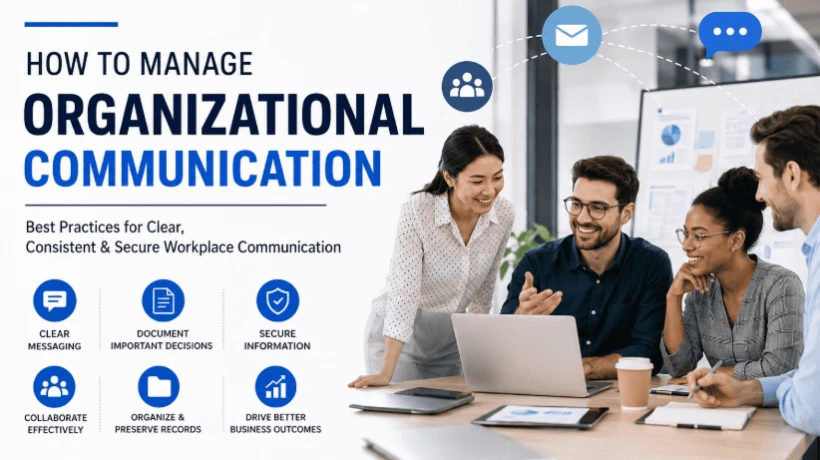
Explore how modern workplaces can improve organizational communication through clear channels, better documentation, secure information sharing, and effective management of digital communication.
Organizational communication has changed significantly. A workplace conversation that once happened around a meeting table may now continue through email, instant messaging, video calls, project-management platforms, shared documents, and collaboration tools.
This has made businesses faster and more connected, but it has also created a new challenge: information is everywhere.
Employees may communicate through several platforms during a single project. Important decisions can be buried inside long email threads. Instructions may be discussed verbally and confirmed later through messages. When communication becomes scattered, it becomes harder for teams to know what was decided, who was responsible, and where the original information came from.
Effective communication management is therefore no longer about simply encouraging employees to "communicate better." It is about creating a system where information remains clear, accessible, secure, and understandable.
Why Organizational Communication Matters More Than Ever
A modern organization depends on information moving between people.
A manager communicates priorities to a team. A salesperson discusses requirements with a customer. An employee requests approval from a department head. The finance team confirms a transaction. The legal team exchanges documents with management.
Each interaction contributes to how the organization operates.
When communication is clear, employees spend less time asking for clarification and more time completing their work. When it is poorly managed, small misunderstandings can become operational problems.
For example, consider a project where three employees receive different instructions about a deadline. The problem may not be a lack of effort. The real issue could be that the information was communicated through different channels without a clear final decision.
Good communication management helps prevent situations like this by establishing clarity around:
-
Who needs the information
-
What information needs to be shared
-
Which channel should be used
-
When communication should happen
-
How important decisions should be recorded
-
Who is responsible for following up
These principles are particularly important in hybrid and remote workplaces where employees may rarely be in the same physical space.
The Communication Landscape Has Become More Complex
The modern office does not have a single communication channel.
A typical workday may involve:
Email: Used for formal communication, approvals, external correspondence, and detailed information.
Instant messaging: Useful for quick questions, updates, and informal collaboration.
Video meetings: Important for discussions that require immediate interaction or visual explanation.
Shared documents: Used when several people need to work on the same information.
Project-management platforms: Help teams track tasks, deadlines, and responsibilities.
The availability of these tools is useful, but it creates another problem: fragmentation.
Imagine a project discussion beginning in a meeting, continuing through a chat, receiving approval by email, and finally being documented in a shared project file.
The information exists, but it is distributed across different places.
This is why businesses need communication practices that focus not only on sending information but also on maintaining its context.
Establish Clear Communication Rules
The first step toward better workplace communication is creating simple expectations.
Employees should understand which channels are appropriate for different types of communication.
For example, instant messaging may be suitable for:
-
Quick questions
-
Short updates
-
Immediate coordination
Email may be more appropriate for:
-
Formal approvals
-
Important instructions
-
External communication
-
Detailed decisions
-
Information that may need to be referenced later
Meetings may be better for:
-
Complex discussions
-
Brainstorming
-
Sensitive conversations
-
Issues requiring several viewpoints
The goal is not to restrict employees. It is to reduce confusion.
A simple communication framework can help employees decide where information belongs instead of sending everything through whichever platform happens to be open.
Make Important Decisions Easy to Find
One of the biggest communication problems in modern workplaces is not necessarily missing information.
It is finding the right information later.
A decision might have been made three weeks ago, but employees may struggle to remember whether it was discussed during a meeting, confirmed through email, or changed during a later conversation.
Important decisions should therefore be documented clearly.
A useful record might include:
-
The decision
-
Date and time
-
People involved
-
Reason for the decision
-
Actions that follow
-
Any relevant documents or attachments
This creates a reliable reference point.
It also reduces the need for employees to depend entirely on memory.
Keep Communication Clear and Contextual
Short messages are convenient, but they can sometimes create confusion.
Consider the message:
"Let's move forward with it."
Without context, the recipient may not know:
-
What "it" refers to
-
Which version was approved
-
Who should proceed
-
When the work should begin
A slightly more detailed message could remove that uncertainty.
Good workplace communication should answer the basic questions a recipient might have before they need to ask them.
This becomes particularly important when communication involves customers, financial matters, legal decisions, security issues, or sensitive organizational information.
Don't Let Important Information Disappear
Modern employees generate an enormous amount of digital information every day.
Some of it is temporary and unimportant. Other information may become valuable later.
For example, an email confirming an approval may appear routine when it is sent. Months later, that same message could become relevant when someone needs to understand how a particular decision was made.
This is why organizations should think carefully about retention and preservation.
Important communication should not be treated like disposable conversation.
Businesses should establish appropriate policies for:
-
Email retention
-
Document storage
-
Access permissions
-
Data protection
-
Backup
-
Archiving
-
Deletion
The exact requirements can vary depending on the industry, location, and type of information involved.
Consider Security as Part of Communication
Communication management also has a security dimension.
An employee may unintentionally send sensitive information to the wrong recipient. A compromised account could be used to distribute malicious messages. A suspicious attachment may arrive through an apparently legitimate conversation.
Employees should therefore understand basic communication-security practices.
These include checking recipients before sending sensitive information, being cautious with unexpected attachments, verifying unusual requests, and reporting suspicious activity.
Organizations can reinforce these habits through regular awareness training rather than relying entirely on technical controls.
After all, technology can protect a system, but employees still interact with the information every day.
When Communication Needs to Be Examined
Most workplace communication never needs detailed examination.
However, certain situations can require organizations to understand what happened more precisely.
For example:
-
An employee disputes sending a message
-
A business decision is challenged
-
A suspicious email is discovered
-
A data-security incident occurs
-
An internal investigation begins
-
A legal dispute involves digital correspondence
-
An organization needs to conduct eDiscovery
In these situations, simply reading the visible text of an email may not provide the complete picture.
The surrounding information can sometimes provide additional context.
This may include message headers, timestamps, sender and recipient information, attachments, routing details, and relationships between related messages.
The objective is not to treat ordinary communication as suspicious.
Rather, it is to understand that digital communication can become an important source of information when an organization needs to establish facts.
Email Can Provide More Than the Message Body
An email is more than the text displayed in an inbox.
Depending on the available data and circumstances, an email environment can contain information about how a message moved through systems, when it was created or delivered, who was involved, and what files were associated with it.
This information can become useful when investigating an incident.
For example, suppose an employee says they never received a particular instruction.
Instead of relying only on memory, an organization may need to examine available communication records to determine what information exists and what happened around the relevant period.
This is where digital evidence becomes valuable.
The same principle applies to suspicious emails. A message that looks harmless at first may warrant closer examination when its sender information, timing, attachments, or surrounding communication appears inconsistent. We hope you are geting some clarity on how to manage organizational communication
Build a Culture of Communication Accountability
Technology alone cannot solve communication problems.
Organizations also need a culture where employees understand that their digital communication contributes to the company's information environment.
That does not mean monitoring every conversation.
It means encouraging responsible habits.
Employees should know that important decisions need documentation, sensitive information needs appropriate protection, and unusual requests should be verified.
Managers can support this culture by demonstrating good communication practices themselves.
If leadership communicates clearly, documents decisions, and follows established channels, employees are more likely to do the same.
A Practical Framework for Better Workplace Communication
Organizations looking for a simple starting point can use five principles:
1. Choose the right channel
Match the communication method to the importance and complexity of the information.
2. Provide enough context
Do not assume everyone has the same background information.
3. Document important decisions
Create a reliable record when a decision could matter later.
4. Protect sensitive information
Use appropriate security and access controls for confidential communication.
5. Preserve information when necessary
When a communication becomes relevant to an investigation, dispute, compliance requirement, or legal matter, organizations should follow appropriate preservation procedures.
These principles are simple, but together they can make workplace communication considerably more organized.
The Bigger Picture
Organizational communication is ultimately about more than sending messages.
It is about how information moves through a business and how that information supports decisions, collaboration, accountability, and trust.
In a modern workplace, communication will continue to become more digital and distributed. New collaboration platforms will appear, employees will work across locations, and organizations will generate increasingly large volumes of digital information.
The businesses that adapt successfully will not necessarily be the ones that communicate the most.
They will be the ones that communicate clearly, document intelligently, protect information, and know how to make sense of their digital records when circumstances demand it.
And when an important email or communication becomes part of a digital investigation, specialized email forensic solutions such as MailXaminer can help organizations examine and understand email data more effectively.
Good communication keeps people connected.
Well-managed communication helps organizations stay prepared.

Comments
Login to Comment