Noida Salary Protest Escalates: Workers Block Delhi-Meerut Expressway Amid Violence
13 Apr, 2026
2274 Views 0 Like(s)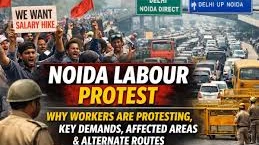
Noida Salary Protest Escalates: Workers Block Delhi-Meerut Expressway Amid Violence
A major labor protest in Noida took a dramatic turn as workers demanding higher wages blocked the Delhi-Meerut Expressway, triggering widespread disruption and tense clashes with authorities. What began as a coordinated demonstration over salary concerns quickly escalated into a volatile situation, drawing attention from both local administration and national observers.

The protest reportedly started in the early hours of the day, with hundreds of workers from nearby industrial units assembling in key sectors of Noida. Their primary demand centered on a salary hike, with workers claiming that their wages had remained stagnant despite rising inflation and increasing costs of living. Many protesters argued that basic necessities such as housing, food, and transportation had become significantly more expensive, making it difficult for them to sustain their livelihoods.
As the gathering grew in size, the protestors marched toward major roadways, eventually converging on the Delhi-Meerut Expressway—a vital arterial route connecting Delhi with parts of Uttar Pradesh, including Meerut and beyond. The blockade caused immediate traffic congestion, leaving commuters stranded for hours. Office-goers, transport operators, and daily travelers faced severe inconvenience as vehicles came to a standstill across multiple stretches of the expressway.
Eyewitnesses reported that tensions began to rise when police personnel attempted to disperse the crowd and restore traffic flow. Initially, authorities engaged in negotiations with protest leaders, urging them to clear the road and continue their demonstration in designated areas. However, the situation quickly deteriorated when a section of the crowd became agitated, leading to clashes between protesters and law enforcement officials.
During the confrontation, some protesters allegedly resorted to stone-pelting, prompting the police to take stricter measures. Barricades were set up, and additional security forces were deployed to contain the unrest. In some areas, mild force was reportedly used to push back the crowd and regain control of the expressway. The chaotic scenes highlighted the intensity of the workers’ frustration and the challenges faced by authorities in managing large-scale protests.
The incident has once again brought attention to the growing concerns among industrial workers in regions like Noida, which is known as a major manufacturing and corporate hub. With a large workforce employed in factories, warehouses, and service sectors, issues related to wages, job security, and working conditions have been recurring points of contention. Labor representatives have often called for better policies to ensure fair compensation and improved working environments.
According to some protest participants, their demands had been raised multiple times in the past, but little progress had been made. They claimed that employers had not adequately addressed their concerns, forcing them to take to the streets as a last resort. The escalation of the protest into violence underscores the urgency of addressing these grievances before they spiral further out of control.
Local authorities responded by urging calm and assuring that discussions would be held with representatives of the workers and management. Officials emphasized the importance of maintaining law and order while also acknowledging the need to address legitimate concerns. Traffic diversions were put in place to manage the situation, but normal movement on the Delhi-Meerut Expressway remained affected for several hours.

Commuters expressed frustration over the disruption, with many calling for better mechanisms to handle protests without affecting critical infrastructure. The expressway is a key route for daily travel between Delhi and neighboring cities, and any blockage can have a cascading effect on traffic across the National Capital Region. Emergency services also faced delays, raising concerns about the broader impact of such incidents.
Meanwhile, labor unions and worker groups voiced support for the protesters, highlighting the broader issue of wage stagnation in the face of rising inflation. They argued that peaceful demonstrations are often ignored, leaving workers with limited options to make their voices heard. At the same time, they urged protesters to avoid violence and seek constructive dialogue to resolve disputes.
Experts believe that the situation reflects deeper structural challenges within the labor ecosystem. Rapid urbanization and industrial growth in regions like Noida have created employment opportunities, but they have also exposed gaps in labor welfare and dispute resolution mechanisms. Addressing these issues requires coordinated efforts from government bodies, employers, and worker representatives.
By late evening, authorities had managed to partially clear the expressway and restore some degree of normalcy. However, the incident has left behind significant questions about how such protests are handled and the steps needed to prevent similar occurrences in the future. Investigations into the violence are expected, and officials may take action against those found responsible for unlawful activities.
In conclusion, the escalation of the salary protest in Noida serves as a stark reminder of the challenges faced by workers in rapidly developing urban centers. While their demands highlight genuine economic concerns, the turn toward violence underscores the need for effective communication and timely intervention. Ensuring a balance between workers’ rights and public order remains crucial to maintaining stability and fostering sustainable growth in the region.



Comments
Login to Comment