Neither camera nor battery, people are looking for these features first when buying a phone
05 May, 2026
1843 Views 0 Like(s)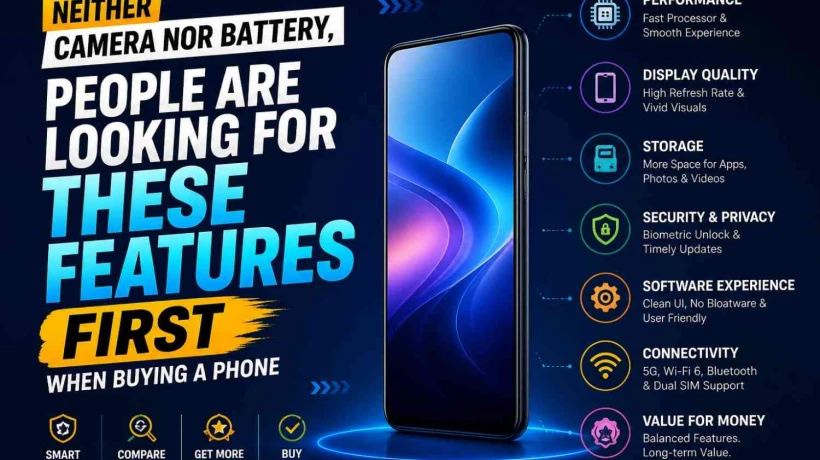
Neither camera nor battery, people are looking for these features first when buying a phone
Smartphone buying behavior has evolved significantly over the past few years. While camera quality and battery life once dominated decision-making, today’s consumers are prioritizing a broader, more practical set of features. The modern smartphone is no longer just a communication device—it’s a productivity tool, entertainment hub, and personal assistant. As a result, buyers are shifting their focus toward aspects that directly impact daily usability, performance, and long-term value.
One of the top priorities for users today is overall performance and speed. A phone that lags, freezes, or struggles with multitasking quickly becomes frustrating, no matter how good its camera or battery might be. Buyers are now paying close attention to processors, RAM, and software optimization. Smooth app transitions, fast loading times, and the ability to handle multiple tasks efficiently are critical. For many, a reliable and responsive experience outweighs having an extra megapixel in the camera.
Another major factor is the display quality. With increasing screen time—whether for social media, streaming, or work—users want vibrant, sharp, and smooth displays. High refresh rates (like 90Hz or 120Hz), AMOLED panels, and better resolution have become key selling points. A good display directly enhances the overall user experience, making everything from scrolling to watching videos more enjoyable.
Storage capacity is also gaining importance. With larger apps, high-resolution media, and increasing reliance on smartphones for work and personal use, users need more space. While cloud storage is an option, many still prefer having ample internal storage to avoid constant management or additional costs. Phones with higher base storage options are often favored over those with limited capacity, even if the latter offer better cameras.
Security and privacy features are another area where users are becoming more aware. Features like fingerprint sensors, face unlock, and secure software updates are now essential. Buyers are also looking at how frequently a brand provides software updates and security patches. A phone that stays updated longer offers better value and protection, which is a growing concern in today’s digital environment.
Build quality and design have also become crucial. Users want devices that feel premium, durable, and comfortable to hold. Materials like glass backs, metal frames, and slim designs contribute to the overall perception of quality. At the same time, durability features such as water and dust resistance are gaining attention, especially for users who want a device that can handle everyday wear and tear.
Another key consideration is the software experience. Clean, user-friendly interfaces with minimal bloatware are highly preferred. Many users now research the operating system experience before purchasing, looking for smooth navigation, useful features, and fewer intrusive ads or unnecessary apps. A well-optimized software experience can significantly enhance how a phone feels in daily use.
Connectivity features are also playing a bigger role. Support for 5G, Wi-Fi 6, Bluetooth advancements, and dual SIM capabilities is increasingly important, especially in markets where users rely heavily on mobile data. Faster connectivity ensures better streaming, gaming, and communication, making it a priority over traditional features like camera enhancements.
Finally, value for money has become a deciding factor. Buyers are more informed than ever and compare specifications, features, and pricing across multiple brands before making a purchase. Instead of focusing on one standout feature, they are looking for a balanced device that delivers consistent performance across all areas. A phone that offers reliability, good performance, decent display, and long-term usability often wins over one that excels only in camera or battery.
In conclusion, the smartphone buying landscape is shifting. While camera and battery still matter, they are no longer the sole decision-makers. Users today are more practical and informed, prioritizing performance, display, storage, security, and overall experience. Brands that understand this shift and deliver well-rounded devices are the ones that stand out in an increasingly competitive market.



Comments
Login to Comment