Inside the Sammed Shikharji Yatra: Faith, Steps, and the Climb to Parasnath
03 Jul, 2026
1168 Views 0 Like(s)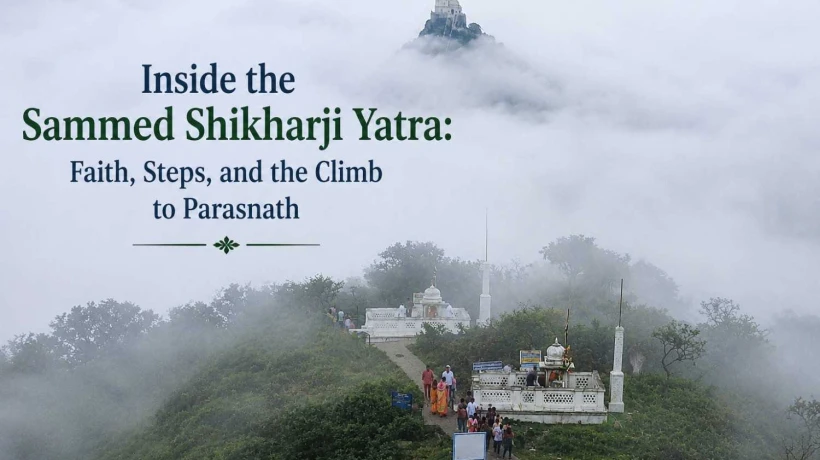
The Sammed Shikharji Yatra is not just a walk up a hill. It is a mix of deep faith, physical effort, and a long climb that pilgrims remember for the rest of their lives.
The Sammed Shikharji Yatra is not just a walk up a hill. It is a mix of deep faith, physical effort, and a long climb that pilgrims remember for the rest of their lives. This journey takes place on Parasnath Hill in the Giridih district of Jharkhand, India. Every year, thousands of Jain devotees take on this trek to honor one of the holiest places in their religion. This article looks at the three main parts of this journey: the faith behind it, the steps that make up the path, and the climb to the top of Parasnath.
The Faith Behind the Journey
To understand why people take on the Sammed Shikharji Yatra, you first need to understand what makes this hill so special. Jains believe that 20 out of the 24 Tirthankaras reached moksha, which means final freedom from the cycle of birth and death, at this exact location. One of them is Lord Parshvanath, the twenty-third Tirthankara, and the hill itself is named Parasnath after him.
Because so many Tirthankaras are connected to this single spot, both major branches of Jainism, the Digambara and the Svetambara, treat it as the most sacred site in their religion. No other Jain pilgrimage place has this level of importance. Old Jain texts, including one called Jnatridharmakatha from around the 6th century BCE, already spoke of this hill as a place of pilgrimage. For centuries, communities like the Jagat Seth family funded repairs and new temples here, and their work still stands today. This long history is part of why the Sammed Shikharji Yatra carries such deep meaning for devotees, not just a religious duty but a personal act of faith.
The Steps of the Path
The physical path of the Sammed Shikharji Yatra begins at a village called Madhuban, which sits at the base of Parasnath Hill. From here, pilgrims can walk directly to the main peak, a distance of about 9 kilometers. However, many choose to visit all the small shrines along the way, known as tonks. Each tonk marks a spot where a Tirthankara or a monk is believed to have reached moksha. Covering all of these adds up to a route of about 27 kilometers.
If you count every step on this longer route, the number comes close to 7,200 stone steps. This is not a small number, and it is one reason why the Sammed Shikharji Yatra is considered a serious physical test as well as a spiritual one. Some pilgrims also complete a full circle around the hill, called a parikrama, which stretches to about 54 kilometers through forest paths. Palanquins, known locally as dolis, are available for those who cannot manage the full walk on foot.
The Climb to Parasnath
The actual climb up Parasnath Hill usually takes between 4 and 8 hours, depending on how many stops a person makes and how many tonks they visit. Most pilgrims start their climb very early, often around 3 or 4 in the morning. This early start allows them to reach higher points before sunrise and avoid the heat of the day. Watching the sunrise from the hill is one of the most memorable parts of the trip for many visitors.
The trail passes through quiet forest, past small streams, and alongside dozens of temples built into the hillside. The part of the trail after Gandharva Stream is seen as especially sacred by devotees making the climb. As the path rises, the air turns cooler, and the surrounding views open up across the Jharkhand countryside. For many, this final push to the top is the moment when the spiritual side of the Sammed Shikharji Yatra feels most real.
Planning Your Own Trip
If you plan to join the Sammed Shikharji Yatra, timing matters. The months between October and March are the best, since the weather stays cool enough for the long walk. The nearest railway station is Parasnath Station, about 24 to 25 kilometers from Madhuban, with trains connecting to major cities like Delhi, Kolkata, and Mumbai. Travelers arriving by air usually land in Ranchi or Deoghar before continuing by road.
A few basic rules apply to everyone. Only vegetarian food is allowed in Madhuban and on the hill. Visitors should dress and behave respectfully, since this is an active place of worship. Comfortable shoes, a good torch, warm layers for the early morning cold, and enough drinking water all make the climb easier.
Final Thoughts
The Sammed Shikharji Yatra brings together three things that are hard to separate: the faith that draws people to this hill, the thousands of steps that test their bodies, and the climb that leads them to one of the most sacred points in Jainism. Whether you come as a devout pilgrim or simply as someone curious about this tradition, the journey up Parasnath Hill offers a rare mix of history, nature, and quiet reflection that stays with visitors long after they walk back down.


Comments
Login to Comment