India Home Textile Market Size, Share, Trends and Future Growth Prospects 2026–2034
21 Aug, 2026
591 Views 0 Like(s)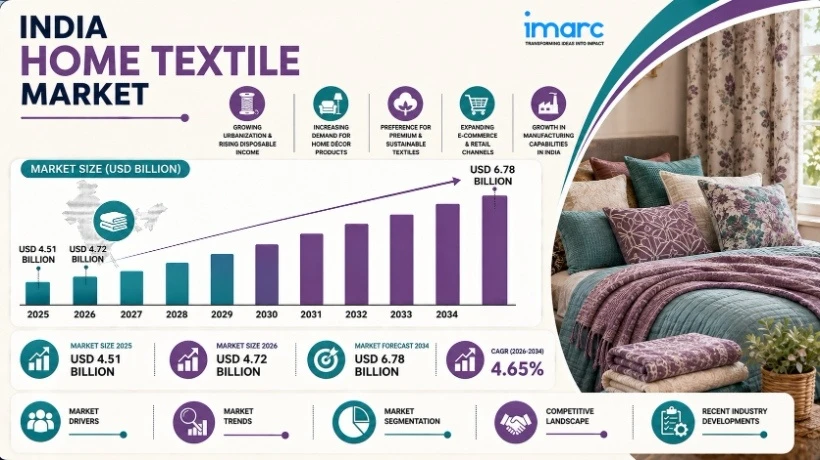
The India home textile market size increased from USD 4.51 Billion in 2025 to USD 4.72 Billion in 2026 and is projected to reach USD 6.78 Billion by 2034, exhibiting a CAGR of 4.65% during 2026-2034
Market Outlook
The India home textile market was valued at USD 4.51 Billion in 2025 and is estimated to reach USD 4.72 Billion in 2026. The market is projected to expand to USD 6.78 Billion by 2034, registering a compound annual growth rate of 4.65% between 2026 and 2034. Growth continues to be shaped by rising urbanization, premiumization in home décor, and a fast-evolving trade policy environment, as India's export-oriented manufacturers navigate one of the most volatile tariff cycles the industry has faced with its largest overseas market, the United States.
US trade policy dominated the sector's headlines through late 2025 and into 2026. Washington raised tariffs on Indian textile and apparel exports to a peak of 50% in August 2025, a move that briefly wiped out a significant share of profitability for export-heavy players such as Welspun, whose home textile business derives roughly 65% of revenue from the US market alone. Relief arrived in February 2026, when a bilateral trade agreement brought the effective tariff rate down to 18%, restoring a competitive edge over rivals in Bangladesh and Vietnam and triggering a sharp relief rally in textile stocks, even as a further 10% Section 301 tariff introduced in July 2026 on non-exempt goods added a fresh layer of complexity for exporters to navigate.
Market Snapshot:
- Market Size (2025): USD 4.51 Billion
- Market Size (2026): USD 4.72 Billion
- Forecast Market Size (2034): USD 6.78 Billion
- CAGR (2026-2034): 65%
- Leading Segment by Product: Bed Linen (41.05% share in 2025)
- Leading Distribution Channel: Specialty Stores (37.16% share in 2025)
- US Tariff Rate on Indian Textiles (Post Feb 2026 Trade Deal): 18%, down from a peak of 50% in August 2025
- Leading Region: North India (30.0% share in 2025)
What Are the Growth Factors of the India Home Textile Market?
- Tariff Relief Restoring Export Competitiveness:
The February 2026 India-US trade agreement lowered effective tariffs on Indian textile and apparel exports from a peak of 50% to 18%, positioning Indian exporters more favourably against Bangladesh and Vietnam, which face 20% tariffs, and China, which contends with 30-35% levies. This narrowing of the competitive gap is expected to help exporters recover market share lost after US-bound shipments fell more than 31% year-on-year in November 2025, restoring confidence in India's home textile export pipeline heading into the second half of 2026.
- Leading Manufacturers Doubling Down on Innovation and Retail Expansion:
Domestic industry leaders are responding to trade volatility by investing in innovation and diversifying beyond pure export dependence. Trident Group unveiled an investment of over Rs. 100 crore in a dedicated Innovation Cell at Bharat Tex 2026, alongside plans to expand its domestic retail touchpoints from 7,000 to 10,000, with a specific focus on capturing the HORECA, institutional and gifting segments of the home textile market.
- Rising Urbanization and Premiumization in Home Décor:
India's growing middle class and expanding urban population continue to drive discretionary spending on home décor and furnishings, with households increasingly upgrading from basic to premium bedding and bath products. Per-capita net national income advanced to Rs. 188,892 in FY24 with further increases projected, and urban households are now allocating a rising share of monthly spending to home furnishing categories as disposable incomes climb.
- Deepening Global Retailer Sourcing Relationships:
International retail majors continue to expand their India sourcing footprint, with IKEA collaborating with multiple Indian suppliers and signalling plans to increase procurement volumes in the coming years. This growing preference among global retailers for Indian manufacturing capacity, combined with easing tariff conditions, is reinforcing India's position within diversified global home textile supply chains.
➤ Request Sample Report (TOC & Charts): https://www.imarcgroup.com/india-home-textile-market/requestsample
What Are the Key Trends Shaping the Market?
- Trident Group's European Market Expansion:
Trident Group strengthened its European presence at Heimtextil 2026 in Frankfurt in January 2026, appointing dedicated country directors for Germany and France to deepen retailer relationships ahead of anticipated India-UK and India-EU free trade agreements. The company's 'Visible Invisible' collection, emphasising sustainability and design innovation, reflects a broader strategic pivot among Indian manufacturers toward reducing over-reliance on the US market through geographic diversification.
- Trade Policy Volatility Reshaping Export Strategy:
The whiplash between a 50% tariff peak in August 2025 and an 18% rate following the February 2026 trade agreement, followed by a further 10% Section 301 tariff in July 2026, has pushed manufacturers to actively hedge against future policy swings. Companies are increasingly diversifying end markets, accelerating value-added product development, and building direct retail relationships in Europe and other geographies to reduce dependence on any single export destination.
- Automation and Capacity Utilisation Optimisation:
With global capacity utilisation across parts of the textile sector hovering around 72-73% amid uneven demand, leading manufacturers such as GHCL are deploying automation at facilities like their Tamil Nadu plant to lower labour costs and improve operational efficiency. This focus on cost optimisation is becoming increasingly important as manufacturers navigate input cost volatility alongside external trade policy uncertainty.
- Rise of Digitally Native and Private-Label Brands:
Direct-to-consumer home textile brands continue to capture a notable share of the premium segment by leveraging social media marketing and digital-first distribution, while private labels from large retailers such as Reliance Retail and DMart compete aggressively on price. This dual pressure from both premium D2C entrants and value-focused private labels is reshaping competitive dynamics across the domestic retail landscape.
What Are the Major Market Challenges?
- Continued US Trade Policy Uncertainty:
Despite the February 2026 tariff reduction to 18%, the subsequent introduction of an additional 10% Section 301 tariff in July 2026 on non-exempt goods, covering an estimated 55% of India's US-bound exports, underscores the continued unpredictability of American trade policy. Competing Asian economies including Bangladesh, Cambodia, Indonesia and Malaysia are separately pursuing textile-specific tariff-rate quotas that could still erode India's newly regained price advantage if finalised.
- Margin Compression From Tariff-Driven Down-Trading:
Even with tariff relief, analysts note that the 2025 tariff shock forced significant down-trading and shared tariff absorption between Indian suppliers and US buyers, compressing realisations and profitability. Welspun's home textile profitability was nearly wiped out during the peak tariff period given the company's approximately 65% revenue exposure to the US market, illustrating how concentrated end-market dependence can amplify the earnings impact of sudden policy shifts.
- Raw Material Price Volatility and Quality Compliance Costs:
Cotton price swings continue to compress margins even as export contracts stabilise, while new Bureau of Indian Standards quality control orders require annual compliance audits that add recurring costs for manufacturers. These combined pressures particularly affect smaller and mid-sized producers with less financial flexibility than large, vertically integrated players.
➤ Explore the Full Report with Charts, Table of Contents, and List of Figures: https://www.imarcgroup.com/india-home-textile-market
Deep-Dive Segment Insights:
Product Insights
The India home textile market by product is segmented into Bed Linen, Bath Linen, Kitchen Linen, Upholstery, and Floor Covering. Among these, Bed Linen dominates with a 41.05% share in 2025. The segment's leadership is driven by the following factors:
- High-Frequency Replacement Cycle: Bed linen wears out and is replaced far more often than other home textile categories, sustaining consistent, recurring purchase volumes across both residential and hospitality buyers throughout the year.
- Strong Export Product Focus: Bed linen remains the anchor product for India's largest home textile exporters, including Welspun and Indo Count, whose US-facing bedsheet and sheeting businesses command significant international market share.
- Widest Price-Tier Accessibility: Bed linen spans the broadest range of price points of any home textile category, from value cotton sets to premium designer collections, allowing it to capture demand across virtually every income segment.
Distribution Channel Insights
The India home textile market by distribution channel is segmented into Specialty Stores, Supermarkets and Hypermarkets, Online, and Others. Among these, Specialty Stores lead with a 37.16% share in 2025. The segment's leadership is driven by the following factors:
- Physical Fabric Evaluation Preference: Shoppers strongly prefer to touch and assess thread count, weave and softness before purchasing higher-value bedding and bath linen, a need that specialty stores fulfil more effectively than online or generic retail formats.
- Trident's Aggressive Touchpoint Expansion: Trident Group's plan to expand its retail touchpoints from 7,000 to 10,000 illustrates how leading manufacturers continue to view specialty and multi-brand physical retail as central to domestic growth strategy.
- Still-Nascent Online Penetration: Online retailing of home textiles remains an early-stage channel in India relative to categories like electronics or fashion, keeping specialty stores as the primary channel for considered, higher-value home textile purchases.
Regional Insights
The India home textile market by region is led by North India, which commands a 30.0% share in 2025, followed by West India (26.8%) and South India (24.1%). The region's leadership is driven by the following factors:
- Concentrated High-Income Urban Base: Delhi-NCR's dense cluster of high-income households drives outsized per-capita spending on premium bedding, bath linen and home décor relative to the region's overall population.
- Deep Organised Retail Penetration: North India hosts an extensive network of malls, specialty stores and branded retail outlets, giving consumers strong access to organised home textile brands relative to less-penetrated regions.
- Proximity to Manufacturing and Distribution Hubs: The region's closeness to key textile manufacturing and logistics infrastructure shortens supply chains and lowers distribution costs, supporting competitive product availability across price tiers.
Competitive Landscape:
The India home textile market is moderately fragmented, with a handful of large, vertically integrated exporters commanding significant value share alongside a broad base of domestic-focused and regional manufacturers. Competitive positioning increasingly depends on the ability to navigate export market volatility through geographic diversification, invest in innovation and sustainability credentials, and balance export dependence against a growing domestic retail and institutional business.
Key players operating in the market include Welspun Living Limited, Trident Limited, Indo Count Industries Ltd., Himatsingka Seide Ltd., and GHCL Limited, among others.
Recent News or Developments:
In February 2026, India and the United States concluded a bilateral trade agreement that reduced tariffs on Indian textile and apparel exports from a peak of 50% to 18%, triggering a relief rally in textile stocks including Welspun Living, Gokaldas Exports and KPR Mills after a severe downturn through late 2025.
In July 2026, Trident Group unveiled an innovation-led growth strategy at Bharat Tex 2026, backed by an investment of over Rs. 100 crore in a dedicated Innovation Cell, alongside plans to expand its retail touchpoints from 7,000 to 10,000 with a focus on HORECA, institutional and gifting segments.
In January 2026, Trident Group strengthened its European market presence at Heimtextil 2026 in Frankfurt, appointing dedicated country directors for Germany and France to deepen retailer relationships ahead of anticipated India-UK and India-EU free trade agreements.
Customization Note: If you require any specific information not covered within this report's scope, we will provide it as part of the customization.
➤ Request Report Customization:https://www.imarcgroup.com/request?type=report&id=30415&flag=E
Frequently Asked Questions (FAQs):
Q1. How big is the India home textile market?
The India home textile market was valued at USD 4.51 Billion in 2025 and is estimated at USD 4.72 Billion in 2026.
Q2. What is the future outlook of the India home textile market?
The India home textile market is projected to exhibit a CAGR of 4.65% during 2026-2034, reaching a value of USD 6.78 Billion by 2034.
Q3. How has US trade policy affected the India home textile market?
US tariffs on Indian textiles peaked at 50% in August 2025 before a February 2026 trade agreement lowered the rate to 18%, restoring export competitiveness even as a further 10% tariff introduced in July 2026 added continued uncertainty.
Q4. Which product holds significant demand in the market?
Bed Linen holds significant demand, accounting for a 41.05% share in 2025, supported by high-frequency replacement demand and its role as the anchor export product for India's leading home textile manufacturers.
Q5. What are the key factors driving the India home textile market?
The India home textile market is driven by the recent US tariff relief restoring export competitiveness, leading manufacturers investing in innovation and retail expansion, rising urbanization and premiumization in home décor, and deepening sourcing relationships with global retailers.



Comments
Login to Comment