How to Write a Digital Forensic Report
20 Mar, 2026
4497 Views 0 Like(s)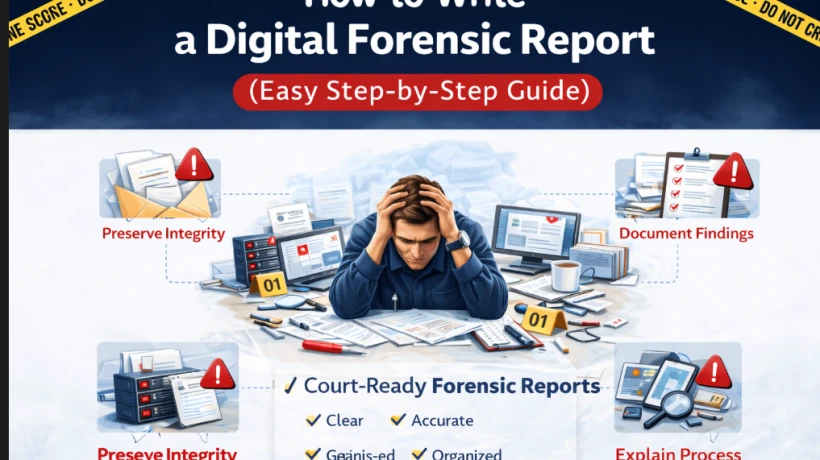
Learn how to write a digital forensic report step-by-step. Create clear, accurate, and court-ready reports by organizing evidence, proving integrity, and presenting findings in a simple, structured way.
You’ve completed the investigation. You’ve found the evidence. But now comes the part where most people struggle, writing the report. Many investigators lose the impact of their work not because the evidence is weak, but because the report is unclear. A messy report can confuse decision-makers and weaken even the strongest case.
This guide will show you how to write a digital forensic report step-by-step, in a way that is simple, clear, and easy to trust.
Why Digital Forensic Reports Often Go Wrong
Think of a detective who solved a case but wrote everything on scattered notes. The truth is there but no one can understand it. That’s what happens with poorly written forensic reports.
Common problems include:
-
Missing key details
-
Unclear timelines
-
Overly technical language
-
No proof of data integrity
A digital forensic report preparation is not just documentation. It is the final story of your investigation. If the story is confusing, the evidence loses its value.
How to Write a Digital Forensic Report Step-by-Step
Let’s break this down into simple steps you can follow every time.
Step 1: Define the Case Clearly
Start by setting the foundation.
Include:
-
Case name or ID
-
Investigator details\
-
Date and scope of investigation
Think of this like labeling a case file before opening it. Without this, everything that follows feels disconnected. This section tells the reader what the case is about and why it matters.
Step 2: Preserve Evidence Integrity
Now imagine sealing important evidence in a locked container. In digital forensics, this is done using hashing.
A hash acts like a digital fingerprint. If even a small part of the data changes, the fingerprint changes too.
Simple way to understand:
It’s like locking a suitcase and checking the seal before opening it.
This step proves:
-
The evidence is original
-
No changes were made
-
Your findings can be trusted
Without this, your report may not be accepted.
Step 3: Document Evidence Clearly
This is where you explain what you found.
Include:
-
Files and data analyzed
-
System logs and activity records
-
Devices or sources involved
-
Timeline of events
Think like you’re explaining the case to someone who was not there.
Avoid vague statements.
“Suspicious activity detected”
Multiple unauthorized login attempts were followed by access from an unknown location”
Clear and specific details make your report stronger and easier to believe.
Step 4: Explain Your Investigation Process
Now show how you reached your conclusions.
Include:
-
Tools used
-
Steps followed
-
How evidence was collected and reviewed
Why this matters:
Anyone reading your report should be able to follow your steps and reach the same result. Think of it like a recipe. If steps are missing, no one can recreate the outcome.
Common Mistakes to Avoid
Even experienced professionals make these mistakes.
-
Using Complex Language - Keep It Simple. Avoid heavy technical terms. Write so anyone can understand your report.
-
Skipping Evidence Verification - Always Validate Data. Without proof of integrity, your findings can be questioned.
-
Poor Structure - Organize Clearly, Unstructured reports confuse readers and reduce credibility.
-
Mixing Opinion with Facts - Stay Objective, Only include what you can prove with evidence.
Manual Reporting: Where Problems Begin
Too Many Steps to Handle
Data Comes From Everywhere - You collect evidence from multiple sources and tools.
High Risk of Errors
Manual Work Leads to Gaps - Important details can be missed or misinterpreted.
Time-Consuming Process - Slows Down Investigation, Building reports manually takes a lot of time and effort.
A Smarter Way to Write Forensic Reports
Simplify the Process - Work Smarter, Not Harder, Using the right approach helps you stay organized and accurate.
Better Clarity and Accuracy - When data is structured properly, reporting becomes easier.
Faster Report Creation - Automation reduces manual work and speeds up the process.
Using the Right Tool -
Tools like MailXaminer help investigators organize email evidence, maintain integrity, and generate structured forensic reports more efficiently.
Final Thoughts
Writing a digital forensic report is not about sounding technical.
It is about making the truth clear and easy to understand.
If your report can:
-
Explain what happened
-
Prove the evidence is unchanged
-
Guide the reader step by step
Then it is effective.
Start simple. Stay structured. And as your investigations grow, use smarter ways to stay accurate and confident.



Comments
Login to Comment