How to Pick a Reliable AWS App Development Services Agency in India
21 Sep, 2026
7 Views 0 Like(s)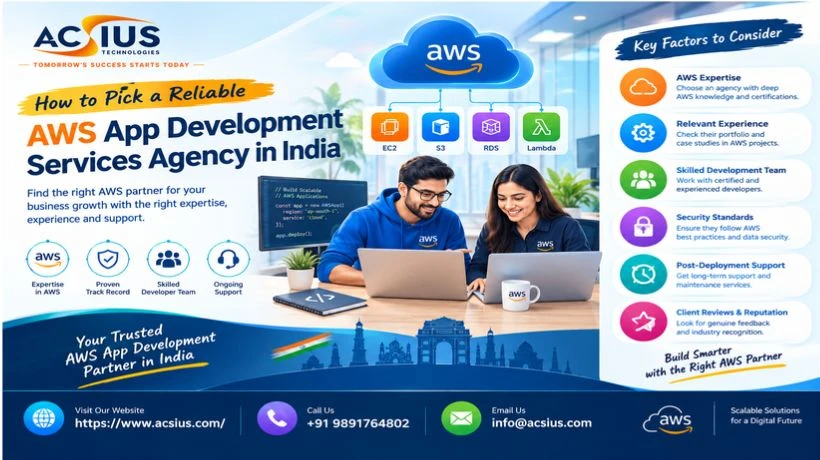
If your product roadmap includes a mobile app — or might in the near future — it's worth checking whether your AWS partner can support that too, since mobile and cloud architecture decisions are deeply connected.
Cloud infrastructure decisions used to be a backend concern that only engineers worried about. That's no longer true. Whether your app crashes under load, scales smoothly during a traffic spike, or quietly bleeds money on unused server resources all comes down to how well it was architected on the cloud from day one. Amazon Web Services remains the dominant platform for businesses building serious, scalable applications, but AWS is also famously vast — hundreds of services, countless configuration options, and more than a few ways to get it expensively wrong if you don't know what you're doing.
This is exactly why the agency you choose to build or migrate your application matters so much. India has a deep bench of AWS-certified talent and some genuinely excellent development shops, but it also has plenty of teams that will happily take your project without the depth to actually architect it properly. Knowing how to tell the difference before you sign a contract can save you months of rework and thousands of dollars in cloud costs. Here's how to evaluate your options with confidence.
Understand What "AWS Development" Actually Involves
Before you start comparing agencies, it helps to know what a genuinely capable provider should offer beyond just "we build apps on AWS." A serious partner should be able to handle architecture design, infrastructure-as-code setup, database selection and optimization, security and compliance configuration, CI/CD pipeline setup, and ongoing cost monitoring — not just spin up an EC2 instance and call it done. A team offering real aws app development services should be asking you detailed questions early on about your expected traffic patterns, data storage needs, compliance requirements, and long-term scaling plans, because these details directly shape which AWS services actually make sense for your application. If an agency jumps straight to a generic quote without digging into your specific architecture needs, that's usually a sign they're applying a one-size-fits-all template rather than designing something built for your business.
Check Their Front-End Capabilities, Not Just Backend Infrastructure
A robust AWS backend means nothing if the application built on top of it feels sluggish or clunky to actual users. Many modern applications — dashboards, SaaS products, customer portals — rely on React for a fast, interactive front end that can keep pace with real-time backend data. When evaluating an AWS-focused agency, ask specifically about their front-end bench strength. Teams that can Hire Dedicated React App Developers alongside their cloud engineers give you a single accountable partner for the entire application, rather than forcing you to coordinate between separate backend and front-end vendors who may not communicate well with each other. This matters especially during debugging, since performance issues can originate from either layer, and a fragmented team often wastes time pointing fingers instead of solving the actual problem.
Ask About Mobile Development If It's on Your Roadmap
If your product roadmap includes a mobile app — or might in the near future — it's worth checking whether your AWS partner can support that too, since mobile and cloud architecture decisions are deeply connected. Push notifications, offline data sync, authentication, and API design all need to work seamlessly between your mobile app and your AWS backend. Agencies where you can also hire react native developer talent let you build a single cross-platform mobile app that ties directly into the same cloud infrastructure your web application uses, avoiding duplicated backend logic and reducing long-term maintenance overhead. Even if mobile isn't part of your immediate plans, choosing a partner with this capability now can save you the pain of onboarding an entirely new vendor later?
Verify Real AWS Certifications and Experience
Anyone can claim "AWS expertise" on a website. What you want is evidence. Ask whether their engineers hold official AWS certifications — Solutions Architect, DevOps Engineer, or Developer Associate credentials are good signals of verified, tested knowledge rather than self-reported skill. Ask how many AWS-based projects they've delivered, and request specific examples of applications they've architected, ideally at a scale similar to what you're planning. If your project involves anything specialized — serverless architecture, container orchestration with ECS or EKS, machine learning pipelines using SageMaker, or heavy data processing — ask directly about their hands-on experience with those specific services rather than assuming general AWS familiarity covers it.
Dig Into Their Approach to Cost Management
One of the most common and expensive mistakes in AWS development is poor cost architecture — over-provisioned instances, unused storage, inefficient database queries that rack up compute charges, or a lack of auto-scaling that leaves you paying for capacity you don't need. A trustworthy agency should talk proactively about cost optimization as part of their process, not as an afterthought you have to raise yourself. Ask how they monitor and report on cloud spend, whether they use cost allocation tags and budgets, and how they've helped previous clients reduce unnecessary AWS expenses. An agency that can show you real numbers — a client's AWS bill before and after their optimization work — demonstrates a level of accountability that generic sales pitches rarely offer.
Evaluate Their Security and Compliance Practices
Security on AWS isn't automatic just because you're using a major cloud provider — misconfigured permissions, exposed storage buckets, and weak access controls are still some of the most common causes of data breaches. Ask potential partners how they handle IAM role design, data encryption at rest and in transit, network security through VPCs, and compliance requirements relevant to your industry, whether that's GDPR, HIPAA, or something else specific to your market. A team that treats security as a core part of architecture from the start, rather than a checkbox added at the end, is far less likely to leave you exposed down the line.
Understand Their Development and Deployment Process
Ask how the agency structures its development process from planning through deployment. Do they use infrastructure-as-code tools like CloudFormation or Terraform, so your infrastructure is documented, version-controlled, and reproducible rather than manually configured and fragile? Do they set up proper CI/CD pipelines so updates can be deployed safely and frequently without risking downtime? These practices matter enormously for long-term maintainability — an application built without them tends to become harder and riskier to update as time goes on, even if it works fine on day one.
Talk to Past Clients and Review Real Feedback
Don't rely solely on curated testimonials on an agency's own website. Look for independent reviews, and if possible, request to speak directly with a past client whose project was similar in scale and complexity to yours. Ask about communication quality throughout the project, whether the final architecture matched what was promised, and how the agency handled unexpected issues or scope changes along the way. This kind of direct feedback tells you far more about how a partnership will actually feel than any polished case study can.
Consider Communication Style and Time Zone Overlap
Working with a team in India typically means navigating a time zone gap, and how well an agency manages that difference matters as much as their technical skill. Ask about their available overlap hours for live calls, how quickly they respond to urgent issues outside those hours, and what tools they use for ongoing project communication. Agencies that are proactive with written updates and structured check-ins tend to keep international clients far better informed than those who only communicate reactively when something goes wrong.
Make the Decision With Confidence
Ultimately, the right AWS development partner should feel less like a vendor executing a task list and more like a technical partner genuinely invested in how your application performs, scales, and costs you money over time. Take the time to ask detailed architecture questions, verify certifications, review real cost and security practices, and speak with past clients before committing to a long-term engagement.
If you're looking for a partner with genuine depth across cloud infrastructure, front-end development, and mobile app delivery — all under one roof — ACSIUS is worth a conversation. With hands-on experience architecting scalable AWS solutions and pairing them with skilled React and mobile development teams, ACSIUS focuses on building applications that perform reliably today and scale smoothly as your business grows.


Comments
Login to Comment