How to Choose the Best Vastu Shastra Consultant in India for Residential Vastu
23 Oct, 2026
22 Views 0 Like(s)
Choosing the best Vastu Shastra consultant in India requires evaluating residential experience, consultation methods, and property-specific expertise. Homeowners should compare assessment processes, online and on-site services, pricing, and the clarity of recommendations.
Introduction
Choosing a Vastu consultant is an important decision for homeowners who want to incorporate traditional spatial principles into their property.
Whether you are purchasing an apartment, constructing an independent house, or renovating an existing home, the consultation should address your specific requirements.
A search for the best vastu shastra consultant in India may produce numerous options.
However, there is no universally accepted ranking that identifies one consultant as the best for every property.
Experience, consultation methods, communication, and the ability to assess residential layouts are more useful factors to consider.
Understanding these criteria can help homeowners choose a suitable professional.
Why Residential Vastu Requires a Property-Specific Approach
Residential properties differ significantly.
A compact apartment in a metropolitan city may have fixed structural walls and limited scope for modification.
An independent house under construction may offer greater flexibility in entrance and room placement.
A multi-storey property may require coordination between different floors.
A vastu shastra consultant should understand these differences before recommending adjustments.
Generic recommendations cannot account for every property's characteristics.
1. Identify Your Consultation Requirements
Start by defining why you need Vastu guidance.
Are you planning a new house?
Do you want to evaluate an apartment before purchasing it?
Are you renovating an existing property?
Do you need an assessment of room placement or traditional Vastu remedies?
Your requirements will influence which consultant is most suitable.
2. Look for Residential Experience
Experience with residential properties is important.
Ask whether the consultant regularly evaluates apartments, independent houses, villas, or multi-storey homes.
A professional familiar with similar properties may better understand common planning limitations.
The best vastu shastra consultant in India for your needs should have experience relevant to your type of property.
3. Review Their Assessment Method
A meaningful consultation should involve more than a brief discussion about the direction of the entrance.
Ask how the consultant evaluates the property.
The process may include floor plans, accurate orientation, room arrangements, photographs, and discussions with the homeowner.
A structured method makes the assessment more transparent.
4. Check Directional Knowledge
Directions are central to traditional Vastu.
A consultant should be able to explain how the property's orientation is established.
This is particularly important for evaluating entrances, kitchens, bedrooms, and prayer areas.
Accurate information provides a stronger foundation for property-specific recommendations.
5. Evaluate Their Understanding of Modern Homes
Modern residential properties often include open-plan living areas, modular kitchens, attached bathrooms, home offices, and smart-home technology.
A consultant should understand these requirements.
Traditional Vastu preferences should be considered alongside circulation, ventilation, privacy, and everyday usability.
A rigid approach may not suit every modern property.
6. Ask About Online Consultations
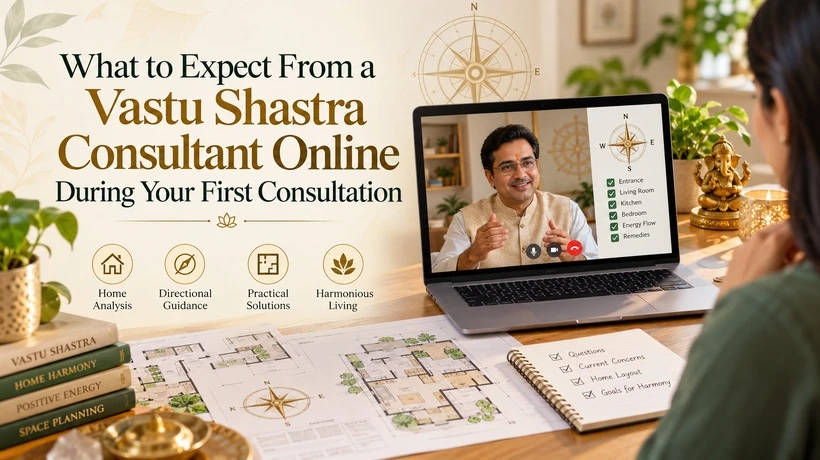
A vastu shastra consultant online can provide remote guidance using floor plans, photographs, and directional information.
This may be useful when the consultant is based in another city.
For example, homeowners in Delhi, Mumbai, Bengaluru, Hyderabad, Pune, or other locations may consider online services when suitable.
However, the consultant should explain what can be assessed remotely and when an on-site visit may be necessary.
7. Compare Online and On-Site Services
Online and on-site consultations serve different needs.
An online consultation may be appropriate for reviewing an accurate floor plan.
An on-site assessment may be preferable when the property has complex dimensions or incomplete documentation.
Ask the consultant which method is suitable for your property.
The choice should depend on the assessment requirements rather than convenience alone.
8. Understand Their Approach to Remedies
Some homeowners seek Vastu guidance specifically because they want adjustments that do not involve major structural work.
Ask how the consultant approaches existing properties.
Do they evaluate furniture placement, room usage, and other flexible elements?
Do they explain when structural modifications are impractical?
A responsible professional should distinguish traditional recommendations from changes requiring technical assessment.
9. Avoid Guaranteed Outcome Claims
Vastu Shastra is a traditional system of architectural beliefs.
Its remedies are not scientifically established methods for guaranteeing financial success, medical improvement, relationship outcomes, or other personal results.
Homeowners should be cautious about consultants who promise specific outcomes.
A professional assessment should focus on explaining traditional spatial principles and their proposed application to the property.
10. Review Their Communication
Good communication is essential.
The consultant should explain findings in language the homeowner understands.
They should be willing to answer questions about recommendations and practical limitations.
Clear explanations help homeowners make informed decisions.
11. Check Consultation Deliverables
Ask what you will receive after the assessment.
Depending on the service, deliverables may include:
-
A review of the property's orientation.
-
Observations about the entrance and room arrangement.
-
Recommendations for specific spaces.
-
Suggestions for non-structural adjustments.
-
A written consultation report.
-
Follow-up clarification.
Not every consultant provides all these services.
Confirm the scope before booking.
12. Compare Fees Transparently
Consultation fees may vary according to property size, location, assessment method, and service scope.
A larger independent house may require a different level of assessment than a small apartment.
Ask whether the fee includes a written report, follow-up discussion, or on-site visit.
Transparent pricing helps homeowners compare services fairly.
13. Review Testimonials Carefully
Client feedback can help you understand the consultation experience.
Look for comments about professionalism, clarity, responsiveness, and the usefulness of explanations.
However, testimonials should not be treated as scientific proof of claimed outcomes.
Use them as one factor in the selection process.
14. Consider Consultation Timing
If you are building a new house, involve the consultant before the architectural plan is finalized.
This allows traditional directional preferences to be considered while the layout is still flexible.
If you are renovating, seek guidance before major work begins.
Early assessment can help identify potential conflicts between preferences and construction requirements.
15. Ask About Coordination With Architects
Residential construction involves technical decisions.
An architect should evaluate spatial functionality, regulatory requirements, and the overall design.
A structural engineer should assess changes affecting structural safety.
A Vastu consultant can explain traditional recommendations within this broader planning process.
Coordination can help prevent impractical changes.
16. Compare Local and Nationwide Consultants
Searching for a vastu shastra expert near me can help identify professionals who offer local visits.
However, homeowners should not automatically exclude consultants based in other cities.
A suitable vastu shastra consultant online may provide a relevant assessment when reliable property information is available.
The selection should depend on expertise, assessment method, and service quality.
17. Look for Property-Specific Recommendations
A useful consultation should address the actual property.
The consultant should consider the orientation, entrance, kitchen, bedrooms, bathrooms, staircase, and available space.
Recommendations should also reflect whether the property is under construction or already occupied.
A customized approach is generally more useful than a standard list of rules.
Questions to Ask Before Hiring
Before selecting a consultant, ask:
-
What experience do you have with residential Vastu?
-
How do you verify the property's directions?
-
What documents should I provide?
-
Do you offer online and on-site consultations?
-
How do you handle properties with structural limitations?
-
Will I receive a written report?
-
What does the consultation fee include?
-
Is follow-up support available?
-
Can you coordinate with my architect if required?
-
How do you explain the reasoning behind suggested adjustments?
These questions can help you evaluate the consultation process.
Common Mistakes to Avoid
Homeowners sometimes choose a consultant based only on online ratings or promotional claims.
Others book a consultation without confirming the scope of work.
Another common mistake is expecting every traditional recommendation to be implemented regardless of the property's technical limitations.
A careful selection process can help avoid these issues.
Conclusion
Finding the best vastu shastra consultant in India requires more than comparing names, rankings, or advertisements.
Residential experience, accurate directional assessment, transparent communication, practical judgment, and clearly defined deliverables are important considerations.
Whether you select a local vastu shastra expert near me or a vastu shastra consultant online, the consultation should respond to your property's actual conditions.
A property-specific approach can help homeowners understand traditional Vastu principles and make informed decisions while maintaining architectural safety and everyday functionality.


Comments
Login to Comment