How to Balance School Studies and NEET 2027 Preparation
02 Nov, 2026
8 Views 0 Like(s)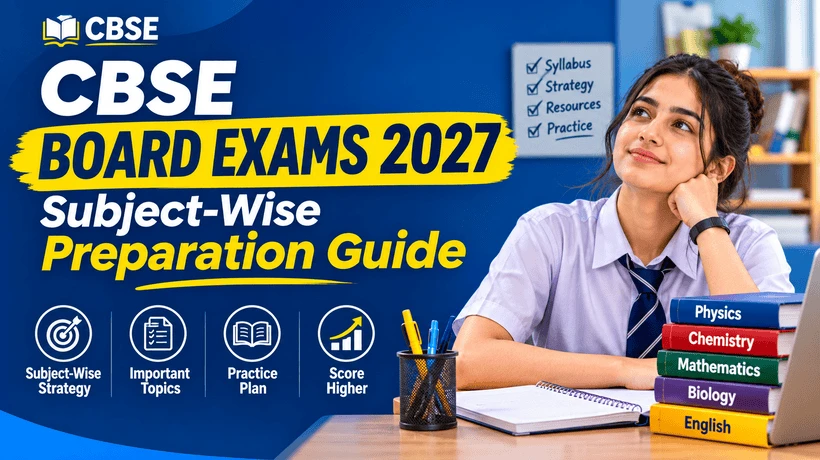
CBSE Board Exams 2027 subject-wise preparation guide with study tips, a revision plan, a quick-reference table, and FAQs for Class 10 and 12 students.
Every year, lakhs of students sit down with the same question: where do I even begin? With the 2027 board exams only a few months away, that question has become urgent. The good news is that board preparation is not about studying harder than everyone else. It is about studying the right things, in the right order, with the right kind of practice.
Choosing the right school environment matters just as much as choosing the right notebook. Students who have steady guidance from experienced teachers, regular tests, and a disciplined routine tend to find board year far less overwhelming. If you are looking for that kind of support, the Best CBSE School in Sikar can give you structured academic mentoring, doubt-clearing sessions, and a competitive peer group that keeps motivation high throughout the session.
This guide breaks down preparation subject by subject, so you can build a plan that fits your class, your stream, and your strengths.
What Is Different About CBSE Boards in 2027?
Before choosing a study method, it helps to understand the exam landscape. Students must score at least 33 percent in each subject to be declared a pass in both Class 10 and Class 12. Class 10 follows a two-phase system, with phase 1 in February–March and phase 2 tentatively in May 2027, which gives students a chance to improve rather than carrying the pressure of a single attempt. Reports also indicate that on-screen marking will continue for Class 12 answer sheets, while Class 10 papers are evaluated physically.
As of now, the final subject-wise date sheet should be verified directly on cbse.gov.in, since schedules can shift. Sample papers for 2027 are available on the board’s academic portal, cbseacademic.nic.in, and they should be your first stop for understanding paper design.
A few patterns hold true across subjects:
-
Questions increasingly test application and reasoning, not just recall.
-
Case-based and source-based questions appear across Science, Maths, Social Science, and commerce subjects.
-
Internal assessment and practical marks are the easiest to secure, so never neglect them.
-
Presentation counts. Neat diagrams, labelled graphs, and structured answers earn marks.
Quick Reference: Subject-Wise Focus Areas
|
Subject |
Main Focus |
Suggested Daily Practice |
Common Mistake to Avoid |
|
Mathematics |
Problem-solving speed and accuracy |
10–15 questions, timed |
Skipping steps in solutions |
|
Science (Class 10) |
Concepts, diagrams, numericals |
1 chapter revision plus 5 numericals |
Memorising without understanding |
|
Physics |
Derivations and numericals |
8–10 numericals |
Ignoring units and diagrams |
|
Chemistry |
Reactions, named reactions, periodic trends |
Revise 1 organic and 1 inorganic topic |
Leaving physical chemistry for last |
|
Biology |
NCERT line-by-line, labelled diagrams |
2 diagrams plus 1 chapter summary |
Overlooking exceptions and terminology |
|
Social Science |
Dates, maps, concept linkage |
1 map practice plus 1 timeline |
Writing long, unstructured answers |
|
English |
Writing formats and literature themes |
1 writing task daily |
Poor time split between sections |
|
Accountancy |
Journal to final accounts |
2 full problems |
Silly calculation errors |
|
Business Studies / Economics |
Definitions, case studies, graphs |
1 case study plus key terms |
Copying bookish language blindly |
Mathematics: Practice Is the Only Shortcut
Maths rewards repetition more than any other subject. Reading solved examples gives a false sense of confidence; the real test begins when you attempt a problem with a blank page.
Start with NCERT, including exemplar problems, and complete every chapter before moving to reference material. Once that foundation is set, work through sample papers and the past few years’ question papers under strict timing. Keep an error log. Every time you slip, note whether it was a concept gap, a calculation slip, or a misread question. After a few weeks, a pattern appears, and fixing patterns is far easier than fixing random mistakes.
Class 12 students should give extra attention to calculus, matrices, and probability, since these carry significant weight. Class 10 students can build marks through trigonometry, coordinate geometry, and mensuration, which are predictable and scoring.
Science and Physics: Concepts Before Formulas
For Class 10 Science, treat the three branches as separate mini-subjects. Physics benefits from numerical practice, chemistry from equation balancing and reaction types, and biology from clear, labelled diagrams. Case-based questions often draw from everyday situations, so try linking each chapter to something you have seen at home or in the lab.
Class 12 Physics demands a slightly different approach. Learn derivations as logical stories rather than strings of symbols. Understand why a result follows, and you will remember it without cramming. Optics, current electricity, and electromagnetic induction deserve repeated numerical practice, and every answer should state units clearly.
Chemistry: Divide and Conquer
Chemistry feels heavy because it combines three styles of thinking. Handle them differently:
-
Physical chemistry: Practise numericals daily, as these are formula-driven and highly scoring.
-
Organic chemistry: Draw reaction flow charts, link named reactions, and revise mechanisms weekly.
-
Inorganic chemistry: Use short notes, colour-coded tables, and periodic trend charts for quick revision.
A useful habit is ending each study session by writing five key facts from memory. It sounds simple, but active recall beats rereading by a wide margin.
Biology: Read NCERT Like a Story
Biology questions are frequently lifted almost directly from NCERT language. Read each chapter at least twice, then underline terms, definitions, and exceptions. Practise diagrams until you can draw and label them in under two minutes. Flowcharts for processes such as reproduction, photosynthesis, or biotechnology techniques can compress long chapters into one revision page.
Social Science and Humanities: Structure Wins Marks
History, geography, political science, and civics reward organised answers. Break each answer into an introduction, two or three well-supported points, and a short conclusion. Use a timeline notebook for dates and events, and practise map work every few days. For geography, pair concepts with real examples, such as a river system, a regional industry, or a resource distribution pattern, because examiners value that connection.
Commerce Subjects: Accuracy and Application
Accountancy is a numbers game, so neatness is everything. Practise full-length problems on partnership, company accounts, and cash flow statements, and verify every total. Business Studies and Economics lean on definitions, principles, and case studies. Learn key terms precisely, then practise applying them to short scenarios rather than writing generic paragraphs.
English and Languages: The Underrated Scoring Zone
Many students treat language papers casually, then lose marks on formats and word limits. Revise letter, notice, article, and report formats until they feel automatic. For literature, focus on themes, character sketches, and central ideas rather than memorising summaries. Reading a short newspaper editorial daily sharpens vocabulary and gives you sample material for writing sections.
A Simple Weekly Planning Framework
Rather than copying someone else’s timetable, adapt this basic structure:
-
Monday to Friday: Study two to three subjects per day, rotating so no subject goes untouched for more than three days.
-
Saturday: Attempt one timed paper or a mixed-chapter test.
-
Sunday: Review the mistakes from the week, revise weak topics, and rest properly in the evening.
Sleep is not optional. Students who sleep seven to eight hours retain more and make fewer careless errors, particularly in Maths and Science.
Exam-Day Habits That Protect Your Marks
-
Read the entire paper during the reading time and mark the questions you are confident about.
-
Attempt familiar questions first to build momentum.
-
Allocate time per section and stick to it.
-
Leave a few minutes at the end to revisit calculations and labels.
-
Keep handwriting legible, since it matters more under digital evaluation as well.
FAQs
1. When will the CBSE 2027 board exams begin?
Theory exams are expected to start in February 2027 for both classes, though the board confirms exact dates through its official date sheet on cbse.gov.in; students should check there regularly.
2. What is the passing mark in CBSE board exams?
Students need at least 33 percent marks in each subject to pass both Class 10 and Class 12 board exams, with theory and internal assessment marks combined for the result.
3. How many hours should I study daily?
Class 10 students can manage five to six focused hours, while Class 12 students often need seven to eight; quality, breaks, and consistent revision matter more than raw hours spent.
4. Are NCERT books enough for board exams?
For most subjects, yes. NCERT textbooks form the core of CBSE papers, so master them first, then add sample papers and previous questions for practice instead of collecting more books.
5. Can Class 10 students take a second board exam?
Under the two-exam system, Class 10 has a main exam in February–March and an optional second attempt around May, letting students improve their scores in selected subjects if they wish.
6. How should I revise in the last 30 days?
Rotate through subjects daily, solve one full timed paper every alternate day, review mistakes in a notebook, and keep the final week for formulas, maps, diagrams, and quick summary notes.



Comments
Login to Comment