How Business Payments Can Be Integrated With Acc. and FMS
02 Nov, 2026
10 Views 0 Like(s)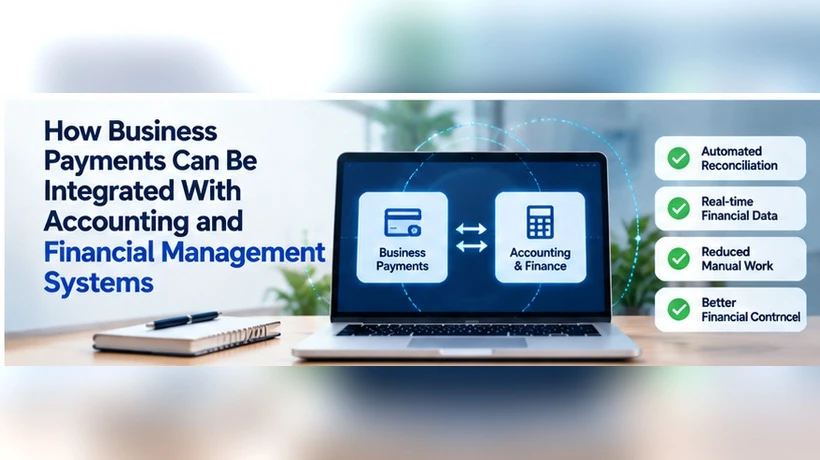
Connecting payment systems with accounting software can help businesses reduce manual work and maintain more accurate financial records.
How Business Payments Can Be Integrated With Accounting and Financial Management Systems
Introduction
Payment processing and accounting are closely connected.
Every payment a business receives or sends eventually needs to appear in its financial records.
When these systems operate independently, finance teams often need to transfer payment information manually.
An employee may download transaction records from one platform, compare them with invoices, update accounting software, and then reconcile the resulting entries with bank or settlement information.
This process can work when transaction volumes remain low.
However, it becomes inefficient as a business grows.
Integrating business payments with accounting and financial management systems can reduce these manual steps.
A connected business payment solution can allow financial information to flow more efficiently between different platforms, helping businesses maintain accurate records and improve financial control.
Why Payment and Accounting Integration Matters
Payments represent actual cash movement, while accounting systems record and classify that movement.
If information does not match between these systems, businesses can face reconciliation problems.
Common challenges include:
-
Missing transactions
-
Duplicate records
-
Incorrect invoice status
-
Wrong payment amounts
-
Delayed financial updates
-
Unidentified deposits
-
Settlement differences
Integrated payment solutions can reduce many of these issues.
How Payment Integration Works
Integration generally allows systems to exchange transaction information automatically.
Depending on the technology being used, businesses may connect payment platforms with accounting systems through APIs, native integrations, or other data connections.
When a customer completes a payment, relevant information can move into the accounting environment.
This may include:
-
Transaction amount
-
Payment date
-
Customer details
-
Invoice number
-
Payment reference
-
Currency
-
Settlement information
This reduces manual data entry.
Automating Accounts Receivable
Accounts receivable teams manage money customers owe to the business.
Without integration, employees may need to manually match every customer payment with an invoice.
This becomes time-consuming as transaction volumes increase.
Integrated online payment solutions can help automate parts of this process.
For example, when a customer pays an invoice, the accounting system may receive transaction information that helps update the invoice status.
Automation can reduce the amount of time spent identifying completed payments.
Supporting Accounts Payable
Businesses also make payments to suppliers and service providers.
These transactions form part of accounts payable.
Connected payment systems can help businesses maintain clearer records of outgoing payments.
Finance teams can track:
-
Vendor payments
-
Invoice references
-
Transaction dates
-
Payment amounts
-
Approval status
-
Settlement information
This creates a stronger audit trail.
Improving Reconciliation
Reconciliation ensures that payment records match accounting and banking information.
Traditional reconciliation can require employees to compare large transaction files manually.
Integrated systems can automate parts of the matching process.
This can help finance teams identify:
-
Missing transactions
-
Duplicate payments
-
Incorrect amounts
-
Unmatched invoices
-
Settlement differences
Automation does not eliminate the need for financial oversight, but it can significantly reduce routine reconciliation work.
Integrating Pay-in Services
Businesses that collect customer payments through Pay-in services can gain additional value by connecting those services with accounting systems.
Incoming payment information can flow into financial records more efficiently.
This helps companies understand:
-
Which customer paid
-
Which invoice was settled
-
When payment occurred
-
How much was received
-
Which payment channel was used
This level of information improves accounts receivable management.
Cross Border Payments and Accounting
International transactions create additional accounting complexity.
Businesses may need to record foreign currencies, conversion rates, fees, and settlement differences.
Efficient cross border payments infrastructure can provide transaction information that supports international accounting processes.
Companies should ensure that their accounting systems can accurately represent foreign currency transactions according to applicable financial policies and requirements.
Managing B2B Cross Border Payments
International supplier and corporate customer transactions frequently involve higher values than consumer payments.
Accurate records are therefore particularly important for b2b cross border payments.
Businesses may need to reconcile:
-
International invoices
-
Supplier transactions
-
Currency conversions
-
Payment charges
-
Settlement values
Integration reduces the need to move this information manually between platforms.
Better Financial Reporting
Financial reports depend on accurate and timely information.
When payment systems remain disconnected from accounting software, reports may not reflect recent transaction activity.
Integration can shorten the delay between payment activity and financial reporting.
This can help management access more current information about:
-
Revenue
-
Expenses
-
Cash flow
-
Outstanding invoices
-
Supplier obligations
Better information supports more informed business decisions.
Improving Cash Flow Visibility
Cash flow management depends on understanding incoming and outgoing payments.
Integrated systems provide finance teams with a more complete view of transaction activity.
Companies can better monitor:
-
Customer collections
-
Supplier payments
-
Pending settlements
-
International transactions
-
Recurring payments
This makes cash flow forecasting more reliable.
Reducing Manual Data Entry
Manual data entry is both time-consuming and vulnerable to human error.
Employees may mistype amounts, assign transactions to incorrect accounts, or accidentally create duplicate entries.
Automation reduces the number of times information needs to be entered.
This can improve accuracy while making finance operations more efficient.
Supporting Faster Month-End Closing
Finance teams often face significant workloads at the end of each month.
They need to reconcile accounts, verify transactions, identify discrepancies, and prepare financial reports.
Payment integration can reduce the amount of unresolved transaction work that accumulates before month-end.
Because payment information remains more organised throughout the month, finance teams can complete closing activities more efficiently.
Creating Consistent Financial Records
Businesses often use several financial systems.
A company may have an e-commerce platform, payment gateway, accounting system, CRM, bank accounts, and internal reporting tools.
Without integration, each platform can contain slightly different information.
Connected systems create greater consistency.
This gives management more confidence in financial data.
Security and Access Controls
Payment and accounting integrations involve sensitive financial information.
Businesses should therefore implement appropriate security controls.
Important considerations include:
-
User permissions
-
Authentication
-
Secure API connections
-
Transaction monitoring
-
Data protection
-
Access logs
Employees should only have access to the information and functions required for their roles.
Scalability for Growing Businesses
Manual financial processes become increasingly difficult as transaction volume grows.
A company processing 50 payments each month may manage reconciliation manually.
A company processing thousands of transactions may require automation.
A scalable business payment solution allows finance operations to grow without requiring the same level of increase in administrative work.
This helps companies support expansion more efficiently.
Using Payment Data for Financial Analysis
Integrated systems also create opportunities for deeper analysis.
Businesses can study payment information to understand:
-
Customer payment behaviour
-
Revenue patterns
-
Settlement timelines
-
Transaction costs
-
International payment activity
-
Payment failures
These insights can inform broader financial strategy.
Choosing the Right Integration Approach
Businesses should evaluate their existing technology before implementing payment integration.
Important questions include:
-
Which accounting system is currently used?
-
Which transaction data needs to be transferred?
-
How frequently should systems synchronise?
-
Which teams require access?
-
How will errors be handled?
-
Which reporting information is required?
Answering these questions helps businesses select an appropriate integration approach.
Payment Providers and Integration Capabilities
Not every payment provider offers the same integration options.
Businesses should evaluate APIs, available integrations, reporting features, transaction data, and technical support.
Companies considering providers such as Uniteller should review available integration and payment capabilities against their accounting infrastructure and operational requirements.
The objective should be to create a payment ecosystem that supports accurate and efficient financial management.
Connecting Online Payment Solutions With Financial Systems
Businesses that rely heavily on online payment solutions can gain significant benefits from integration.
E-commerce transactions, digital subscriptions, customer invoices, and other online payments can generate large volumes of financial data.
Automatically transferring this data into accounting systems can reduce repetitive tasks and improve transaction accuracy.
Integration as Part of a Wider Payment Strategy
Payment integration should not be treated as an isolated technical project.
It should form part of the company's wider financial strategy.
An effective strategy connects:
-
Customer collections
-
Pay-in services
-
Vendor payments
-
Cross border payments
-
Accounting
-
Reconciliation
-
Reporting
This creates a more complete financial environment.
Conclusion
Integrating payment systems with accounting and financial management platforms can significantly improve financial operations.
Connected business payments reduce manual data entry, support faster reconciliation, improve reporting, and create better cash flow visibility.
Businesses managing international transactions can also use integrated cross border payments and b2b cross border payments data to maintain more accurate financial records.
By combining reliable payment solutions, a scalable business payment solution, efficient online payment solutions, and structured Pay-in services, companies can build a more connected financial infrastructure.
As payment volumes increase, integration becomes increasingly valuable because it allows finance teams to spend less time managing transaction data and more time analysing financial performance and supporting business growth.

Comments
Login to Comment