How The Future of Car Registration Plates Is Being Shaped by Computer Vision
30 Sep, 2026
22 Views 0 Like(s)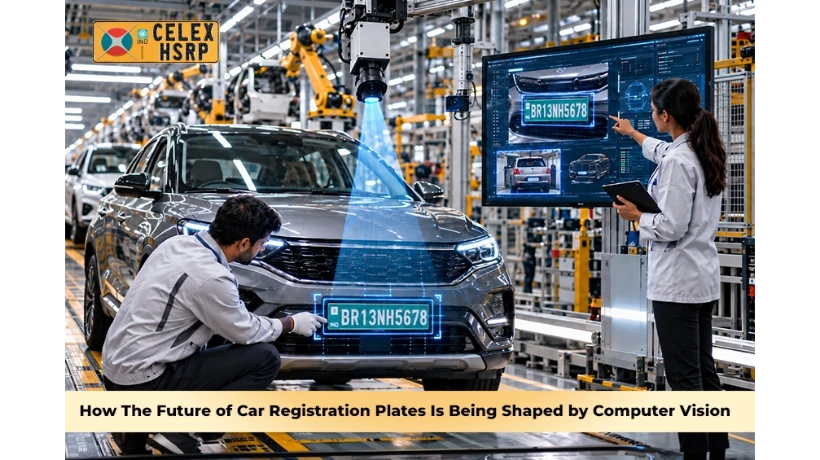
Computer vision is redefining car registration plates. Discover how dimensions, contrast, and retroreflectivity shape recognition in 2026.
Your car registration plate is quietly becoming the most scrutinised ten centimetres of metal on your vehicle. Computer vision systems now scan plates at highway gantries, toll booths, city junctions, and parking gates, often from multiple angles within the same second.
A plate that looks perfectly fine to your eye can still confuse a vision model if the contrast is weak, the characters sit too close together, or the embossing catches light the wrong way. Get this wrong, and you risk a failed toll deduction, a misapplied fine, or a vehicle that simply refuses to register in a database it should already belong to.
Keep reading, because this guide breaks down exactly how plate dimensions, contrast, retroreflectivity, character spacing, and embossing depth influence what a camera actually sees, and why India's expanding network of highway, city, and toll cameras is quietly rewriting the engineering rules behind every car registration plate on the road in 2026.
Why Computer Vision Is Becoming the Default Way India Identifies Vehicles
Vehicle identification in India has moved well past a single camera watching a single lane. Multi-camera perception now sits at the core of how highways, toll corridors, and city junctions track vehicles, and this shift changes what's actually expected from the plate itself.
The Shift from Barrier Tolling to Camera-First Systems
India's tolling network is moving toward a fully barrier-free model, with overhead gantries fitted with Automatic Number Plate Recognition cameras and RFID readers that work together to track vehicles in motion at highway speeds. Sensors detect a vehicle's presence, while cameras capture the plate from multiple angles simultaneously. This multi-angle capture is necessary because a single camera angle can miss a plate obscured by glare, dirt, or an awkward mounting position. How does computer vision identify a car without stopping it at a toll booth? The system uses ANPR as a backup verification layer alongside RFID, so even when a tag fails, or a vehicle has no active tag, the camera still needs to extract a clean, readable plate number to generate a valid toll notice.
Why Multi-Camera Perception Changes Plate Requirements
A plate designed for one camera looking straight on is a very different engineering problem from a plate that needs to stay readable across three or four cameras positioned at different heights and angles. Highway corridors increasingly rely on this layered camera approach, and vehicle owners rarely realise that their plate is being evaluated from angles the original design never accounted for. This is precisely why registration plate specifications keep tightening around dimensions and placement, because a plate that shifts even a few degrees off its intended mounting position can fall outside the recognition window of one or more cameras in the array.
Plate Dimensions and Why Every Millimetre Matters to a Vision Model
A computer vision model doesn't see a plate the way a human does. It sees a bounded region of pixels, and that region has to match expected proportions closely enough for the detection algorithm to even flag it as a plate before reading begins.
How Detection Algorithms Locate a Plate First
Before a system reads a single character, it has to find the plate within a much larger image that includes the bumper, the road, and everything around the vehicle. Why do plate dimensions matter so much for automated recognition? Detection algorithms are trained on expected aspect ratios and standard plate sizes, so a plate that's undersized, oversized, or mounted with an unusual border can confuse the initial detection step even before optical character recognition gets involved. This is one reason authorities enforce strict plate dimensions rather than leaving size to individual preference.
The Compounding Effect of Non-Standard Sizing
A plate that's slightly too small might still be readable by a nearby toll camera but completely missed by a highway gantry camera mounted higher up and further away. Detection failures at this early stage don't just cause a misread character; they cause the system to miss the plate entirely, which means no toll deduction, no violation record, and no vehicle match at all. Every millimetre of deviation from standard dimensions compounds across every camera in a multi-camera network, which is exactly why dimensional consistency has become non-negotiable in 2026.
Contrast, Colour, and the Physics of Being Seen Clearly
Contrast is the difference between the background colour of the plate and the colour of the characters, and it's one of the most underrated factors in automated vehicle identification. A camera doesn't care how attractive a plate looks; it cares about how sharply the characters separate from the background.
White Backgrounds, Black Characters, and Why the Combination Persists
Standard plates use white or yellow backgrounds with black characters precisely because this combination produces the highest contrast ratio under most lighting conditions, from harsh midday sun to dim streetlight. A car registration plate with a low-contrast colour scheme, a metallic finish, or a background pattern behind the numerals forces the vision model to work significantly harder to separate character from background, which increases both processing time and error rate. This becomes especially critical at highway speeds, where a camera has only a fraction of a second to capture and process a usable frame.
How Weather and Lighting Interact with Contrast
Rain, fog, and dust all reduce effective contrast further, since particles in the air scatter light and soften the sharp edges a camera depends on. A plate with borderline contrast under clear conditions can become genuinely unreadable the moment monsoon rain or early morning fog enters the picture. This is why plate specifications don't just define colour values on paper; they account for how those colours perform under the full range of weather conditions a vehicle will actually encounter on Indian roads.
Retroreflectivity: The Feature Most Drivers Never Think About
Retroreflectivity determines how much light bounces back toward a camera's sensor rather than scattering in random directions, and it's arguably the single most important physical property for night-time and low-light recognition.
Why Retroreflective Sheeting Exists in the First Place
Most modern ANPR cameras use infrared flash to capture plates at night without blinding drivers with visible light, and this only works if the plate's surface reflects that infrared light directly back toward the camera lens. What role does retroreflectivity play in car registration plate recognition? Retroreflective sheeting is engineered with microscopic glass beads or prismatic structures that redirect incoming light back to its source, which is what keeps a plate legible in a camera frame captured from thirty or forty metres away in complete darkness. Without this property, a plate might look fine to a passing driver's headlights but appear as a dark, featureless rectangle in infrared camera footage.
The Angle Problem That Breaks Retroreflectivity
Retroreflective performance depends heavily on the angle between the light source, the plate surface, and the camera sensor. A plate mounted at an angle, bent from a minor collision, or fitted with a decorative frame that tilts it even slightly can scatter reflected light away from the camera rather than back toward it. This is a purely physical problem, not a software one, and no amount of AI processing power can compensate for a plate that simply isn't sending usable light back to the sensor in the first place.
Character Placement, Spacing, and Embossing Depth
Character-level engineering decides whether a vision model reads your plate correctly in one pass or struggles through multiple failed attempts. This section breaks down the details that most vehicle owners never consider.
Why Spacing Between Characters Cannot Be Arbitrary
Characters set too close together risk merging into a single blob at the pixel level, especially when a camera captures a plate from a distance or at a steep angle. Characters spaced too far apart can cause a detection algorithm to interpret them as separate objects rather than parts of a single plate string. How does character spacing affect automated number plate reading accuracy? Standardised spacing ensures each character occupies a predictable pixel region within the plate boundary, which lets optical character recognition models segment and read characters individually with far greater consistency across different camera types and distances.
Embossing and Why Raised Characters Behave Differently Under Light
Embossed or raised characters interact with light differently than flat printed characters, since the raised edges create shadow lines that either help or hurt recognition depending on the light source's angle. A well-executed embossing depth adds a subtle shadow that sharpens character edges under direct sunlight, but a poorly calibrated embossing depth can create shadow patterns that confuse a camera under low-angle evening light. This is precisely why embossing specifications are tested across multiple lighting scenarios rather than approved based on daytime appearance alone.
The Data Behind Why This Matters at National Scale
None of this engineering detail exists in a vacuum. The numbers behind India's vehicle population and road safety record explain exactly why plate readability has become a national infrastructure priority.
Vehicle Volume and the Scale of the Recognition Challenge
India's automobile industry produces well over 4.6 million vehicles annually, and vehicle ownership continues climbing steadily across both urban and semi-urban regions. With more than a thousand toll plazas operating across the national highway network and barrier-free tolling targeted for wider rollout through 2027, the sheer volume of vehicles that computer vision systems must identify accurately, every single day, keeps growing at a pace few other countries are managing simultaneously.
Road Safety Statistics Driving Faster Adoption
India continues to record traffic collision numbers among the highest in the world, with government data showing road accidents running into the several lakhs annually and fatalities crossing well over a lakh each year. This accident burden is a core reason transport authorities are investing so heavily in computer vision-based enforcement and identification, since accurate vehicle tracking directly supports faster incident response, better hit-and-run investigation, and more consistent traffic law enforcement across a road network that human patrols alone simply cannot cover at this scale.
What Vehicle Owners Should Actually Do About This
All this technical detail translates into a short, practical set of habits every car owner can follow without needing to understand the underlying vision algorithms.
Stick to Certified, Standard-Compliant Plates
Always source your car registration plate from an authorised manufacturer or fitment centre rather than a generic local vendor, since certified plates are tested against dimensional, contrast, and retroreflectivity standards that generic plates simply aren't built to meet. An HSRP manufacturer licensed by a state transport department has already validated its plates against these recognition requirements, which removes most of the guesswork for the vehicle owner.
Keep the Plate Clean, Flat, and Correctly Mounted
Wipe down your plate regularly, especially before long highway drives, since dust and grime reduce both contrast and retroreflectivity simultaneously. Avoid decorative frames or covers that tilt the plate or obscure its edges, and check periodically that the mounting hasn't loosened or bent, since even a small physical deviation can affect how multiple cameras across a toll corridor interpret your plate.
Conclusion
Computer vision has quietly turned the humble car registration plates into a precision-engineered component rather than a simple identification tag. Dimensions, contrast, retroreflectivity, character spacing, and embossing depth all directly influence whether a highway gantry, toll camera, or city junction system reads your plate correctly on the first attempt.
As India pushes toward barrier-free tolling, wider multi-camera enforcement networks, and increasingly sophisticated vehicle tracking across highways and cities, the physical quality of your plate matters just as much as the software reading it.
A properly manufactured, well-maintained plate protects you from failed toll deductions, misapplied fines, and identification errors, while quietly supporting a road safety system that depends on getting vehicle identification right, every single time, at scale.
Frequently Asked Questions (FAQs)
1. Why do car registration plates need standardised dimensions for computer vision?
Standard dimensions let detection algorithms locate the plate accurately within a larger image before reading begins, preventing missed detections across different camera types.
2. How does retroreflectivity help with night-time plate recognition?
Retroreflective sheeting bounces infrared light back toward the camera sensor, keeping plates readable in darkness without relying on visible headlight illumination alone.
3. Can a bent or tilted plate affect toll and enforcement camera accuracy?
Yes, tilting scatters reflected light away from the camera and distorts character geometry, increasing the chance of missed reads or incorrect toll charges.
4. What is barrier-free tolling and how does it use computer vision?
Barrier-free tolling uses overhead gantry cameras and RFID readers to identify moving vehicles without stopping them, relying on ANPR as a backup verification layer.
5. Should vehicle owners buy plates from a certified HSRP manufacturer only?
Yes, certified manufacturers test plates against dimension, contrast, and retroreflectivity standards, ensuring reliable recognition across highway, toll, and city camera networks.


Comments
Login to Comment