High Purity Alumina Market Size, Share, Growth & Industry Outlook 2026-2034
01 Oct, 2026
10 Views 0 Like(s)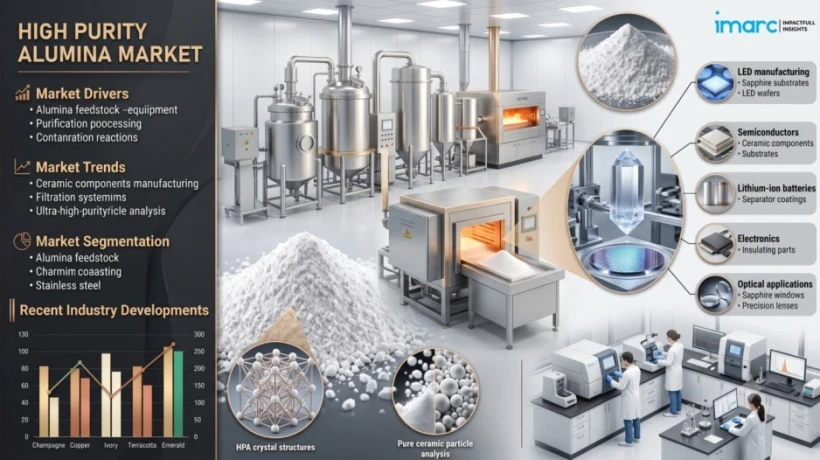
The high purity alumina market size was valued at USD 3.06 Billion in 2025, expected to hit USD 15.95 Billion at a CAGR of 19.51% during 2026-2034.
IMARC Group, a leading global market research and management consulting firm, has published its latest market intelligence report on the high purity alumina market. The global high purity alumina market size was valued at USD 3.06 Billion in 2025. Looking forward, IMARC Group estimates the market to reach USD 15.95 Billion by 2034, exhibiting a CAGR of 19.51% from 2026-2034, driven by rising LED lighting adoption, surging semiconductor fabrication demand, expanding use of high purity alumina-coated separators in electric vehicle batteries, and increasing sapphire substrate requirements across consumer electronics and optical applications worldwide.
The market is experiencing strong growth momentum as high purity alumina, an advanced non-metallurgical alumina product with a purity level of at least 99.99%, has evolved from a niche specialty material into a critical enabler across LED lighting, semiconductor fabrication, and battery technologies. Its role as the essential precursor for synthetic sapphire substrates ties demand directly to the global transition from conventional lighting to energy-efficient LED solutions, while 5N and 6N grades are gaining relevance in wafer polishing slurries, plasma-resistant chamber components, and insulating substrates used in advanced chip manufacturing. Lithium-ion batteries for electric vehicles add a further volume driver, since alumina-coated separators help prevent thermal runaway and improve safety performance. On the supply side, falling production costs through advanced purification routes such as hydrochloric acid leaching and solvent extraction are broadening adoption, and the regulatory push toward sustainable manufacturing and clean energy technologies is accelerating investment in low-carbon capacity. The value chain spans bauxite and aluminum hydroxide suppliers, specialist refiners, quality testing laboratories, distributors, and end use manufacturers, where multi-year customer qualification cycles and proprietary purification technology continue to favor established producers.
High Purity Alumina Market at a Glance:
-
Market Size (2025): USD 3.06 Billion
-
Forecast Market Size (2034): USD 15.95 Billion
-
CAGR (2026-2034): 19.51%
-
Leading Purity Level: 4N, holding a 42.0% share in 2025
-
Leading Application: LED, holding a 49.6% share in 2025
-
Dominant Region: Asia Pacific, holding a 75.0% share in 2025
How AI is Reshaping the Future of the High Purity Alumina Market
-
AI Infrastructure Buildout Driving Demand for Low-Alpha, High-Thermal-Performance Alumina: Sumitomo Chemical launched its ELA series on 7 May 2026, which it describes as the world's first line combining ultra-low alpha radiation with high purity fine spherical alumina, with particle size controlled to within several micrometers and a focus on advanced packaging for AI semiconductors. Alpha HPA reported that the semiconductor sector accounted for roughly 77% of its Stage 1 sales in the March 2026 quarter, and the World Semiconductor Trade Statistics organization now projects global semiconductor sales to reach USD 1.5 Trillion in 2026 as AI infrastructure demand accelerates.
-
Machine Learning for Purification Control and Yield Optimization: A June 2026 review of AI-driven smart manufacturing in the aluminum industry documents machine learning and deep learning models, including sliding-window online models with error compensation and LSTM-based approaches, being applied to alumina production, with physics-guided machine learning and digital twin architectures proposed for full-process optimization. These techniques are directly relevant to high purity alumina refiners, where holding impurity levels inside the narrow windows that separate 4N, 5N, and 6N grades across hydrolysis, hydrochloric acid leaching, and solvent extraction circuits determines yield, customer qualification, and cost per tonne.
-
AI-Era Semiconductor Fabrication Raising Specifications for Plasma-Resistant Ceramics and Polishing Slurries: As chipmaking processes advance, Sumitomo Chemical reports that sintered ceramics made with its NXA ultra-fine alumina deliver approximately 1.5 times the bending strength and approximately 2 times the plasma resistance of ceramics made with its existing fine alumina. Alpha HPA is installing nano-milling equipment to serve the chemical mechanical planarization market with ultra-high purity liquid dispersions that it expects to command premium pricing, a sign that producers are moving up the value chain toward application-specific product forms.
Grab a sample PDF of this report: https://www.imarcgroup.com/high-purity-alumina-market/requestsample
High Purity Alumina Market Trends and Drivers:
The global high purity alumina market is witnessing rapid expansion, fueled by the convergence of energy-efficient lighting adoption, semiconductor capacity additions, and the electrification of transport, all of which depend on a material that few producers can make at consistent 4N to 6N purity. LED lighting remains the foundational demand driver, with high purity alumina serving as the precursor for synthetic sapphire substrates used in LED chip manufacturing, and the LED application accounted for 49.6% of market demand in 2025 according to IMARC Group analysis. The global LED lighting market was valued at USD 97.7 Billion in 2025, and the continued displacement of incandescent and fluorescent lighting across residential, commercial, and industrial settings sustains steady substrate and, in turn, high purity alumina consumption. Scratch-resistant sapphire glass in smartphones, wearable devices, and optical instruments adds a second consumer electronics pull, while phosphor applications extend usage across the lighting and display chain.
Electrification and sustainability are reshaping the demand profile at the same time. According to the International Energy Agency's Global EV Outlook 2026, global electric car sales exceeded 20 million units in 2025, a 20% increase over the previous year and 25% of all new cars sold, with sales expected to reach around 23 million in 2026. Lithium-ion batteries for these vehicles rely on high purity alumina-coated separators for thermal runaway prevention, which links battery volumes directly to alumina consumption, and the advance of solid-state battery technologies is expected to open new demand for ultra-high purity alumina as an electrolyte and separator material. Sustainability considerations are equally influential, as traditional alumina extraction generates significant volumes of red mud waste and tightening industrial waste regulations are raising compliance costs. Producers are responding with hydrochloric acid leaching, solvent extraction, renewable energy-powered facilities, closed-loop chemical recycling, and alternative feedstocks such as kaolin clay, turning cleaner production into a competitive differentiator as ESG and carbon-neutrality requirements tighten across global supply chains.
Semiconductor fabrication is the third pillar and the one that most directly links the market to government policy. Expanding fabrication capacity is increasing demand for 5N and 6N grades used in wafer polishing slurries, plasma-resistant chamber components, and insulating substrates, with the semiconductor substrate application holding a 21.8% share in 2025, while the World Semiconductor Trade Statistics Spring 2026 forecast, endorsed by the Semiconductor Industry Association, projects global semiconductor sales of USD 1.5 Trillion in 2026. At the same time, the market remains exposed to feedstock and supply concentration, since bauxite reserves sit in a limited number of countries and only a small number of qualified producers hold proprietary purification technology, with new entrants facing multi-year qualification cycles and high capital requirements. These dynamics are drawing governments in Australia, the United States, the European Union, and India to treat advanced materials and semiconductor supply chains as strategic priorities, supported by trade policy, critical mineral programs, and direct financing that are reshaping where and how new capacity is built.
Global Regulatory, Trade, and Sustainability Landscape Shaping Demand:
-
U.S. Geological Survey, Bauxite and Alumina Supply Concentration: USGS data show that Australia, China, and Guinea accounted for 73% of world bauxite production in 2022, while China, Australia, Brazil, and India accounted for 85% of world alumina output of 140 million tonnes, exposing high purity alumina feedstock chains to export restrictions, geopolitical disruption, and price volatility in a small group of producing nations.
-
International Energy Agency, Global EV Outlook 2026: The IEA reports that electric car sales grew 20% to exceed 20 million in 2025, equal to 25% of all new cars sold, with around 40 countries recording electric shares of at least 10% and global sales expected to reach 23 million in 2026, a trajectory that directly supports demand for high purity alumina-coated battery separators.
-
World Semiconductor Trade Statistics and Semiconductor Industry Association, Global Chip Demand: SIA reported global semiconductor sales of USD 110.5 Billion in April 2026 against USD 56.9 Billion in April 2025, and endorsed the WSTS Spring 2026 forecast of USD 1.5 Trillion in annual sales for 2026, underscoring the scale of fabrication capacity that consumes 5N and 6N alumina for polishing, plasma-resistant components, and substrates.
-
International Aluminium Institute, Bauxite Residue Management: The IAI estimates that the aluminum industry generated 159 million tons of bauxite residue in 2017, that the global inventory exceeds 3 billion tons, and that annual generation could reach about 220 million tons by 2050, a waste burden that is increasing compliance costs and favoring lower-waste high purity alumina routes such as hydrochloric acid leaching and solvent extraction.
Key Government Schemes and Policy Programs Supporting the Industry:
-
India, India Semiconductor Mission and Semicon India Programme: The Semicon India Programme was launched with an outlay of Rs 76,000 crore (over USD 10 Billion), and the Union Cabinet approved the successor Semicon 2.0 in July 2026 with a fiscal outlay of Rs 1,27,500 crore (about USD 13 Billion). On 5 May 2026 the Cabinet approved two further Gujarat projects worth Rs 3,936 crore, including Crystal Matrix's Rs 3,068 crore gallium nitride Mini/Micro-LED facility at Dholera, taking approved projects under the mission to 12 with cumulative investment of about Rs 1.64 lakh crore.
-
United States, Department of Energy and Department of War Critical Minerals Programs: On 13 March 2026 the Department of Energy issued a USD 500 Million funding opportunity for demonstration and commercial facilities that expand domestic critical minerals and materials supply for advanced batteries, followed in April 2026 by an up to USD 69 Million Critical Minerals and Materials Accelerator covering processes to refine materials used in the semiconductor industry. On the defense side, the FY2026 National Defense Authorization Act, signed on 18 December 2025, expands critical materials sourcing rules, with associated funding of USD 2 Billion for the National Defense Stockpile, USD 5 Billion for the Industrial Base Fund, and USD 1 Billion in Defense Production Act Title III financing through September 2027.
-
European Union, Critical Raw Materials Act and RESourceEU: The Act sets 2030 benchmarks of at least 10% of annual strategic raw material consumption extracted in the EU, 40% processed, and 25% recycled, with no more than 65% sourced from a single third country, adds aluminium to the strategic raw materials list, and gives strategic projects permitting timelines of 15 months for processing and recycling. The Commission selected 47 strategic projects in March 2025, and its RESourceEU plan, which responds to export restrictions on materials such as graphite, gallium, germanium, and rare earths, provides for a European Critical Raw Materials Centre to be set up in 2026.
-
Australia, Critical Minerals Production Tax Incentive and National Reconstruction Fund: The incentive provides a refundable tax offset of 10% of eligible processing and refining costs for up to 10 years per project for production between 1 July 2027 and 30 June 2040, is valued at A$7 billion over the decade to 2033-34, and covers high purity alumina processing under the 2025 regulations. Alongside it, the Australian Government provided a A$400 million (about USD 271 Million) debt facility for Alpha HPA's Stage 2 project, and the National Reconstruction Fund Corporation invested A$75 million in January 2026, supporting up to 420 construction and commissioning jobs and 120 ongoing roles.
High Purity Alumina Industry Segmentation:
The report has segmented the market into the following categories:
Breakup By Purity Level:
-
4N
-
5N
-
6N
4N accounts for the largest purity level segment with a 42.0% share in 2025, driven by its balanced performance-to-cost profile that makes it the preferred grade for LED sapphire substrates, lithium-ion battery separator coatings, and standard ceramic applications, supported by established manufacturing processes and broad industrial acceptance. 5N follows with a 34.5% share, serving semiconductor wafer polishing, advanced optical components, and specialty electronics, while 6N holds a 23.5% share and is expanding faster than the overall 19.51% market CAGR as advanced semiconductor fabrication and next-generation display technologies demand ultra-high purity specifications.
Breakup By Production Method:
-
Hydrolysis of Aluminium Alkoxide
-
Hydrochloric Acid Leaching
-
Others
Hydrolysis of aluminum alkoxide remains the dominant commercial production method, valued for its established process know-how and its ability to deliver consistent purity, while hydrochloric acid leaching is gaining traction as an alternative that offers lower energy consumption and improved compatibility with diverse feedstock sources. Solvent extraction, the newest commercial technology, enables near-zero waste production at competitive cost, and these routes are being complemented by renewable energy-powered facilities and closed-loop reagent recycling as environmental performance becomes a competitive differentiator.
Breakup By Application:
-
LED
-
Semiconductor Substrate
-
Phosphor
-
Sapphire Glass
-
Others
LED commands the largest application share at 49.6% in 2025, reflecting the global transition to energy-efficient lighting and the essential role of high purity alumina as a precursor for synthetic sapphire substrates, with growing LED penetration across residential, commercial, and industrial settings sustaining dominant demand. Semiconductor substrate is the second-largest application at 21.8%, supported by expanding global fabrication capacity and rising demand for high-performance chips in computing, telecommunications, and consumer electronics, while phosphor, sapphire glass, and other applications complete the demand base.
Breakup By Region:
-
North America (United States, Canada)
-
Asia Pacific (China, Japan, India, South Korea, Australia, Indonesia, Others)
-
Europe (Germany, France, United Kingdom, Italy, Spain, Russia, Others)
-
Latin America (Brazil, Mexico, Others)
-
Middle East and Africa
Asia Pacific dominates the global high purity alumina market with a 75.0% share in 2025, driven by China, Japan, and South Korea hosting large LED manufacturing clusters, semiconductor fabrication facilities, and lithium-ion battery production lines, with established supply chains and strong government support for advanced electronics manufacturing reinforcing regional leadership. Europe follows with a 9.8% share on the back of stringent environmental regulations and investment in clean-technology manufacturing, while North America, at 7.6%, is the fastest-growing region as rising domestic semiconductor fabrication investment, expanding EV battery production, and government focus on critical mineral supply chain resilience accelerate demand. Latin America (4.2%) and the Middle East and Africa (3.4%) are supported by growing electronics manufacturing and rising industrialization.
Competitive Landscape:
The report provides a comprehensive analysis of the competitive landscape in the high purity alumina market with detailed profiles of key companies, including:
-
Sumitomo Chemical Co., Ltd.
-
Nippon Light Metal Holdings Co., Ltd.
-
Alpha HPA
The market is moderately concentrated, with established Japanese and European manufacturers leading production capacity while emerging Australian and Chinese producers scale through proprietary technologies, and process innovation, purity consistency, and long-term supply agreements forming the key competitive moats. Sumitomo Chemical, which relies on a proprietary hydrolysis process and offers the AKP-50 and ELA series, reported sales revenue of approximately JPY 2.33 Trillion for the fiscal year ended March 2026 and is positioning its ELA and NXA lines as the core growth drivers of its high purity alumina business, while Nippon Light Metal Holdings continues to focus on purification efficiency for LED, semiconductor, and sapphire substrate demand. Alpha HPA, the emerging solvent extraction specialist, is building a 10,000 tonne per annum Stage 2 refinery at Gladstone against a re-baselined budget of A$699.2 million and reported non-binding customer letters of intent above 12,000 tonnes as of June 2026.
Market Concentration Analysis:
-
Moderately Concentrated Structure: IMARC Group estimates that the top companies, Sumitomo Chemical, Nippon Light Metal Holdings, and Alpha HPA, held approximately 50-60% of global production capacity share in 2025, with the balance held by regional and emerging producers.
-
High Barriers to Entry: Proprietary purification technology, multi-year customer qualification cycles, and high capital requirements favor established producers, as illustrated by Alpha HPA's A$699.2 million re-baselined budget for 10,000 tonnes per annum of Stage 2 capacity, and by Impact Minerals' Alluminous scoping study for a staged 2,000 to 4,000 tonne per annum US plant at an estimated capital cost of US$74 million for the preferred case, which had no binding offtake or project debt secured as of September 2026.
-
Consolidation and Regional Champions: Consolidation is accelerating through strategic partnerships, capacity expansion investments, and technology licensing agreements, while regional champions are forming around government-backed capacity, including Japan's incumbents such as Sumitomo Chemical with its Korean subsidiary Dongwoo Fine-Chem, Australia's Alpha HPA backed by A$400 million of government debt and A$75 million of National Reconstruction Fund equity, and US developers targeting domestic supply, against an Asia Pacific region that holds 75.0% of global demand.
What Does The Full Report Cover?
If you are tracking the high purity alumina market for investment decisions, market entry planning, competitive benchmarking, or strategic advisory, IMARC Group's report gives you everything in one place:
-
Complete market sizing with revenue forecasts covering the full projection period of 2026-2034, built on historical data from 2020-2025
-
Quantified growth driver analysis across purity level, production method, application, and regional markets, alongside restraints, opportunities, and challenges
-
Sub-segment breakdowns for 4N, 5N, 6N, hydrolysis of aluminium alkoxide, hydrochloric acid leaching, LED, semiconductor substrate, phosphor, and sapphire glass with individual share data
-
Country-level data for the United States, Canada, Germany, France, the United Kingdom, Italy, Spain, Russia, China, Japan, India, South Korea, Australia, Indonesia, Brazil, and Mexico
-
Competitive profiles of key companies including Sumitomo Chemical Co., Ltd., Nippon Light Metal Holdings Co., Ltd., and Alpha HPA with strategic landscape assessment
-
Porter's Five Forces, industry value chain analysis, and market concentration assessment
-
Latest technology trends covering hydrochloric acid leaching and solvent extraction, rising demand for 5N and 6N ultra-high purity grades, EV battery separator integration, and sustainable low-carbon production developments shaping market competition and customer preference across key regional markets
Recent News and Developments in High Purity Alumina Market
-
September 2026: Impact Minerals' 50%-owned Alluminous released an independent scoping study for a staged US high purity alumina plant growing from 2,000 to 4,000 tonnes per annum, with the preferred Houston-area case modelling a 42.3% internal rate of return and a total capital cost of US$74 million. The study found that a US Gulf Coast site requires about 26% less upfront capital than Perth for the same 2,000 tonne per annum plant, supporting the case for domestic North American supply as semiconductor and battery demand expands.
-
July 2026: Alpha HPA reported for the quarter ended 30 June 2026 that Stage 2 construction at Gladstone remained on schedule and on budget against its re-baselined A$699.2 million budget, with concrete foundations completed in the solvent extraction, leaching, and utilities areas. The company also reported that non-binding customer letters of intent had exceeded 12,000 tonnes and that Stage 1 operated at full capacity with product approximately three times oversubscribed.
-
May 2026: The Union Cabinet approved two semiconductor projects in Gujarat under the India Semiconductor Mission, including Crystal Matrix's Rs 3,068 crore gallium nitride Mini/Micro-LED facility at Dholera and Suchi Semicon's Rs 868 crore OSAT unit at Surat. The approvals take the mission to 12 projects with cumulative investment of about Rs 1.64 lakh crore and add 2,230 skilled jobs, reinforcing the Asia Pacific LED and semiconductor manufacturing base that anchors high purity alumina demand.
-
May 2026: Sumitomo Chemical launched the ELA series of low alpha radiation, high purity fine spherical alumina, developed by its Korean subsidiary Dongwoo Fine-Chem and described as the world's first of its kind, with particle size controlled to within several micrometers for advanced semiconductor packaging including AI chips. The company also reported that sintered ceramics made with its NXA ultra-fine series deliver approximately 1.5 times the bending strength and approximately 2 times the plasma resistance of those made with its existing fine alumina.
-
January 2026: Alpha HPA completed a fully underwritten A$225 million equity raise cornerstoned by a A$75 million investment from the National Reconstruction Fund Corporation, giving the fund a pro-forma holding of about 6.9%. The proceeds support construction and commercialization of the 10,000 tonne per annum Stage 2 facility, which the company describes as the world's largest single-site high purity alumina manufacturing plant and which is expected to create up to 420 temporary jobs and 120 ongoing roles.
-
June 2025: Alpha HPA awarded a flagship concrete works contract valued at more than A$20 million to McCosker Contracting for its Stage 2 high purity alumina facility in Gladstone, Australia, which is designed to produce more than 10,000 tonnes of high purity aluminum materials annually. The award marked a major construction milestone ahead of the Stage 2 groundbreaking, positioning the project to deliver what the company expects to be the world's largest single-site manufacturer of high purity aluminum materials.
Note: If you require specific details, data, or insights that are not currently included in the scope of this report, we are happy to accommodate your request. As part of our customization service, we will gather and provide the additional information you need, tailored to your specific requirements. Please let us know your exact needs, and we will ensure the report is updated accordingly to meet your expectations.
Key Questions This Report Answers
-
What is the current global high purity alumina market size and what is its projected value by 2034?
-
Which purity level segment holds the largest share in the global high purity alumina market?
-
What are the key drivers of global high purity alumina market growth?
-
Which region dominates the global high purity alumina market and why?
-
How are semiconductor fabrication, EV battery separator adoption, and sustainable production technologies reshaping product development and competitive strategies in the high purity alumina industry?
-
Who are the top companies in the global high purity alumina market and what are their competitive strategies?
-
What are the investment and market entry opportunities across 5N and 6N ultra-high purity grades, sustainable production technologies, and solid-state battery applications?
About Us:
IMARC Group is a global management consulting firm that helps the world's most ambitious changemakers to create a lasting impact. The company provides a comprehensive suite of market entry and expansion services. IMARC offerings include thorough market assessment, feasibility studies, company incorporation assistance, factory setup support, regulatory approvals and licensing navigation, branding, marketing and sales strategies, competitive landscape and benchmarking analyses, pricing and cost research, and procurement research.
Media and Sales Contact
IMARC Group
Email: sales@imarcgroup.com
United States: +1-201-971-6302
India: +91-120-433-0800
United Kingdom: +44-753-714-6104

Comments
Login to Comment