How Regular Aircon Servicing Can Reduce Energy Bills in Singapore
23 Sep, 2026
9 Views 0 Like(s)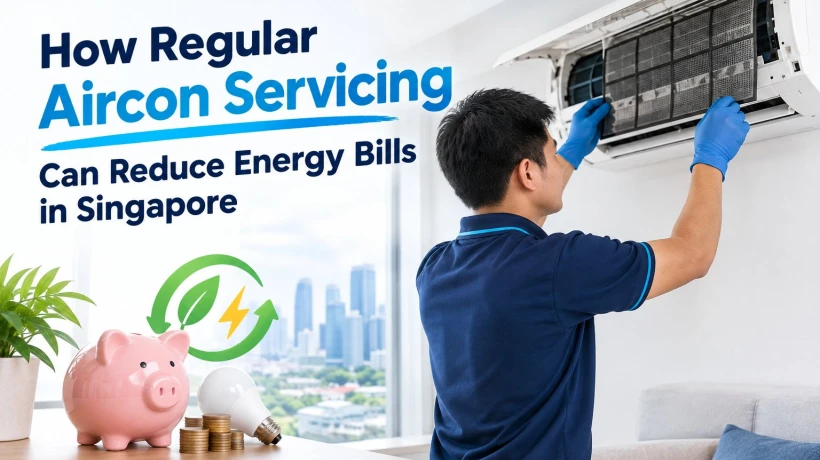
Singapore's tropical climate means air conditioners run year-round there's no off-season. Humidity levels regularly exceed 80%, which accelerates mould growth inside drainage systems and on coils.
Regular aircon servicing can meaningfully reduce energy bills by restoring the unit's cooling efficiency. When filters, coils, and drainage components are cleaned and maintained, the system uses less electricity to reach and hold the desired temperature. In Singapore's humid climate, a well-maintained air conditioner can consume up to 25% less energy than a neglected one.
If you've noticed your electricity bill creeping up without a clear reason, your air conditioner could be the culprit. For homeowners and landlords in Singapore, aircon servicing energy savings Singapore is not just a maintenance checkbox it's one of the most practical ways to cut monthly costs without replacing equipment.
Why Aircon Units Lose Efficiency Over Time
Air conditioners don't fail overnight. They degrade gradually, and most of the efficiency loss happens silently inside components you can't easily see.
Dust accumulates on the evaporator and condenser coils. Filters become clogged. Drainage pipes develop blockages. Each of these issues forces the compressor to work harder to deliver the same cooling output. That extra effort translates directly into higher electricity consumption.
According to the Energy Market Authority (EMA) of Singapore, air conditioning accounts for approximately 40% of total electricity consumption in residential households. Even a modest reduction in aircon energy draw can produce visible savings on your SP Group utility bill each month.
The Link Between Dirty Filters and Power Consumption
A clogged air filter restricts airflow, forcing the fan motor to run longer and harder. Studies referenced by Singapore's National Environment Agency (NEA) confirm that restricted airflow is among the top contributors to unnecessary energy waste in cooling systems.
Cleaning or replacing filters regularly is one of the simplest forms of aircon maintenance and one of the highest-return actions for reducing electricity bills.
What Happens During a Professional Aircon Service
A standard professional aircon service in Singapore typically covers the following:
-
Filter cleaning - Removes accumulated dust that blocks airflow
-
Evaporator coil cleaning - Restores heat exchange efficiency
-
Drainage pipe flushing - Prevents water backup and mould growth
-
Fan blade inspection and cleaning - Reduces motor strain
-
Refrigerant level check - Ensures the system cools at rated capacity
-
Thermostat calibration check - Confirms accurate temperature control
Each of these steps directly supports energy efficient aircon performance. A unit running on clean coils and an unobstructed drainage path reaches the set temperature faster and cycles off sooner. Fewer cycles mean less electricity used.
How Much Can Regular Servicing Actually Save?
The numbers are worth paying attention to. The NEA's guidelines suggest that air conditioners with dirty or poorly maintained components can consume 10–25% more electricity than properly serviced units of the same model and capacity.
Consider a typical 3-room HDB flat running two air conditioners for 8 hours a day. At Singapore's average residential tariff of approximately $0.32 per kWh (as published by SP Group), a 15% improvement in aircon efficiency could save between $15 and $30 per month — or $180 to $360 annually — without changing any usage habits.
For landlords managing multiple units across different properties, those figures multiply quickly.
Servicing Frequency That Makes a Difference
The general recommendation for Singapore households is servicing every 3 months, given the year-round heat and humidity. Units running daily in enclosed spaces particularly in homes with pets or near busy roads may benefit from quarterly or even bi-monthly servicing.
For newer, energy efficient aircon models with inverter technology, regular maintenance also protects the inverter compressor from the strain caused by restricted airflow preserving long-term performance and your investment.
Aircon Efficiency: Maintenance vs. Replacement
Many homeowners assume that rising energy bills mean it's time to replace the unit. In many cases, however, a thorough chemical wash or overhaul restores performance to near-original levels at a fraction of the replacement cost.
|
Action |
Estimated Cost (SGD) |
Energy Saving Potential |
Lifespan Impact
|
|---|---|---|---|
|
General Servicing |
$50 – $80 per unit |
10–15% |
Maintains current lifespan |
|
Chemical Wash |
$80 – $150 per unit |
15–25% |
Extends lifespan 1–2 years |
|
Chemical Overhaul |
$150 – $250 per unit |
Up to 25% |
Restores near-original performance |
|
Full Replacement |
$800 – $2,000+ |
Varies by model |
Full reset (10–12 year cycle) |
Before committing to a new unit, a chemical overhaul is often the smarter first step — especially if the existing system is less than 8 years old.
Practical Tips to Reduce Electricity Bill Beyond Servicing
Servicing sets the foundation, but a few additional habits can further reduce electricity bill amounts each month:
-
Set the thermostat to 25°C - NEA recommends this as the optimal balance between comfort and energy use
-
Use the fan mode during cooler evenings - Reduces compressor runtime
-
Keep doors and windows closed - Prevents cool air from escaping, reducing cycle frequency
-
Use ceiling fans alongside the aircon - Allows a higher thermostat setting without sacrificing comfort
-
Check for refrigerant leaks - Low refrigerant forces the compressor to run continuously, spiking electricity use
Signs Your Aircon Is Already Costing You More Than It Should
Don't wait until a breakdown to act. These are clear signals that aircon efficiency has dropped and servicing is overdue:
-
The unit takes longer than usual to cool the room
-
Airflow feels noticeably weaker despite the same fan setting
-
There's a musty smell when the unit is running
-
Water is dripping from the indoor unit
-
Electricity bills have risen without any change in usage habits
-
The compressor runs almost continuously without cycling off
Any one of these signs indicates that aircon maintenance is needed not optional. Continuing to run a struggling unit accelerates component wear and compounds the energy waste.
Why This Matters More in Singapore Than Elsewhere
Singapore's tropical climate means air conditioners run year-round there's no off-season. Humidity levels regularly exceed 80%, which accelerates mould growth inside drainage systems and on coils. This makes the degradation cycle faster than in temperate climates, and the case for regular servicing stronger.
The NEA's mandatory Energy Labelling Scheme for air conditioners in Singapore also highlights how seriously energy consumption is taken at a national level. Choosing to maintain your existing unit well is fully in line with that philosophy and it keeps money in your pocket.
Choosing the Right Aircon Servicing Provider
Not all servicing is equal. A rushed 20-minute job that only cleans the visible filter will not deliver the energy savings a thorough service provides. When selecting a provider, look for:
-
Transparent service checklists you should know exactly what's being done
-
Experience with your aircon brand and model type
-
Clear pricing with no hidden charges
-
Availability of service contracts for consistent quarterly maintenance
Aircon Express offers professional aircon servicing across Singapore, with trained technicians who follow systematic service procedures designed to restore and maintain cooling efficiency. For homeowners and landlords looking to manage energy costs without compromising comfort, a regular servicing schedule is the most cost-effective place to start.
Frequently Asked Questions
How much can I save on electricity bills with regular aircon servicing in Singapore?
Regular servicing can improve aircon efficiency by 10–25%, which may translate to $15–$30 in monthly savings per household depending on usage. Over a year, consistent maintenance can reduce electricity costs by $180–$360 without changing how often you use the unit.
How often should I service my aircon in Singapore to maintain energy efficiency?
For most Singapore households, servicing every 3 months is recommended due to the year-round heat and high humidity. Units in heavy use or dusty environments may benefit from bi-monthly servicing to maintain optimal aircon efficiency and prevent unnecessary energy waste.
Does a chemical wash save more energy than a general aircon service?
Yes. A chemical wash cleans deeper internal components including the evaporator coil and drainage tray restoring more of the unit's original efficiency. It typically delivers 15–25% energy savings compared to 10–15% from a standard general service, making it worthwhile for older or heavily used units.
Can a dirty aircon filter really increase my electricity bill?
Absolutely. A clogged filter restricts airflow, forcing the motor and compressor to work harder to maintain the set temperature. This directly increases electricity consumption. Cleaning or replacing filters is one of the simplest and most effective forms of aircon maintenance for reducing energy use.
What temperature should I set my aircon to save electricity in Singapore?
The National Environment Agency (NEA) recommends setting your aircon to 25°C, which balances thermal comfort with energy efficiency. Each degree below this setting increases energy consumption by approximately 8–10%, making thermostat discipline one of the easiest ways to reduce electricity bills.
Is it better to service my aircon or replace it to save on energy costs?
If your unit is under 8 years old, a chemical wash or overhaul often restores performance at a fraction of replacement cost. Replacement only makes clear financial sense when the unit is beyond repair, frequently breaking down, or significantly below current energy efficiency rating standards.


Comments
Login to Comment