How Investigators Trace Insider Threats Through Employee Emails
07 May, 2026
1824 Views 0 Like(s)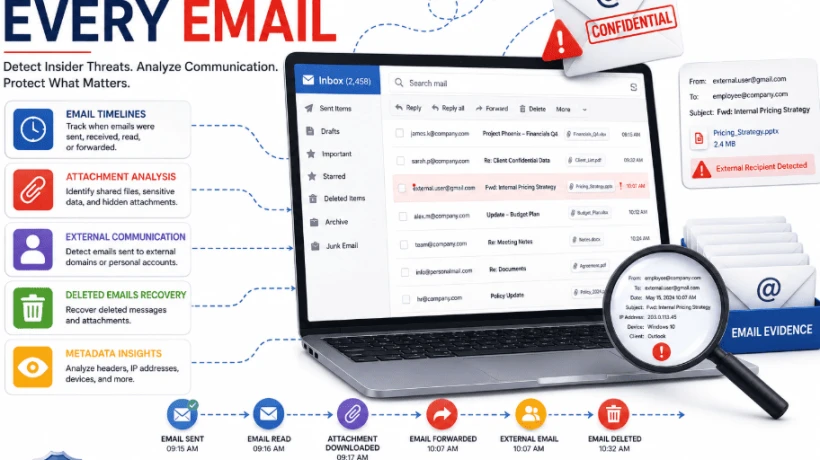
Insider threats often hide in everyday emails. Structured analysis of employee communication uncovers suspicious activity, speeds investigations, and protects sensitive corporate data.
Blog Overview - Insider threats rarely begin with obvious warning signs. Most cases start quietly with a forwarded attachment, an unusual late-night email, or sensitive files shared outside the organization. By the time enterprises realize something is wrong, critical data may already be exposed. This blog explains how investigators trace insider threats through employee emails, why manual investigations often fail, and how modern investigation teams uncover hidden evidence faster through organized email analysis.
Why Insider Threat Investigations Have Become More Difficult
Modern enterprises manage thousands of employee emails every day. Inside those conversations are contracts, financial records, confidential documents, login details, and internal discussions.
When suspicious activity appears, investigators face a difficult challenge. They must identify harmful communication without disrupting normal business operations.
Think of it like an intelligence officer studying hundreds of flight signals during a security operation. Most signals are harmless, but one unusual movement may reveal the real threat.
Insider threat investigations become more complex during:
-
employee resignation cases
-
intellectual property theft
-
financial fraud investigations
-
policy violations
-
unauthorized file sharing
-
compliance reviews
The biggest problem is volume. Investigators may need to review years of emails across multiple mailboxes while working under legal and operational pressure.
Why Manual Email Review Creates Blind Spots
Many organizations still rely on manual inbox searches and screenshots during investigations. This creates dangerous blind spots.
A single employee mailbox may contain:
-
thousands of conversations
-
hidden attachments
-
deleted messages
-
forwarded email chains
-
external communication records
Reviewing emails one by one increases the possibility of missing critical evidence.
One overlooked attachment or suspicious timestamp can completely change the direction of an investigation.
How Employee Emails Reveal Insider Threat Activity
Employee emails often contain communication trails that help investigators reconstruct events clearly.
Investigators analyze:
-
email timelines
-
attachment activity
-
external communication
-
deleted conversations
-
sender behavior
-
metadata patterns
Email metadata works like a travel history attached to a package. Even if someone changes the message inside, the travel route still reveals where the communication moved and who interacted with it.
This makes email evidence one of the most valuable assets during insider threat investigations.
Hidden Warning Signs Investigators Look For
Insider threats are not always dramatic cyberattacks. Sometimes the warning signs appear small in the beginning.
Investigators often look for:
-
unusual file sharing behavior
-
repeated forwarding of confidential attachments
-
communication with personal email accounts
-
sudden deletion of conversations
-
abnormal login or sending times
-
unauthorized external recipients
For example, an employee preparing to leave a company may quietly forward sensitive spreadsheets or project files before resignation. Individually, those emails may appear harmless. Together, they may reveal a clear data exfiltration pattern.
Why Deleted Emails Still Matter
Deleting an email does not always remove the evidence completely.
During investigations, traces may still exist through:
-
mailbox archives
-
metadata records
-
communication references
-
attachment history
-
timeline activity
This becomes especially important during legal disputes and corporate compliance investigations where investigators must reconstruct communication history accurately.
How Modern Investigation Teams Analyze Email Evidence Faster
Modern enterprises no longer depend entirely on scattered inbox reviews. Investigation teams now use structured forensic workflows to reduce investigation delays and organize evidence more efficiently.
|
Manual Investigation |
Structured Email Analysis |
|
Slow review process |
Faster evidence discovery |
|
High investigator fatigue |
Organized communication analysis |
|
Missed metadata |
Better visibility into timelines |
|
Scattered screenshots |
Centralized investigation workflow |
Imagine an HR investigation team reviewing thousands of employee emails after confidential documents appear outside the organization. Manually reviewing every mailbox would consume days or even weeks.
This is where specialized email investigation platforms become valuable.
Email analysis tools helps investigators analyze communication trails, review attachments, identify suspicious activity, and organize evidence from multiple email sources within a centralized investigation environment.
Instead of searching mailbox after mailbox manually, teams can focus directly on identifying communication patterns connected to insider threat activity.
The Risk of Missing One Communication Thread
Insider threat investigations often depend on one overlooked detail.
A forwarded attachment, deleted reply, or hidden recipient may completely change the outcome of a case.
The challenge is not simply accessing employee emails. The real challenge is identifying suspicious communication quickly before operational, financial, or legal damage grows larger.
What Enterprises Should Prioritize During Insider Threat Investigations
Organizations should focus on investigation clarity, evidence visibility, and communication tracing instead of relying entirely on manual review methods.
An effective insider threat investigation process should help teams:
-
review large mailboxes efficiently
-
identify suspicious communication faster
-
organize investigation timelines
-
analyze attachments clearly
-
reduce manual investigation effort
-
support legal and compliance reporting
Quick Reality Check
The biggest investigation challenge today is not lack of evidence. Most organizations already possess the data they need.
The real challenge is finding critical communication hidden inside massive email environments before time pressure and human error create larger risks.
Final Thoughts
Insider threats continue growing as enterprises handle larger volumes of digital communication every year. Emails often contain the communication trails investigators need to understand what happened, when it happened, and who was involved.
However, modern investigations require more than manual inbox searching. Enterprises need structured email analysis workflows that simplify evidence discovery, reduce blind spots, and help investigators uncover suspicious activity faster.
For organizations handling sensitive investigations, organized email evidence analysis has become an essential part of protecting data, reducing risk, and supporting faster decision-making under pressure.



Comments
Login to Comment