Why Buyers Ignore Some Booths and Stop at Others
10 Jun, 2026
1399 Views 0 Like(s)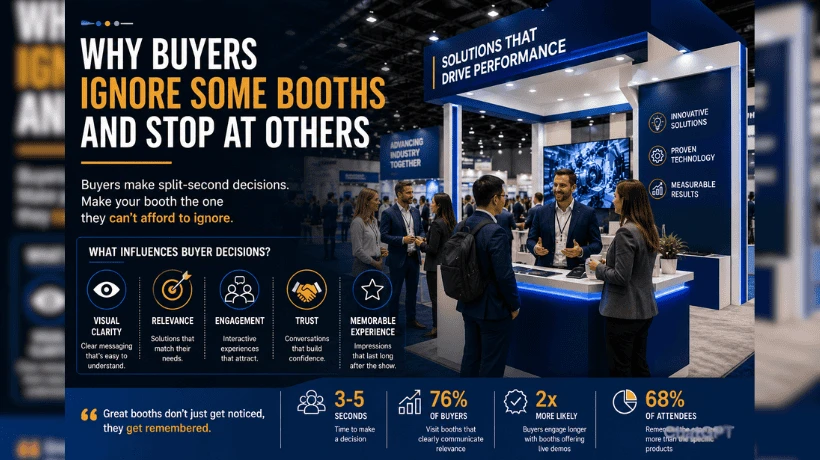
Learn why buyers stop at certain booths and how exhibit design, engagement, and visitor experience influence trade show success.
Trade show attendees make hundreds of decisions during an event. Which booths to visit, which products to explore, and which conversations are worth their time.
What's surprising is how quickly these decisions are made.
In many cases, visitors decide whether to approach a booth within a few seconds. Long before a sales representative introduces themselves, attendees have already formed an opinion based on what they see, understand, and experience from a distance.
For exhibitors, understanding this behavior can make the difference between attracting qualified prospects and becoming part of the background noise.
Attention Is Earned Before Engagement
Many exhibitors assume visitors are looking for products. In reality, visitors are looking for relevance.
When attendees walk through an exhibition hall, they subconsciously ask themselves:
-
Is this solution relevant to my business?
-
Can this company solve a problem I have?
-
Is it worth spending time here?
Exhibits that answer these questions quickly often outperform booths that rely solely on flashy graphics or large displays.
This is one reason companies exhibiting at AAPEX Expo 2026 are placing greater emphasis on storytelling and product-focused experiences rather than simply showcasing as many products as possible.
The Power of Visual Hierarchy
One of the most common mistakes exhibitors make is trying to communicate everything at once.
When visitors see too many messages, products, or graphics competing for attention, they often choose to move on rather than process the information.
Successful exhibits guide visitors toward a single message first and then provide additional information as engagement increases.
A skilled Trade Show Booth Builder in Las Vegas understands how booth architecture, graphics, and visitor flow work together to create a clear and intuitive experience.
The best exhibits make information easy to discover instead of forcing attendees to search for it.
Visitors Follow Energy
People are naturally attracted to activity.
A booth filled with conversations, demonstrations, and engaged attendees often attracts additional visitors. In contrast, a quiet booth can unintentionally signal that there is little worth exploring.
This is why many exhibitors are investing in interactive experiences, live presentations, and hands-on demonstrations.
The objective is not entertainment for its own sake. The goal is to create moments that encourage participation and discussion.
Product Demonstrations Create Confidence
Visitors are far more likely to trust what they can see than what they are told.
At automotive-focused events, exhibitors evaluating a trade show booth design for SEMA Show 2026 are increasingly incorporating live demonstrations into their exhibit strategies. Demonstrations help attendees understand product performance, compare solutions, and ask informed questions.
When buyers can experience a product in action, decision-making becomes easier.
The result is often higher-quality conversations and stronger post-show opportunities.
Why Consistency Builds Trust
Trade show success is rarely achieved at a single event.
Many attendees participate in multiple industry exhibitions throughout the year. Brands that maintain consistent messaging and presentation across events become more familiar and memorable over time.
A Custom Booth Design Company in USA can help exhibitors create a unified exhibit strategy that supports brand recognition while adapting to different show environments.
Consistency helps transform one-time visitors into long-term prospects.
Buyers Remember Experiences More Than Displays
Months after a trade show ends, most attendees won't remember every product they saw.
They will remember:
-
Valuable conversations
-
Useful demonstrations
-
Helpful insights
-
Positive interactions
-
Memorable experiences
The exhibitors that create these moments often achieve stronger returns from their trade show investments.
Booth design plays an important role, but the overall experience is what ultimately shapes visitor perception.
Conclusion
Visitors do not choose booths randomly. Their decisions are influenced by relevance, clarity, engagement, and experience.
Companies that understand how buyers evaluate exhibits can create environments that attract attention, encourage conversations, and support long-term business growth.
The most successful booths are not necessarily the largest or most expensive—they are the ones that make it easy for visitors to understand why they should stop and stay.

Comments
Login to Comment