How HSM Solutions Help Businesses Meet Data Security and Compliance Requirements
26 Aug, 2026
518 Views 0 Like(s)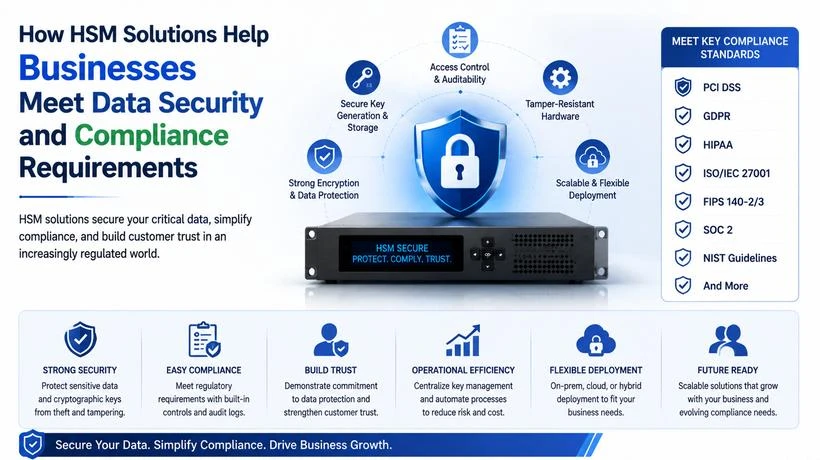
Businesses today face increasing challenges in protecting sensitive information while meeting strict data security and compliance requirements. HSM Solutions provides a secure foundation for managing encryption keys, protecting digital assets, and strengthening cybersecurity frameworks.
Introduction
Data security has become a major priority for organizations across industries. Businesses collect and process large volumes of sensitive information, including customer records, financial details, intellectual property, and confidential business data. As cyber threats continue to grow, protecting this information requires advanced security strategies beyond traditional passwords and firewalls.
Encryption is one of the most effective methods for securing digital information. However, encryption depends heavily on the protection of cryptographic keys. If attackers gain access to encryption keys, they can potentially bypass security measures and access protected data.
This makes proper Key management a critical part of every organization’s cybersecurity strategy. Businesses need secure methods to generate, store, control, and monitor encryption keys throughout their lifecycle.
HSM Solutions help organizations address these challenges by providing dedicated hardware-based security for cryptographic operations. By using HSM technology, businesses can strengthen data protection, improve compliance readiness, and create a more reliable security framework.
Understanding the Importance of Data Security and Compliance
Organizations today operate in a highly regulated digital environment. Governments and industry bodies have introduced strict security requirements to ensure businesses protect sensitive information.
Companies across sectors such as banking, healthcare, e-commerce, telecommunications, and government services must follow compliance standards related to:
- Data privacy protection
- Encryption management
- Secure authentication
- Financial transaction security
- Access control
- Audit requirements
Failing to meet these requirements can result in financial penalties, reputational damage, and loss of customer trust.
A strong security framework requires businesses to protect not only their data but also the encryption keys that secure that data. This is where key management in cryptography becomes essential.
What Is Key Management in Cryptography?
Key management in cryptography refers to the complete process of handling encryption keys throughout their lifecycle. This includes generating, storing, distributing, rotating, using, and securely removing cryptographic keys.
Effective key management ensures that encryption keys remain protected from unauthorized access and misuse.
A complete cryptographic key management process includes:
- Secure key generation
- Controlled key access
- Key rotation and renewal
- Key backup and recovery
- Key expiration management
- Secure key destruction
Without proper key management, organizations may face security vulnerabilities even when they use advanced encryption algorithms.
What Are HSM Modules?
HSM modules, or Hardware Security Modules, are specialized devices designed to protect cryptographic keys and perform sensitive security operations in a secure hardware environment.
Unlike software-based key storage systems, HSM modules provide physical protection against unauthorized access and tampering. They create a secure area where organizations can perform encryption, authentication, and digital signing operations.
HSM modules support various security functions, including:
- Encryption and decryption
- Cryptographic key generation
- Digital certificate management
- Digital signatures
- Secure authentication
- Payment processing security
By keeping cryptographic operations inside a protected hardware environment, HSM modules significantly reduce the risk of key exposure.
How HSM Solutions Improve Data Security
1. Secure Protection of Encryption Keys
Encryption keys are among the most valuable assets within any security system. If these keys are compromised, attackers may gain access to sensitive information.
HSM Solutions protect encryption keys by storing them inside secure hardware instead of regular servers or applications. This prevents unauthorized users and malicious software from accessing critical cryptographic materials.
2. Strong Access Control and Authentication
Organizations need strict controls to ensure only authorized users can access sensitive security functions.
HSM Solutions provide advanced access management features such as:
- Role-based permissions
- Multi-factor authentication
- User authorization controls
- Activity monitoring
These controls help businesses prevent unauthorized key usage and maintain better security governance.
3. Secure Cryptographic Operations
HSM modules perform encryption and other cryptographic processes directly within the hardware environment. This reduces the need to expose sensitive keys during operations.
For example, when an organization performs digital signing or encryption, the private keys remain protected inside the HSM while the device completes the required operation securely.
4. Automated Key Lifecycle Management
Managing thousands of encryption keys manually can create security risks and operational challenges.
HSM Solutions simplify the entire key lifecycle by helping organizations automate:
- Key creation
- Key distribution
- Key rotation
- Key storage
- Key retirement
Automation improves efficiency while reducing the possibility of human errors.
How HSM Solutions Support Compliance Requirements
Compliance regulations often require businesses to demonstrate strong encryption and security controls. HSM technology helps organizations meet these requirements by providing secure key management and detailed security monitoring.
Meeting Payment Security Standards
Financial organizations and payment providers handle extremely sensitive transaction data. HSM modules help secure payment environments by protecting payment keys and supporting secure transaction processing.
Supporting Data Privacy Regulations
Privacy regulations require businesses to protect personal information from unauthorized access. HSM Solutions help organizations secure encryption keys used for protecting customer and business data.
Improving Audit Readiness
Compliance audits require organizations to demonstrate how they manage security processes.
HSM Solutions provide detailed logs and monitoring capabilities that help businesses track cryptographic activities and maintain transparency.
The Role of Thales Key Management in Enterprise Security
Large enterprises often require advanced solutions to manage encryption keys across multiple systems and environments. Thales key management solutions help organizations centralize encryption control and improve security management.
Thales key management enables businesses to:
- Manage encryption keys across different platforms
- Improve visibility into key usage
- Strengthen compliance controls
- Simplify encryption management
- Protect sensitive enterprise data
By combining centralized key management with HSM technology, organizations can build a stronger and more scalable security architecture.
HSM Solutions for Cloud and Hybrid Environments
Modern businesses increasingly use cloud services to improve flexibility and scalability. However, cloud adoption also introduces new security challenges, especially around encryption key control.
HSM Solutions help businesses maintain ownership and control over their cryptographic keys while using cloud platforms.
They support security across:
- Public cloud environments
- Private cloud systems
- Hybrid infrastructures
- Multi-cloud applications
With HSM-based protection, organizations can secure sensitive information while taking advantage of modern cloud technologies.
Key Benefits of Implementing HSM Solutions
Enhanced Security Protection
HSM technology provides dedicated hardware protection that reduces the risk of encryption key theft.
Improved Compliance Management
Organizations can demonstrate stronger security practices through controlled access, auditing, and secure key management.
Reduced Operational Risks
Automated key management processes reduce manual errors and improve efficiency.
Better Customer Trust
Strong security practices help businesses build confidence among customers, partners, and stakeholders.
Scalable Security Infrastructure
HSM Solutions can support organizations as their data security requirements grow over time.
Best Practices for Implementing HSM-Based Security
To maximize the benefits of HSM technology, businesses should follow these practices:
Create a Clear Key Management Policy
Organizations should define how encryption keys are created, accessed, monitored, and retired.
Use Strong Access Controls
Businesses should limit access to cryptographic operations based on user roles and responsibilities.
Monitor Security Activities
Regular monitoring helps organizations identify suspicious activities and maintain compliance.
Plan for Backup and Recovery
Secure backup processes ensure organizations can recover critical keys when required.
Integrate HSMs With Existing Security Systems
HSM modules should work alongside identity management, security monitoring, and compliance solutions for complete protection.
Conclusion
As businesses face growing cybersecurity threats and stricter compliance requirements, protecting sensitive information has become more challenging than ever. Encryption provides strong protection, but effective encryption depends on secure key management.
HSM Solutions provide organizations with a reliable way to protect encryption keys, secure cryptographic operations, and meet industry security standards. Through advanced hardware protection, automated processes, and strong access controls, HSM modules help businesses build a stronger security framework.
By implementing effective key management in cryptography and adopting solutions such as Thales key management, organizations can improve data protection, simplify compliance efforts, and prepare for future security challenges.
A secure approach to Key management is no longer optional—it is an essential requirement for businesses that want to protect their digital assets and maintain trust in the modern technology landscape.


Comments
Login to Comment