From Clinical Development to Commercial Supply, Outsourcing Demand Is Expanding
22 Sep, 2026
7 Views 0 Like(s)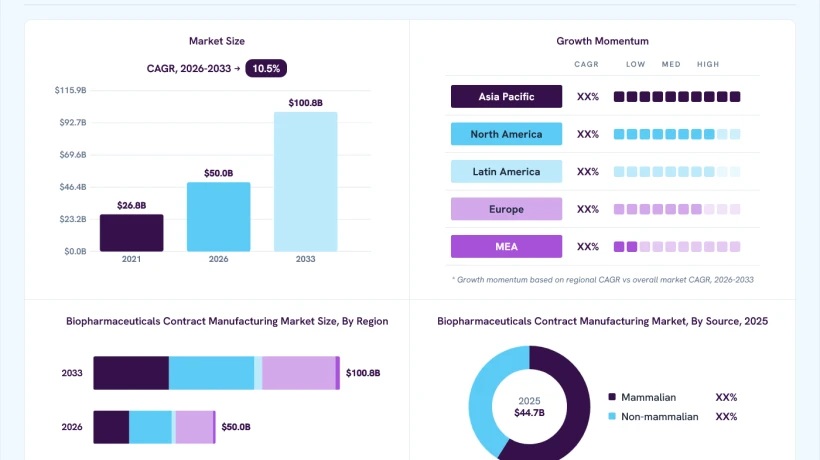
The global biopharmaceuticals contract manufacturing market size was valued at USD 44.7 billion in 2025 and is projected to grow from USD 50.0 billion in 2026 to USD 100.8 billion by 2033, at a CAGR of 10.5% from 2026 to 2033.
The Biopharmaceuticals Contract Manufacturing Market is expanding as pharmaceutical and biotechnology companies increasingly outsource complex biologics manufacturing to specialized contract development and manufacturing organizations. The market was valued at USD 44.7 billion in 2025 and is projected to grow from USD 50.0 billion in 2026 to USD 100.8 billion by 2033, registering a CAGR of 10.5% from 2026 to 2033. The expanding biologics pipeline, rising demand for monoclonal antibodies and biosimilars, increasing commercial manufacturing requirements, and continued investments in manufacturing capacity are supporting this expansion.
Market Growth and Outsourcing Demand
Biologic manufacturing involves specialized technologies, process development capabilities, quality systems, and stringent regulatory requirements. These complexities are encouraging pharmaceutical and biotechnology companies to partner with contract manufacturers that can provide established infrastructure and technical expertise.
Outsourcing is also gaining importance among emerging biotechnology companies with limited internal manufacturing capabilities. Contract manufacturers can provide integrated services spanning cell line development, process optimization, analytical testing, drug substance production, and commercial fill-and-finish. This allows companies to access specialized capabilities while supporting development and commercialization requirements.
The growing biologics pipeline remains an important source of demand. Monoclonal antibodies, recombinant proteins, vaccines, and other biologic products require specialized manufacturing platforms and regulatory-compliant facilities. Increasing numbers of biologic products advancing through clinical development are therefore generating demand across both clinical and commercial manufacturing stages.
Source and Service Landscape
The mammalian segment led the market by source, accounting for 58.9% of revenue in 2025. Mammalian cell expression systems, particularly Chinese hamster ovary cells, are widely used for monoclonal antibodies, recombinant proteins, and other complex biologics. The non-mammalian segment is projected to register the fastest CAGR during the forecast period, supported by demand for cost-effective manufacturing of recombinant proteins, vaccines, enzymes, plasmid DNA, and peptide therapeutics.
By service, process development held the largest revenue share of 34.7% in 2025. The increasing complexity of biologic production creates demand for process optimization, cell culture development, scale-up studies, and manufacturing validation. Analytical and QC studies are expected to register the fastest CAGR as regulatory requirements for biologic characterization, impurity profiling, comparability assessments, and stability testing increase.
Drug Type and Manufacturing Insights
Biologics represented the leading drug type, accounting for 78.1% of revenue in 2025. Commercialization of monoclonal antibodies, recombinant proteins, vaccines, and other biologic therapies continues to generate substantial demand for contract manufacturing services.
Biosimilars are projected to register the fastest CAGR during the forecast period. Patent expirations for high-value biologics, increasing regulatory approvals, and demand for affordable biologic therapies are encouraging further biosimilar development and commercialization.
By type, drug substance manufacturing accounted for 57.6% of revenue in 2025. Growing outsourcing of upstream and downstream manufacturing, cell culture production, purification, and process optimization supports the segment. Finished drug product is anticipated to register the fastest CAGR as pharmaceutical companies seek integrated formulation, aseptic fill-and-finish, packaging, and commercial supply capabilities.
Scale of Operation and Therapeutic Applications
Commercial operations led by scale of operation with a 75.1% revenue share in 2025. Increasing regulatory approvals, expanding commercial production volumes, and long-term manufacturing agreements are supporting demand for commercial-scale services. The clinical segment is projected to register the fastest CAGR as more biologics enter clinical development and biotechnology research activities expand.
On the therapeutic side, oncology accounted for 38.3% of revenue in 2025. Increasing cancer prevalence and growing approvals of monoclonal antibodies, antibody-drug conjugates, bispecific antibodies, and other targeted biologic therapies are supporting contract manufacturing demand. The autoimmune diseases segment is expected to register a significant CAGR, supported by increasing prevalence of autoimmune disorders and continued development of biologic therapies and biosimilars.
Regional Market Outlook
North America dominated the market with a 34.6% revenue share in 2025. A well-established biopharmaceutical industry, expanding biologics pipeline, advanced manufacturing infrastructure, and increasing outsourcing are supporting the region. Asia Pacific is expected to register the fastest growth during the forecast period, driven by expanding pharmaceutical manufacturing capacity, biotechnology investments, lower manufacturing costs, and supportive government initiatives.
Europe is supported by its mature pharmaceutical industry, biologics development, advanced manufacturing infrastructure, and stringent regulatory standards. Latin America is experiencing gradual growth through increasing pharmaceutical manufacturing activities, improving healthcare infrastructure, and rising demand for biosimilars. Middle East and Africa are gradually expanding as healthcare investments, pharmaceutical manufacturing, and demand for biologic therapies increase.
Technology, Investment, and Competitive Landscape
Technological advancements are reshaping contract manufacturing through advanced bioprocessing technologies, single-use manufacturing systems, continuous bioprocessing, automation, and digital manufacturing platforms. Digital monitoring and automated systems are helping improve process consistency, manufacturing efficiency, and operational flexibility.
FAQ
How big is the biopharmaceuticals contract manufacturing market?
The market was valued at USD 44.7 billion in 2025, is projected to reach USD 50.0 billion in 2026, and is forecast to reach USD 100.8 billion by 2033, growing at a CAGR of 10.5% from 2026 to 2033.
What trends are shaping the biopharmaceuticals contract manufacturing market?
The market is being shaped by increasing outsourcing, an expanding biologics pipeline, biosimilar commercialization, advanced bioprocessing technologies, automation, integrated manufacturing services, capacity expansion, and growing demand for specialized biologics manufacturing capabilities.
Key Biopharmaceuticals Contract Manufacturing Companies:
· Boehringer Ingelheim GmbH
· Lonza
· Inno Biologics Sdn Bhd
· Rentschler Biotechnologie GmbH
About us:
Grand View Research, a market research and consulting company, provides syndicated research reports, customized research reports, and consulting services. Grand View Research database is used by the world's renowned academic institutions and Fortune 500 companies to understand the global and regional business environment. Our database features thousands of statistics and in-depth analysis on 46 industries in 25 major countries worldwide.

Comments
Login to Comment