Enhancing Medico-Regulatory Writing with Artificial Intelligence
06 Jul, 2026
1088 Views 0 Like(s)
Medico-regulatory writing plays a vital role within regulatory affairs in the pharmaceutical and life sciences sectors.
Medico-regulatory writing plays a vital role within regulatory affairs in the pharmaceutical and life sciences sectors. As regulatory requirements become increasingly stringent and dynamic, there is a growing emphasis on integrating accurate and up-to-date medical data into regulatory submissions. Ensuring this precision is essential not only for gaining timely approvals but also for minimizing the risk of application rejections. However, the task of processing vast amounts of unstructured data and converting it into well-organized, submission-ready formats remains both time-consuming and labor-intensive, often resulting in delays.
With the ongoing adoption of artificial intelligence (AI) and automation across industries, Medical Writing Services is also evolving. These technologies are being utilized to streamline processes and accelerate output generation. AI and machine learning (ML) have already demonstrated significant value in areas such as patient recruitment, clinical data analysis, and protocol design. In the context of medical writing, AI offers solutions to longstanding challenges like peer review inefficiencies, bias, lack of transparency, plagiarism, and poor reporting. Automation-enhanced AI tools can also help ensure that regulatory documents meet the required formats and compliance standards .
Revolutionizing Medical Writing with NLP and NLG
Natural Language Processing (NLP), a subset of AI, enables machines to understand and interpret human language. Natural Language Generation (NLG) allows computers to produce coherent text from raw, unstructured data. Together, these technologies have shown promise in healthcare settings, including early detection of chronic diseases and improved outcome predictions . Their integration into medico-regulatory writing holds the potential to transform the field entirely.
Through NLP, information is automatically extracted and analyzed from both structured and unstructured sources. This content is then classified and organized contextually, culminating in the creation of structured data clusters. NLG then takes over, generating clear, comprehensive reports from this structured information. The result is a dynamic, reusable repository of medical content tailored to the needs of diverse regulatory stakeholders.
Currently, medical writers manually gather data from multiple, often unstructured, sources—a process that is not only tedious but also prone to delays. After drafting the document, it typically undergoes several review stages before it is finalized. Depending on the document\’s complexity, additional reviews may be required. By leveraging NLP and NLG technologies, this traditional workflow can be significantly streamlined. AI tools can generate an initial draft automatically, conduct automated reviews, and produce a final version ready for submission. This approach reduces manual effort, shortens timelines, and facilitates faster market access for new pharmaceutical products.
What Exactly is Pharmacovigilance?
The term is derived from the Greek pharmakon (drug) and the Latin vigilare (to keep watch). According to the World Health Organization (WHO), it is defined as:
“The science and activities relating to the detection, assessment, understanding, and prevention of adverse effects or any other drug-related problem.”
In simpler terms, it’s the long-term monitoring of a medicine’s behavior in the real world. While clinical trials are rigorous, they often involve a limited number of people under controlled conditions. PV steps in once a drug hits the market and is used by millions of people with different genetics, lifestyles, and existing health conditions.
The Pharmacovigilance Process
The lifecycle of drug safety follows a continuous loop. Here is how it typically works:
- Detection (Signal Management): Identifying a potential new side effect or a change in a known side effect.
- Assessment: Using data science and medical expertise to determine if the drug actually caused the reaction (causality).
- Understanding: Researching why the reaction happened. Is it a dosage issue? A drug-to-drug interaction?
- Prevention: Taking action to minimize risk. This could involve updating the warning label, changing the recommended dose, or, in rare cases, withdrawing the drug from the market.
Key Terminology Every Patient Should Know
To navigate the world of PV, it helps to know the lingo:
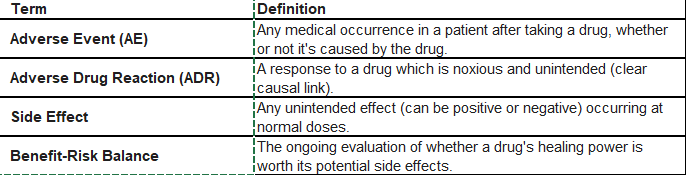
Pharmacovigilance is the reason we have trust in our healthcare systems. Without it, we wouldn’t have discovered that certain popular painkillers increased heart attack risks or that some antibiotics shouldn’t be mixed with common juice types.
For More Information Read out blog -: https://resource.ddregpharma.com/blogs/enhancing-medico-regulatory-writing-with-artificial-intelligence/
To get the daily updates, follow us on:
Facebook — https://www.facebook.com/DDReg
LinkedIn — https://www.linkedin.com/company/ddregpharma/
Twitter — https://x.com/DDRegPharma
Instagram — https://www.instagram.com/ddreg.pharma/



Comments
Login to Comment