Email Evidence in Legal Disputes: How Lawyers Can Test Authenticity Before Trusting a Message
23 Oct, 2026
10 Views 0 Like(s)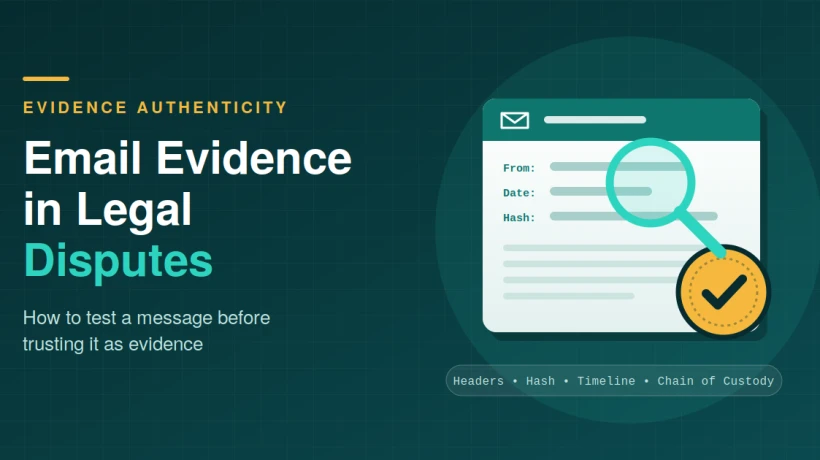
Learn how to test email evidence before trusting it: check headers, SPF, DKIM and DMARC, preserve originals, verify hashes and timelines, and read forensic reports with a critical eye.
Emails often decide disputes. They record promises, approvals, complaints, and denials, and each side tends to treat its own copies as the truth. Yet a printed email proves very little by itself. Lawyers who understand how email evidence is collected, tested, and explained are better placed to build a strong argument or challenge a weak one. This guide covers the practical points that matter most before an email is relied on in a legal matter.
Why a Printout Is Not Enough
A printed or forwarded email shows only the visible surface: a sender name, a date, and some text. It hides the technical fields, routing records, and mailbox context that help show where the message came from and whether it was altered. Screenshots are weaker still, since they are easy to edit and carry no underlying data.
To weigh email evidence properly, start with what is email forensics, the practice of collecting, preserving, examining, and explaining email data so that conclusions rest on verifiable material. A lawyer does not need to run the technical analysis personally, but knowing what an examiner can and cannot establish makes it easier to ask sharper questions and spot overstated claims.
The Questions Courts Tend to Ask
Rules differ between jurisdictions, so local law always governs. Even so, most disputes about email evidence circle around a handful of questions:
-
Is the message authentic, meaning is it what the party says it is?
-
Is it relevant to an issue actually in dispute?
-
Has it stayed intact since it was collected?
-
Can the collection method and handling be explained and documented?
-
Who is the source, and how did the message reach the party presenting it?
A forensic report can support answers to these questions, but it does not decide admissibility. Admissibility depends on applicable law, the circumstances of the case, and the quality of documentation.
What Makes an Email Authentic?
Authenticity is rarely proved by one fact. It builds from several pieces of evidence pointing the same way.
Headers and Routing Records
Every email carries technical headers, and the servers that handle it add routing entries along the way. The structure follows RFC 5322. Examiners read these entries to see which systems touched the message and in what order. The visible From line is just text the sender chose, so it can be forged. Entries added by trusted servers deserve more weight than anything the sender typed.
Authentication Results
SPF, DKIM, and DMARC help show whether a message is linked to the domain it claims. SPF checks whether the sending server is authorized, DKIM checks a digital signature on parts of the message, and DMARC checks whether the visible From domain aligns with the authenticated one. A failure may suggest spoofing. A pass, however, does not prove who personally wrote the message, because a compromised account or look-alike domain can satisfy every check.
Corroborating Records
Strong cases rarely rest on a single copy. Matching versions in the sender’s and recipient’s mailboxes, server logs, backups, and related correspondence all help confirm a message. If the only copy comes from one interested party, expect that fact to be tested.
Preservation: Where Many Cases Are Won or Lost
How evidence is gathered can matter as much as what it says. Poor handling creates doubt that no technical argument can remove.
Good practice includes keeping the original source untouched, working from a controlled forensic copy, and calculating a cryptographic hash such as SHA-256. A matching hash shows the data has not changed between checks. It does not prove the message was genuine before collection, and lawyers should resist claims that say otherwise.
A chain-of-custody record should show who received, handled, transferred, and examined the evidence, along with dates, times, tools, and results. Gaps in this record are exactly what opposing counsel looks for.
Forwarding a message to a lawyer, or saving it into a new folder, can rewrite headers and strip detail. Ask clients to preserve the original in its native form, such as an EML or MSG file, and to avoid tidying up their mailboxes once a dispute is likely.
Timestamps and Sequence of Events
Many disputes turn on who knew what and when. Timestamps are therefore central, but they need care. A message may show one time while a server records another. The difference can come from time zones, processing delays, or a device clock set incorrectly, or it may call for deeper review.
A careful examiner records the original times, accounts for time zones, and explains the reasoning used to reconstruct the sequence. Lawyers should ask to see that reasoning rather than accept a timeline stated without support.
Attachments, Metadata, and Images
Attachments can matter more than the email body. A contract draft may reveal an author and revision history, and an invoice may show altered figures. Metadata should be handled cautiously, because it may be missing, stripped during export, edited, or generated by software that does not reflect the event in question.
Optical Character Recognition (OCR) can turn text inside image attachments into searchable characters, which helps locate a scanned document buried in a large mailbox. OCR only reads the text. It does not show where or when a photograph was taken. Location questions need separate steps, such as reviewing embedded GPS data when present, or treating signs and landmarks as leads that still need verification.
Deleted Messages and Missing Emails
Disputes frequently involve emails that one side says never existed or no longer exists. Deleted messages can sometimes be recovered from mailbox files, forensic images, backups, or authorized server-side sources. Recovery is never guaranteed, and it depends on the storage format, how the deletion happened, and what backups were kept.
Deleting a message from one inbox does not necessarily remove every copy from every system. When recovered data is presented, it should be labeled as recovered, its source should be documented, and any uncertainty about completeness should be stated plainly.
Reading a Forensic Report Critically
Lawyers receive reports from their own experts and from the other side. A useful report states its scope, source data, methods, findings, and limitations. It separates direct observation from interpretation. For instance, “the Return-Path domain differs from the From domain” is an observation, while “the sender impersonated the vendor” is an inference that needs support.
Watch for conclusions that go further than the evidence allows. An IP address does not identify a person or a physical location. A sender address does not prove authorship. A search hit is a lead, not a conclusion. A report that admits its limits is generally more credible than one that claims certainty.
Working at Scale
Commercial disputes can involve enormous volumes of email spread across cloud mailboxes, PST and OST files, archives, and backups. Reviewing these manually is slow and increases the risk of missing something important. Many legal and investigative teams use Email Forensics Software to organize mailbox data, search across fields and attachments, and surface relevant communications for review and reporting.
When evaluating any tool, check that it supports the evidence formats in your matter, keeps original data intact, and produces output that can be explained to a judge or opposing expert.
A Practical Checklist for Lawyers
Before relying on an email, consider these points:
-
Do we have the native file, or only a printout?
-
Who collected it, when, and how?
-
Is there a hash value and a chain-of-custody record?
-
Do headers and authentication results support the claimed origin?
-
Do other records corroborate the message and its timing?
-
Has the report distinguished facts from interpretation?
-
Are the limits of the evidence clearly stated?
Final Thoughts
Email evidence can be persuasive, but only when its origin, integrity, and context can be explained. Treat every message as a starting point: preserve the original, test it against independent records, and be honest about what remains uncertain. Lawyers who ask these questions early build stronger positions and are far less likely to be surprised by a challenge to their own evidence.
Frequently Asked Questions
Q: Is a screenshot of an email acceptable evidence?
It depends on the jurisdiction and the circumstances, but a screenshot is generally weaker than a native file with headers, since it is easy to alter and lacks underlying data.
Q: Does a matching hash prove an email is genuine?
No. It shows the data has not changed since the hash was calculated, but it cannot prove the message was authentic before collection.
Q: Can a forensic report guarantee admissibility?
No. Admissibility depends on applicable law, authenticity, relevance, integrity, collection method, documentation, and the facts of the case.



Comments
Login to Comment