Degree Worth Lakhs, Salary Worth Thousands: A Package of Rs 5 Lakh Has Become a Dream for 73% of Students
05 May, 2026
1843 Views 0 Like(s)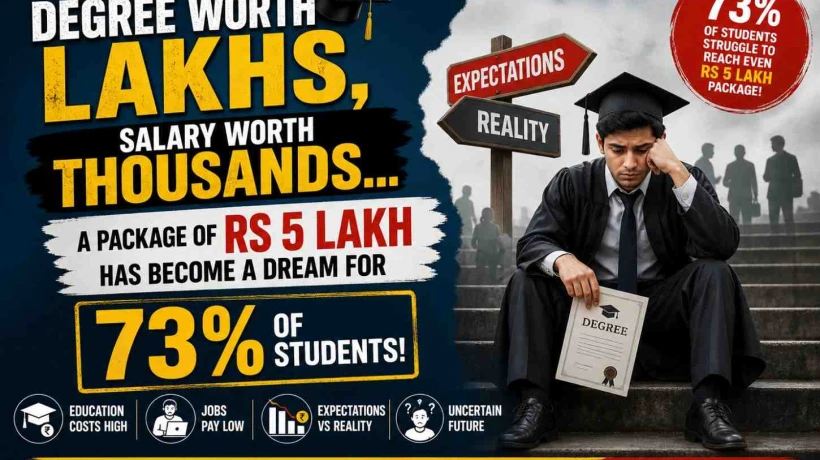
Degree Worth Lakhs, Salary Worth Thousands: A Package of Rs 5 Lakh Has Become a Dream for 73% of Students
Higher education in India is becoming increasingly expensive, but the return on investment is not always matching expectations. Thousands of students spend lakhs of rupees on engineering, management, medical, and professional courses with hopes of securing a stable and high-paying job. However, recent placement trends reveal a worrying reality — for nearly 73% of students, even a salary package of Rs 5 lakh per annum has become difficult to achieve.
The gap between education costs and salary expectations is widening rapidly. While tuition fees continue to rise in private colleges and universities, job opportunities with attractive salary packages are becoming limited, especially for fresh graduates entering the workforce.
Rising Cost of Education
Over the last decade, the cost of higher education in India has increased significantly. Engineering degrees from private institutions often cost between Rs 8 lakh and Rs 20 lakh. MBA programs can cost even more, with some institutions charging upwards of Rs 25 lakh for a two-year course. Students and families frequently rely on education loans to finance these dreams.
For many middle-class households, education is considered an investment in a secure future. Parents expect that once students graduate, they will secure jobs capable of repaying loans and supporting financial stability. Unfortunately, the reality is proving more challenging.
Why Rs 5 Lakh Packages Are Hard to Get
Industry experts point to several reasons behind the declining number of decent entry-level salary offers.
1. Skill Gap Among Graduates
One of the biggest concerns is the mismatch between academic learning and industry requirements. Many graduates possess theoretical knowledge but lack practical skills, communication abilities, and real-world problem-solving experience.
Companies today prefer candidates who can contribute immediately. Employers increasingly focus on digital skills, AI tools, coding proficiency, analytical thinking, and adaptability. Students without updated skills often struggle during placement interviews.
2. Oversupply of Graduates
India produces millions of graduates every year. However, the number of quality jobs is not growing at the same pace. This imbalance has created intense competition in the job market.
Recruiters now have access to a large talent pool, allowing them to offer lower starting salaries. As a result, many students settle for packages ranging between Rs 2.5 lakh and Rs 4 lakh annually.
3. Economic Uncertainty
Global economic slowdown, layoffs in the technology sector, and cautious hiring practices have also affected campus placements. Many companies are reducing hiring budgets or delaying recruitment plans.
Several IT firms that once offered attractive packages to freshers are now focusing on cost optimization. This has impacted salary growth for entry-level employees across industries.
4. Automation and AI Impact
The rise of automation and artificial intelligence is reshaping the employment landscape. Routine tasks are increasingly being handled by software and AI systems, reducing the demand for traditional entry-level roles.
Companies are now looking for candidates with specialized expertise rather than generic degrees. Students who fail to adapt to evolving industry trends risk falling behind.
Student Frustration Growing
Many graduates today feel disappointed after completing expensive courses and receiving limited salary offers. Social media platforms are filled with discussions about unemployment, underemployment, and placement struggles.
Students from smaller towns and middle-income families face additional pressure because they often take education loans expecting a quick financial recovery after graduation. When salaries remain low, loan repayment becomes stressful.
Some graduates even choose to prepare for government exams or pursue additional certifications because they are unable to find suitable private-sector jobs.
Importance of Skill-Based Learning
Experts believe the solution lies in shifting focus from degrees alone to skill-based education. Employers now value practical expertise, internships, certifications, and project experience more than academic marks.
Students who invest time in learning in-demand skills such as:
- Artificial Intelligence
- Data Analytics
- Cybersecurity
- Digital Marketing
- Cloud Computing
- UI/UX Design
- Financial Analysis
often have better chances of securing higher salary packages.
Internships and industry exposure during college also play a major role in improving employability.
Need for Educational Reform
Education experts argue that colleges and universities must update their curriculum regularly to match industry needs. Collaboration between educational institutions and companies can help students gain real-world exposure before graduation.
Career counseling, entrepreneurship support, and practical training should become an essential part of higher education. Simply earning a degree is no longer enough in today’s competitive environment.
Students Adapting to New Reality
Despite the challenges, many students are finding alternative paths to success. Freelancing, remote work, startups, and online businesses are emerging as attractive career options for young professionals.
Platforms offering online courses and certifications are helping students learn new skills at affordable costs. Many graduates are now focusing on continuous learning rather than depending solely on traditional college education.
Conclusion
The dream of securing a high-paying job immediately after graduation is becoming increasingly difficult for a large section of Indian students. With education costs touching lakhs and average salary packages remaining modest, concerns about employability and financial stability are growing.
However, the changing job market also presents opportunities for students willing to adapt, upgrade skills, and embrace new technologies. In the coming years, success may depend less on the value of a degree and more on the value of practical knowledge, innovation, and continuous learning.
Comments
Login to Comment