Chain of Custody in the Cloud Era: How to Keep Email Evidence Defensible
26 Aug, 2026
543 Views 0 Like(s)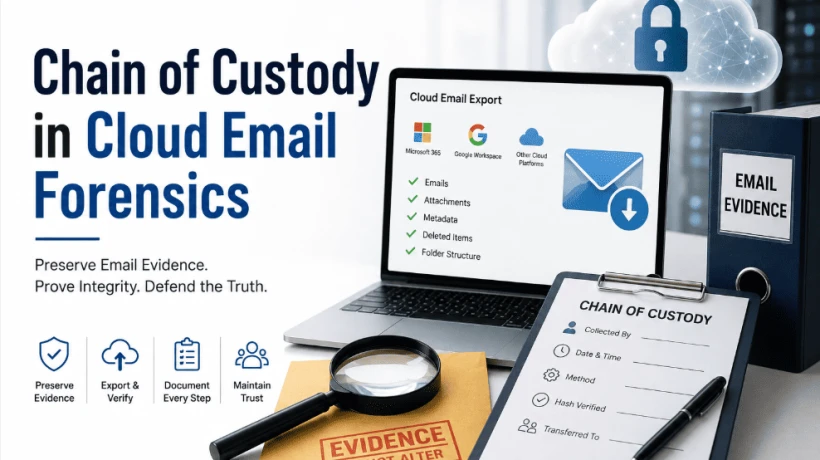
Cloud email evidence is only as strong as the process behind it. Learn how to build a defensible chain of custody for Office 365 mailbox data in investigations.
Digital investigations live or die on one principle: evidence is only as good as the process behind it. A perfectly relevant email means nothing to a court, a regulator, or an internal review board if nobody can prove where it came from, how it was collected, or whether it was altered along the way. That principle — chain of custody — has existed since the earliest days of forensic science, but the cloud has made it considerably harder to uphold.
Two decades ago, email lived on physical servers that organizations controlled directly. An IT administrator could pull a hard drive, image it, and hand it to an investigator with a clear, documentable path from source to evidence file. Today, that same email might live on shared infrastructure spread across multiple data centers, governed by a cloud provider's own access policies, retention rules, and administrative permissions. The evidence is just as real, but the path to preserving it defensibly is far less direct.
Why Chain of Custody Still Matters When Nothing Is Physical
It's tempting to think that chain of custody is a concept built for physical evidence — fingerprints, hard drives, seized devices — and less relevant once everything is digital. In reality, the opposite is true. Digital evidence is inherently easier to alter, and often without leaving obvious traces, which makes the documentation trail around it even more important than it was for physical items.
For cloud-based email specifically, three factors make chain of custody especially delicate:
-
Shared responsibility. The organization doesn't fully control the infrastructure the data lives on, which means preservation depends partly on how quickly and correctly an admin, investigator, or IT team acts within the tools the platform provides.
-
Silent changes. Retention policies, auto-deletion rules, and account deprovisioning can quietly remove data in the background, sometimes without anyone realizing evidence has been lost until it's too late.
-
Multiple hands. Between legal, IT, and outside forensic examiners, a piece of email evidence often passes through several people before it reaches a courtroom or a final report. Each handoff is a point where the chain can break if it isn't documented properly.
None of this means cloud evidence is less trustworthy by nature. It simply means the process around collecting it has to be more deliberate.
Building a Defensible Preservation Workflow
A strong chain of custody for cloud email generally follows a consistent structure, regardless of which platform the data originates from.
1. Identify and lock down the source early. As soon as an investigation begins, the relevant accounts should be placed on hold where possible, and access should be restricted to only those who need it. This limits the window in which data could be altered, whether accidentally or deliberately.
2. Export using a repeatable, documented method. Whether the team is working through admin consoles, scripting, or a dedicated platform, the export process itself needs to be consistent and recorded. This is exactly the kind of process outlined in guides such as Export Office 365 Mailbox to PST, which walks through the practical steps of pulling mailbox content out of a cloud environment and into a portable, reviewable format — a foundational step that everything downstream depends on.
3. Generate and record a verification hash immediately. The moment an export completes, a cryptographic hash should be generated and logged. This single value becomes the anchor point for proving, at any later stage, that the file being reviewed is identical to the one originally collected.
4. Log every access and transfer. Every time the evidence file is opened, copied, or moved — whether between team members, storage locations, or review platforms — that action should be documented with a timestamp and the name of the person responsible.
5. Keep analysis separate from the original. Investigators should always work from a copy, never the original preserved file, so that the source evidence remains untouched no matter how extensive the analysis becomes.
Where Manual Processes Tend to Break Down
Most organizations start out managing chain of custody with a mix of spreadsheets, email threads, and manual export steps. This can work for a single mailbox and a short timeline, but it becomes fragile quickly once a case grows — additional custodians get added, date ranges expand, or the matter drags on for months.
The common failure points look similar across cases:
-
Hashes generated inconsistently, or not at all, for some custodians
-
Export settings that differ slightly between team members, creating inconsistent datasets
-
No centralized log of who accessed which file and when
-
Manual re-exports needed later because the first pass missed folders, attachments, or metadata
Each of these gaps might seem minor in the moment, but any one of them can become the basis for a legal challenge to the evidence's admissibility.
How Purpose-Built Platforms Close the Gap
This is where dedicated Email Forensics Software earns its place in an investigator's toolkit. Rather than relying on a patchwork of manual steps and separate logging tools, purpose-built platforms are designed to keep acquisition, verification, and documentation tied together in a single workflow. Hashes are generated automatically as part of the export, access logs are built into the platform rather than tracked externally, and multiple custodians can be processed under identical settings — removing the inconsistency that so often undermines manual efforts.
For teams handling recurring investigations, or cases involving several custodians at once, this consistency isn't just a convenience. It's often the difference between evidence that survives cross-examination and evidence that becomes a liability.
Practical Recommendations for Teams Handling Cloud Evidence
A few habits consistently separate well-run investigations from ones that run into trouble later:
-
Treat preservation as step one, not step three. Waiting until an investigation is well underway to think about evidence integrity almost always means some data has already been lost or altered.
-
Standardize the export process across the team. Everyone involved should follow the same documented steps, regardless of who is performing the export.
-
Never skip hash verification, even for "obvious" or low-priority mailboxes. Cases evolve, and a mailbox that seems irrelevant today can become central to the investigation later.
-
Centralize documentation. A single, shared log of custody events is far more defensible than scattered notes across different tools or people.
-
Review the chain before presenting findings. Before any report or evidence file is shared externally, walk back through the documented chain to confirm there are no gaps.
What Courts and Regulators Actually Look For
When cloud email evidence eventually lands in front of a judge, opposing counsel, or a regulatory body, the questions asked rarely focus on the content of the messages alone. Far more often, scrutiny centers on the process behind the collection itself. Reviewers want to know when the data was collected, by whom, using what method, and whether anything could have changed between collection and presentation.
This is why documentation carries as much weight as the evidence itself. A well-preserved mailbox with no accompanying record of how it was obtained is a far weaker asset than a smaller dataset backed by clear, timestamped documentation of every step. Investigators who treat documentation as an afterthought often find themselves unable to answer basic questions during cross-examination — not because the underlying evidence was flawed, but because the process around it wasn't recorded well enough to defend.
Regulators in particular tend to focus on consistency across custodians. If ten employees' mailboxes were collected as part of the same investigation, reviewers will often check whether the same method, filters, and verification steps were applied to all ten. Any deviation raises questions about whether some evidence was handled with less rigor than the rest, even if that wasn't the intent.
Final Thoughts
Chain of custody was never just a legal formality — it's the mechanism that turns raw data into evidence anyone can trust. As more organizations move their communication entirely into cloud platforms, the discipline required to maintain that trust has to grow alongside the technology. The tools and specific steps may differ from one case to the next, but the underlying goal stays the same: collect the data correctly, verify it immediately, document every step, and never give anyone a reason to question whether what's being reviewed is exactly what was originally found.

Comments
Login to Comment