AI Agent Security: Protecting Enterprise Data Securely
27 Aug, 2026
499 Views 0 Like(s)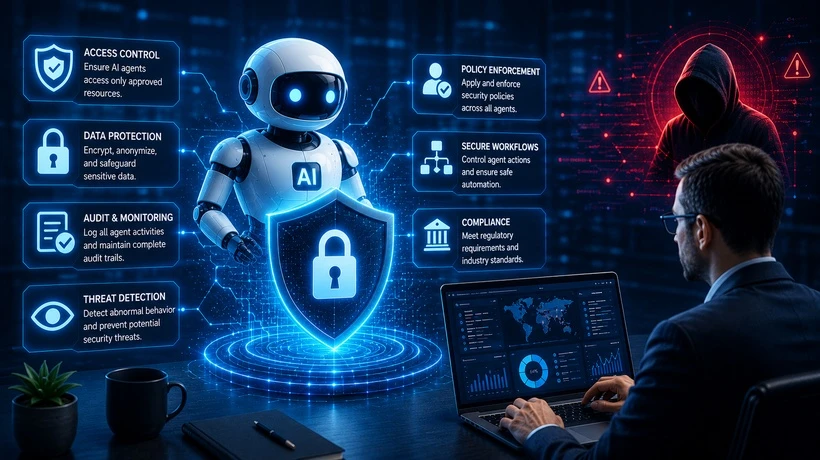
Learn how AI Agent Security protects enterprise data from unauthorized access, prompt injection, and agent risks with privacy-first solutions from Questa AI. 820x460px
Artificial intelligence is moving from simple productivity tools to systems capable of taking actions on behalf of businesses. AI agents can retrieve information, communicate with applications, analyze documents, update records, and automate complex workflows. This creates significant opportunities for enterprises, but it also introduces a new category of security risks.
As organizations give AI agents access to business applications and sensitive information, AI Agent Security becomes an important part of enterprise cybersecurity. The challenge is no longer only about protecting an AI model. Businesses must also control what an AI agent can access, what actions it can perform, and how those actions are monitored.
The growing use of autonomous AI makes data protection, access management, and governance increasingly important.
Why AI Agents Create New Security Risks
Traditional software generally follows predefined instructions. AI agents can interpret information, make decisions, select tools, and execute multiple actions as part of a single workflow.
This flexibility makes agents useful, but it also makes their behavior more difficult to predict.
An enterprise AI agent might connect to a customer relationship management system, internal knowledge base, financial database, cloud storage platform, or external API. If the agent receives excessive permissions, an error or malicious instruction could expose information beyond the original task.
The security challenge therefore extends beyond the AI model itself. Organizations must protect the entire workflow surrounding the agent.
Protecting Enterprise Data From AI Exposure
Enterprise data can include customer information, financial records, employee details, intellectual property, contracts, source code, and confidential business strategies.
When AI agents interact with this information, organizations need to establish clear boundaries.
An agent should receive only the information necessary for the task it is performing. Sensitive information should not automatically become available simply because an agent has technical access to a particular system.
Data classification and access controls can help organizations determine which information an AI agent is allowed to retrieve and process.
Privacy technologies such as anonymization can provide another layer of protection by reducing the amount of identifiable information exposed during AI processing.
The Importance of Least-Privilege Access
Least-privilege access is one of the most important principles for securing AI agents.
An AI agent designed to summarize customer support requests does not necessarily need access to financial systems, employee records, or confidential legal documents.
Giving every agent broad permissions creates unnecessary risk. If an agent is manipulated, compromised, or incorrectly configured, those permissions can increase the potential impact.
Organizations should therefore design agent permissions around specific business tasks.
Temporary access can also be useful for sensitive operations. Once a task is completed, unnecessary permissions should be removed rather than remaining active indefinitely.
Prompt Injection Can Become an Action Risk
Prompt injection is particularly concerning for AI agents because agents can take actions rather than simply generate text.
A malicious instruction can be hidden inside an email, document, webpage, or other information that an agent retrieves during a workflow. If the agent interprets that instruction as trusted guidance, it could potentially perform an unintended action.
For a standard chatbot, this may result in an incorrect response. For an AI agent connected to enterprise systems, the consequences can be much greater.
The agent could potentially access unauthorized information, modify records, trigger workflows, or send information to an external service.
This makes prompt injection an important consideration when designing AI Agent Security controls.
Shadow AI Adds Another Layer of Risk
Organizations also need to consider Shadow AI.
Employees may use AI applications or create AI-powered workflows without informing security or IT teams. These tools can become connected to company information without going through normal security reviews.
The problem is not simply that an employee is using an AI application. The bigger concern is that the organization may not know what information the application can access or where that information is being processed.
Providing employees with secure and approved AI solutions can reduce the motivation to use unauthorized tools.
AI governance should make secure AI adoption practical rather than relying only on restrictions.
Monitoring AI Agent Activity
Visibility is essential when AI systems can perform actions independently.
Organizations should be able to understand which systems an AI agent accesses, what data it retrieves, which tools it uses, and what actions it performs.
Monitoring at the action level can provide much greater visibility than simply recording a user's initial prompt and the final AI response.
For example, security teams may need to know whether an agent accessed a database, called an external API, modified a business record, or triggered another automated workflow.
Detailed activity records can support both security investigations and compliance requirements.
AI Governance Should Continue After Deployment
AI governance should not end when an agent receives approval.
AI systems evolve. Models change, applications are updated, new data sources are connected, and employees may modify workflows.
A security assessment completed several months ago may not accurately represent the current risk of an AI agent.
Continuous reviews can help organizations identify changes in permissions, data access, integrations, and behavior.
This makes governance an ongoing process rather than a one-time approval exercise.
Protecting AI Agents With Privacy by Design
Privacy should be incorporated into AI workflows from the beginning.
Organizations should consider what information an agent needs before giving it access to sensitive systems. Data minimization can reduce unnecessary exposure, while anonymization can help protect personally identifiable information.
For businesses operating in regulated industries, these controls can be especially important.
A privacy-first architecture allows organizations to use AI without automatically exposing all available business information to every model or agent.
This is an important distinction between simply deploying AI and deploying AI responsibly.
How Questa AI Supports Secure AI Adoption
Businesses looking to strengthen AI Agent Security need technology that addresses both AI productivity and data protection.
Questa AI focuses on privacy-first enterprise AI, helping organizations protect sensitive information while using AI across business workflows.
Its approach includes secure data processing and anonymization capabilities designed to reduce unnecessary exposure of sensitive business information.
For enterprises adopting AI agents, privacy protection can work alongside access controls, governance, monitoring, and security policies.
This creates a stronger foundation for organizations that want to expand AI adoption without losing control over their data.
Questa AI's broader approach to enterprise AI emphasizes protecting sensitive information while enabling organizations to use AI more securely.
Human Oversight Still Matters
Greater AI autonomy does not mean removing humans from every workflow.
Some AI tasks may have limited consequences and can operate with minimal intervention. Other actions can have significant financial, legal, operational, or customer impact.
Organizations should identify which activities require human approval.
For example, an AI agent may be allowed to prepare a financial report but require human approval before submitting or publishing it. Similarly, an agent might recommend a customer action without being authorized to execute the final decision.
Risk-based human oversight creates a balance between automation and accountability.
Building a Strong AI Agent Security Strategy
A strong security strategy starts with visibility.
Organizations need to know how many AI agents are operating in their environment, who owns them, which systems they connect to, and what data they can access.
From there, businesses can establish appropriate permissions, monitor agent activity, test for prompt injection, protect sensitive data, and create clear governance policies.
Security teams should also regularly review third-party integrations and credentials associated with AI agents.
As organizations deploy more agents, these controls become increasingly important because a connected network of agents can create a larger potential attack surface.
Preparing for the Future of Enterprise AI
AI agents are likely to become more deeply integrated into everyday business operations.
Instead of using one AI assistant for a single task, enterprises may eventually operate networks of specialized agents that communicate with internal applications and with one another.
This could significantly improve productivity, but it also increases the importance of identity management, data protection, monitoring, and governance.
Organizations that establish strong security foundations now will be better positioned to scale AI responsibly.
The goal should not be to prevent AI agents from accessing business systems. The goal should be to make sure that access is controlled, observable, and aligned with business requirements.
Conclusion
AI agents can transform enterprise workflows, but their ability to access information and take autonomous actions creates new security challenges.
Effective AI Agent Security requires more than protecting the underlying model. Organizations need to control permissions, protect sensitive information, monitor agent activity, test for prompt injection, manage Shadow AI, and establish continuous governance.
Privacy should also remain central to the strategy.
With privacy-first solutions such as Questa AI, enterprises can take a more controlled approach to AI adoption while reducing unnecessary exposure of sensitive business data.
As AI agents become more capable, organizations that combine automation with security, privacy, and accountability will be better prepared to scale enterprise AI with confidence.
Disclaimer: ThynkTales is a public blogging platform where content is contributed by individual users. While we encourage thoughtful and accurate sharing, we do not independently verify the information provided. Readers are advised to use their discretion and verify any information before relying on it.

Comments
Login to Comment