7 Reasons to Choose Odoo Over Traditional ERP Systems
22 May, 2026
1668 Views 0 Like(s)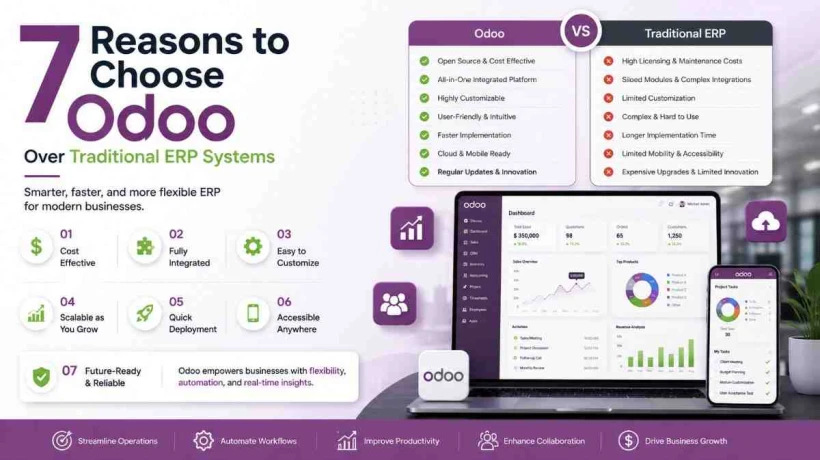
Discover why businesses choose Odoo vs Traditional ERP for better flexibility, lower costs, scalability, and easy business management.
Selecting an Enterprise Resource Planning (ERP) platform dictates a company's operational efficiency for decades. Surveys show that a majority of CIOs regard traditional legacy ERP systems as too rigid for modern business pivots. Additionally, studies indicate that 64% of traditional ERP implementation projects exceed their initial budgets significantly. Industry data reveals that the average implementation of an old-school ERP takes 14 to 18 months. This slow timeline stalls corporate growth.
Modern enterprises require agile, modular, and cost-effective software environments to survive. Traditional software suites burden companies with high licensing fees, closed ecosystems, and complex upgrade paths.
Deploying targeted Odoo ERP services resolves these fundamental structural IT issues. By utilizing professional Odoo Implementation Services, technical teams build flexible, integrated application networks. This technical analysis explores the seven primary reasons why modern businesses choose Odoo over legacy ERP architectures.
Technical Advantages Driving Modern ERP Selection
Enterprise organizations face distinct infrastructure choices when upgrading their business management software. Below are the seven primary technical and financial reasons why modern businesses choose Odoo over legacy ERP architectures.
1. Modular Architecture Prevents Code Bloat
Traditional ERP systems use a monolithic software structure. This means the entire database schema and application code are installed as a single massive unit. A business that only needs accounting must still host and manage code for manufacturing, shipping, and human resources. This monolithic design creates massive server overhead and slows system speeds.
Odoo relies on a completely modular app framework. The core system contains only basic security, user management, and base data structures.
-
On-Demand Apps: Developers install individual technical modules like account, sales, or stock as the business grows.
-
Isolated Footprints: Unused application code never enters the server environment. This isolation keeps your database light and fast.
-
Easy Upgrades: Technical teams modify single modules without risking the stability of unrelated system apps.
2. Open Source Model Maximizes Customization Freedom
Legacy ERP vendors protect their source code behind proprietary software locks. If an enterprise wants to change a database validation rule or build a custom dashboard view, it must hire the vendor's specialized engineers. This closed design creates vendor lock-in and raises IT maintenance expenses.
Odoo operates on an open-source core model. The system uses the Python programming language and a PostgreSQL database.
Because engineers have full access to the source code layer, they create custom modules using inheritance patterns. Developers write Python scripts that override core Object-Relational Mapping (ORM) methods safely. This access allows software architects to tailor the system to exact operational requirements.
3. Web-Native Stack Lowers Infrastructure Expenses
Many traditional ERP platforms rely on old desktop client applications. These systems require local installation on every corporate workstation. This setup demands high-end hardware and hours of manual device configuration by IT support staff.
Odoo uses a modern, web-native software architecture. The backend engine runs on a Linux server environment, while the frontend displays using standard HTML5, CSS3, and JavaScript frameworks.
Users access their operational workspaces via any secure web browser on laptops, tablets, or mobile devices. This web‑centric build often reduces enterprise hardware deployment expenses by up to around 60% in many organizations.
4. Double-Entry Tracking Simplifies Inventory Controls
Standard inventory systems track stock balances using simple plus and minus quantity counts. When a warehouse worker moves an item, the system increments one column and decrements another. This method masks inventory discrepancies and leaves data tracking gaps.
Odoo applies a unique double-entry bookkeeping logic to warehouse management. Stock moves do not create or destroy products. Instead, items transfer between distinct physical, virtual, or partner locations.
-
Virtual Locations: Tracks items sitting in transit, inventory loss zones, or production lines.
-
Complete Trail: Every single product move leaves a permanent database audit record.
-
Easy Reconciliation: Warehouse managers trace inventory discrepancies back to specific operations instantly.
5. Unified APIs Ease Third-Party Integration Tasks
Connecting traditional ERP software to modern e-commerce storefronts or external shipping APIs requires complex middleware. Monolithic platforms lack flexible API endpoints, forcing developers to write heavy, custom SQL bridge scripts.
Odoo contains native, built-in external communication protocols. The platform offers comprehensive JSON-RPC and XML-RPC interfaces right out of the box.
Every custom field and standard database object exposes itself through these secure API access routes automatically. This data visibility allows software developers to integrate external tools like Salesforce, Shopify, Hubspot, or FedEx inside short development cycles.
6. Transparent Pricing Structures Cut Licensing Expenses
Traditional ERP licensing involves convoluted, hidden fee structures. Companies pay per user, per module, and per database record volume. Annual vendor maintenance audits can trigger unexpected multi-thousand-dollar compliance fines.
|
Cost Component |
Traditional Legacy ERP |
Odoo Enterprise Framework |
|
Licensing Fee Basis |
Complex tier systems per user and app |
Flat single fee gives access to all apps |
|
Database Server Costs |
High proprietary license expenses |
Zero open-source database fees |
|
Development Sandboxes |
Extra fees are charged for staging testing servers |
Unlimited free local staging options |
Odoo Enterprise uses a transparent, flat user pricing structure. One subscription fee grants an organization access to every single official app in the catalog. This commercial clarity allows corporate finance teams to project IT budgets accurately without fearing surprise audit penalties.
7. Fast Technical Development Speeds Time-to-Market
The monolithic code patterns of old ERP platforms slow down software innovation cycles. Adding a single custom data field requires hours of database schema modification and system compiling tasks.
Odoo development relies on modular XML views and clear Python data models. The platform's framework handles database table generation automatically based on your Python class definitions.
This automated object management reduces manual coding work. Development teams move features from initial design to live production servers in days rather than months.
Guidelines for Transitioning from Traditional ERP to Odoo
Shifting a company's data operations from a legacy platform to Odoo requires careful planning. System administrators must follow strict software engineering frameworks.
Step 1: Execute Complete Data Extraction and Cleanse
Do not import corrupt data into your new system. Extract your historical transaction logs from your legacy ERP database using structured SQL queries. Filter out duplicate customer profiles, remove dead product SKUs, and fix broken date string formats before starting any upload tasks.
Step 2: Establish Test Staging Environments
Configure isolated staging servers that mirror your live production hardware specifications precisely.
-
Deploy Test Scripts: Run your custom data transformation code inside the sandbox environment.
-
Verify Financial Matches: Compare trial balances between the old system and Odoo to ensure absolute numerical parity.
-
Run Stress Tests: Simulate maximum concurrent user logins to verify server responsiveness.
Step 3: Implement Continuous Deployment Workflows
Modern IT teams use Git repositories to manage the source code for their custom apps. Build automated continuous integration (CI) pipelines. These pipelines run syntax checks and automated Python unit tests every time a developer updates code components. This practice keeps bugs away from your production servers.
Developer Code Update ──► Automated Linting Engine ──► Unit Test Run ──► Safe Staging Push
Conclusion
Rigid software frameworks and high maintenance costs make traditional ERP platforms a liability for growing enterprises. Monolithic legacy systems slow operational speed, create data siloes, and drain corporate financial resources.
Transitioning to Odoo provides businesses with a modern, modular, web-native enterprise architecture. The platform's open-source design allows companies to customize the software to match their competitive operational workflows.
By executing a structured implementation path, companies cut hardware overhead, eliminate data fragmentation, and build a scalable digital foundation for long-term growth.



Comments
Login to Comment