10 Different Ways of Transportation
31 Oct, 2026
9 Views 0 Like(s)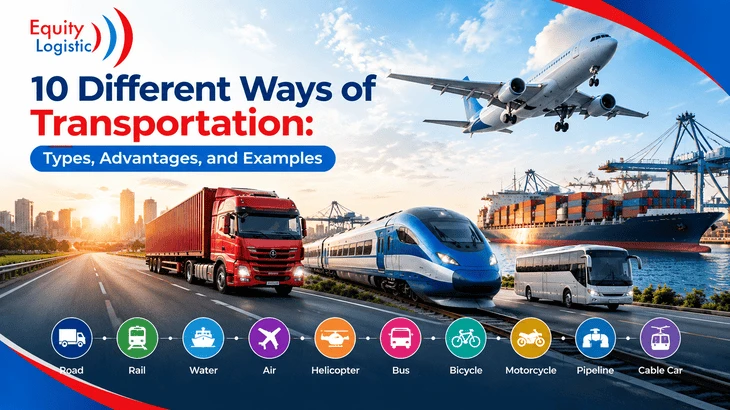
From a pedestrian on a footpath to a transformer crossing the country on a multi-axle trailer, the different ways of transportation each play a role in keeping people and goods moving. No single mode is best in every situation. Road gives flexibility, rail gives efficiency, sea gives scale, air gives speed, and specialist methods make the impossible possible.
Every product you've ever bought, every meal on your table and every journey you've ever taken depended on transportation. It's one of the quiet forces holding modern life together. And yet most people only think about it when something goes wrong: a delayed delivery, a cancelled flight, a road closed for repairs.
Understanding the different ways of transportation helps whether you're a student learning the basics, a business owner shipping goods, or a project manager planning the movement of heavy equipment. Each mode has its own strengths, costs, speeds and limits, and choosing well can save money, protect cargo and keep schedules on track.
In this guide, we break down 10 different ways of transportation, covering the types of transportation, their advantages, and real-world examples of each. We'll also look at how these modes work together in freight transportation, and how to pick the right one for your needs.
What Are the Main Ways of Transportation?
Transportation is the movement of people, animals or goods from one place to another. It's usually grouped by the medium it travels across: land, water or air, with a few specialised categories alongside them.
The different modes of transportation are commonly classified as:
-
Land transportation, which includes road, rail, pipeline, cable and non-motorised travel
-
Water transportation, which includes sea (ocean) and inland waterways
-
Air transportation, which covers passenger and cargo flights
-
Intermodal or multimodal transportation, which combines two or more modes in one journey
Below are the 10 ways of transportation we'll explore, each with its types, advantages and examples.
|
# |
Mode |
Best for |
Main strength |
Main limitation |
|
1 |
Road |
Door-to-door movement |
Flexibility |
Congestion and weight limits |
|
2 |
Rail |
Bulk goods, long distances |
Cost per tonne |
Fixed routes and timetables |
|
3 |
Sea |
International bulk and containers |
Huge capacity |
Slower transit times |
|
4 |
Inland waterways |
Heavy, low-value cargo |
Low cost and emissions |
Limited to navigable rivers |
|
5 |
Air |
Urgent, high-value goods |
Speed |
Higher cost |
|
6 |
Pipeline |
Liquids and gases |
Continuous, efficient flow |
Only suits specific products |
|
7 |
Cable and ropeway |
Steep or difficult terrain |
Reaches where roads can't |
Low capacity |
|
8 |
Intermodal |
Complex, long-haul freight |
Combines strengths of each mode |
Needs careful coordination |
|
9 |
Non-motorised |
Short trips, last mile |
Zero fuel, low cost |
Short range |
|
10 |
Specialised project and heavy cargo |
Oversized, high-value loads |
Engineered, tailored movement |
Needs expert planning |
1. Road Transportation
Road transportation is the most familiar way of moving people and goods. It covers everything from cars, buses and motorbikes to trucks, trailers and delivery vans, all running on highways, city streets and rural roads.
Types: passenger vehicles, public buses, taxis, light commercial vehicles, trucks, tankers, container carriers and multi-axle trailers.
Advantages:
-
Door-to-door service. Road is often the only mode that can collect from a warehouse and deliver straight to a customer or site.
-
Flexibility. Routes, timings and vehicle sizes can be adjusted quickly.
-
Wide reach. Roads connect towns, villages and industrial areas that other modes can't.
-
Lower setup cost for shippers. There's no need for specialised terminals for most consignments.
Examples: National highways and expressways carrying trucks between cities, city bus networks, and delivery fleets handling e-commerce parcels.
In freight transportation, the road is the backbone of domestic movement, especially for the first and last legs of a journey. Businesses often rely on dedicated domestic transport services to move goods reliably across regions, and on pan-India heavy transport for larger industrial loads.
2. Rail Transportation
Rail transportation moves people and goods on steel tracks. It's one of the most efficient ways of covering long distances over land, particularly for heavy and bulky cargo.
Types: passenger trains, high-speed rail, metro and suburban rail, freight trains, container trains and dedicated freight corridors.
Advantages:
-
High capacity. A single freight train can carry the load of many trucks.
-
Cost-effective over distance. Rail is typically economical for bulk goods like coal, cement, grain and steel.
-
Energy efficient. Moving large volumes by rail generally uses less fuel per tonne than road.
-
Reliable in most weather. Rail networks tend to be less affected by traffic congestion.
Examples: Indian Railways' passenger and freight services, metro systems in major cities, and dedicated freight corridors designed to speed up goods movement.
The main limitation is that rail runs on fixed routes and timetables. Goods still usually need a truck at each end, which is why rail pairs so well with road in multi-leg shipments.
3. Sea Transportation
Sea transportation, also called maritime transport, carries the vast majority of the world's international trade by volume. Ships can move enormous quantities of cargo at a low cost per unit, which is why almost everything from machinery to clothing crosses an ocean at some point.
Types: container ships, bulk carriers, tankers, roll-on/roll-off (Ro-Ro) vessels, general cargo ships and passenger ferries or cruise liners.
Advantages:
-
Unmatched capacity. Large vessels carry thousands of containers at once.
-
Low cost per unit. For long-distance, non-urgent cargo, sea is usually the most economical option.
-
Suits heavy and oversized goods. Ships can handle cargo too large or heavy for other modes.
-
Global reach. Ports link continents and trade routes.
Examples: Container shipping through major ports, tanker movement of crude oil, and ferry services connecting islands to the mainland.
Sea transport is especially important for remote and island destinations. Equity Logistics, for instance, offers dedicated sea transportation and combines sea and road for destinations such as the Andaman and Nicobar Islands and Lakshadweep, where cargo has to cross open water before reaching its final site.
4. Inland Waterway Transportation
Inland waterway transportation uses rivers, canals, lakes and other navigable inland routes. It's a quieter, less visible part of the water transportation family, but a valuable one.
Types: barges, river cargo vessels, passenger boats, ferries and tugboats pushing cargo barges.
Advantages:
-
Very low cost per tonne. Ideal for heavy, low-value goods such as sand, coal, fertiliser and construction materials.
-
Lower emissions. Barges are among the most fuel-efficient ways to move bulk cargo.
-
Less road congestion. Moving goods by water relieves pressure on highways.
-
Good for oversized loads. Large items can sometimes be moved more easily by water than through busy road networks.
Examples: Cargo barges on major rivers, ferry services across rivers and lakes, and canal networks used for bulk goods.
The drawback is geography: waterways only help where suitable routes exist, and speeds are slow compared with road or air.
5. Air Transportation
Air transportation is the fastest way to move people and goods over long distances. It shrinks continents into hours, which makes it essential for time-sensitive and high-value cargo.
Types: passenger airlines, dedicated cargo aircraft, charter flights, helicopters and, increasingly, drones for light deliveries.
Advantages:
-
Speed. Unbeatable for urgent shipments and long-haul travel.
-
Global connectivity. Airports link almost every major city in the world.
-
Suits high-value and perishable goods. Electronics, pharmaceuticals, fresh flowers and fashion all rely on air freight.
-
Reliable schedules. Frequent departures and tight handling reduce delay risks.
Examples: Passenger airlines linking cities, express courier services, and cargo airlines carrying electronics or medical supplies.
The trade-off is cost and capacity. Air freight is typically the most expensive mode per kilo, and there are size and weight limits on what can be loaded, so very heavy or oversized machinery usually travels by road, rail or sea instead.
6. Pipeline Transportation
Pipeline transportation moves liquids and gases through sealed pipes, often over very long distances. It rarely makes headlines, but it quietly delivers the fuel and water many of us use daily.
Types: oil pipelines, natural gas pipelines, water supply lines, slurry pipelines and product pipelines for refined fuels.
Advantages:
-
Continuous flow. Once built, pipelines move product around the clock.
-
Low running cost. There's no need for drivers, vehicles or frequent handling.
-
Safe and efficient. Properly maintained pipelines are a reliable way of transporting hazardous liquids and gases.
-
Minimal congestion impact. They keep tankers off the roads.
Examples: Crude oil lines from fields to refineries, natural gas networks supplying homes and industry, and municipal water mains.
The limitation is flexibility. Pipelines are expensive to build, fixed in location, and only suit specific products.
7. Cable and Ropeway Transportation
Cable transportation moves people or goods using cables, usually suspended above the ground. It's a specialised mode designed for challenging terrain.
Types: aerial ropeways, gondola lifts, cable cars, funiculars and cargo ropeways.
Advantages:
-
Reaches difficult terrain. Ropeways cross valleys, rivers and steep slopes where building a road would be costly or impractical.
-
Low environmental disturbance. They need less ground footprint than roads.
-
Safe and quiet. Often powered by electricity with minimal noise.
-
Useful for tourism and remote communities. Cable cars can link hill stations and mountain villages.
Examples: Mountain gondolas for tourists, ropeways carrying materials to remote project sites, and urban cable car systems.
Capacity is modest compared with road or rail, so cable systems are best seen as a targeted solution rather than a general-purpose network.
8. Intermodal and Multimodal Transportation
Most modern freight journeys don't rely on a single mode. Intermodal and multimodal transportation combine two or more of the types of transportation above, such as road, rail and sea, to move cargo from origin to destination.
The difference is small but useful: in intermodal transport, goods travel in the same container or load unit across different modes with separate contracts, while multimodal transport is typically managed under a single contract and one point of responsibility.
Advantages:
-
Plays to each mode's strengths. Sea or rail for the long haul, road for the final delivery.
-
Cost savings. Matching the right mode to each leg can reduce total expense.
-
Reduced handling. Containerised cargo moves between modes without being unpacked.
-
Resilience. If one route is disrupted, another mode may offer a workaround.
Examples: A container shipped by sea to a port, moved by rail to an inland hub, then delivered by truck to a warehouse.
The challenge is coordination. Many handovers mean many opportunities for delay, which is why having one accountable partner makes a real difference. Providers of integrated logistics solutions manage the entire chain so that customers deal with one team instead of several.
9. Non-Motorised and Human-Powered Transportation
Not every journey needs an engine. Non-motorised transportation covers walking, cycling and animal-powered travel, and it remains one of the most common ways people move around, especially in cities and rural areas.
Types: walking, bicycles, cargo bikes, rickshaws and animal-drawn carts.
Advantages:
-
Zero fuel cost and zero direct emissions.
-
Healthy. Walking and cycling support fitness and wellbeing.
-
Perfect for short distances. Ideal for neighbourhood trips and last-mile deliveries.
-
Accessible. Low cost, with minimal infrastructure requirements.
Examples: Cargo bikes making city deliveries, pedestrians using footpaths and cycle lanes, and animal carts in rural areas.
Although they won't carry heavy freight over long distances, these modes play a growing role in sustainable urban logistics and last-mile delivery.
10. Specialised Project and Heavy Cargo Transportation
The tenth entry isn't a vehicle type but a distinct way of approaching transportation. When cargo is extremely heavy, oversized or valuable, such as transformers, turbines, industrial machinery or large structural components, ordinary freight methods aren't enough. These loads need engineered planning, specialist equipment and careful coordination.
Types: over-dimension consignments (ODC), project cargo, hydro and power project components, telecom infrastructure, solar modules and special or sensitive cargo.
Advantages:
-
Built around the cargo. Equipment, routes and methods are chosen for the specific load.
-
Safer movement. Route surveys, permits, escorts and lashing plans reduce risk.
-
Schedule control. Project movements are sequenced around site readiness and milestones.
-
Single accountability. One team can manage the full journey, from origin to site.
Examples: Moving a power transformer to a substation, transporting wind or solar equipment to a remote project site, or delivering telecom towers across difficult terrain.
This is the field Equity Logistics specialises in. Its over-dimension consignments service covers route surveys, permits, escorts and specialised multi-axle or hydraulic trailers, while project handling coordinates multi-consignment programmes around project milestones. Other focused offerings include special cargo handling, solar module transportation, telecom tower transportation and hydro power project transportation. For remote destinations, the team also moves cargo to Leh and Ladakh, where high altitudes and difficult roads call for careful planning.
Land, Water and Air: A Quick Comparison
If you're studying the basics or just want a simple mental model, it helps to group the ways of transportation into three broad categories.
Land transportation (road, rail, pipeline, cable and non-motorised) is the most flexible and the most widely used. It covers short and medium distances well, connects most places directly, and handles everything from small parcels to heavy industrial loads.
Water transportation (sea and inland waterways) offers the greatest capacity and lowest cost per unit for bulk and international cargo, but it's slower and depends on ports and navigable routes.
Air transportation is the fastest option and the best fit for urgent, high-value or perishable goods, but it costs more and has tighter limits on size and weight.
Most real-world journeys use a mix of all three.
How to Choose the Right Mode of Transportation
With so many options, how do you decide? Start by asking these questions.
1. What are you moving? Light parcels, bulk raw materials, liquids, fragile electronics and oversized machinery all point to different modes.
2. How urgent is it? If speed is critical, air or express road may justify the cost. If time is flexible, rail or sea will usually be cheaper.
3. What's the distance and route? Short distances favour road. Long, high-volume routes favour rail or sea. Remote or mountainous destinations may need specialised options.
4. What's your budget? Weigh the cheapest transport option against the cost of delays, damage and extra handling. The lowest freight rate isn't always the lowest total cost.
5. How sensitive or valuable is the cargo? High-value, fragile or hazardous goods need extra protection, insurance and tracking.
6. What's the final destination? If the delivery point is a construction site, a power plant or an island, door-to-door access may require a combination of modes and a partner who understands the terrain.
7. Do you need one point of contact? For complex journeys, working with a single accountable provider is often simpler and safer than managing several carriers yourself.
Why Freight Transportation Planning Matters
For businesses, getting freight transportation right affects almost everything: costs, delivery times, customer satisfaction and even brand reputation. A shipment that arrives late, damaged or incomplete can stall a project or lose a customer.
Good planning usually includes:
-
Choosing the right mode, or combination of modes, for each shipment
-
Route assessment, especially for heavy, oversized or remote deliveries
-
Documentation and permits completed before dispatch
-
Insurance and tracking for visibility and protection
-
Storage and staging where goods need to wait for the right moment. Secure warehousing and staging can hold cargo and release it in phases aligned to project schedules.
The broader your coverage, the easier it is to adapt when conditions change. A provider with a strong pan-India logistics network can reroute, reschedule and recover faster than one working piecemeal.
Final Thoughts
From a pedestrian on a footpath to a transformer crossing the country on a multi-axle trailer, the different ways of transportation each play a role in keeping people and goods moving. No single mode is best in every situation. Road gives flexibility, rail gives efficiency, sea gives scale, air gives speed, and specialist methods make the impossible possible.
The real skill lies in matching the right mode to the right cargo and combining them intelligently. Whether you're moving everyday goods or complex project cargo, understanding these options puts you in a stronger position to plan, budget and deliver with confidence.
If you're planning a demanding movement and want a partner who can manage it from origin to site, explore Equity Logistics' full range of logistics solutions, read more on the blog, learn about the company and its network, or contact the team to request a quote.
Blog source- https://www.equitylogistic.com/blogs/details/different-ways-of-transportation/

Comments
Login to Comment