Why Stacker Cranes Are Becoming Essential to High-Density Warehouse Storage
31 Aug, 2026
507 Views 0 Like(s)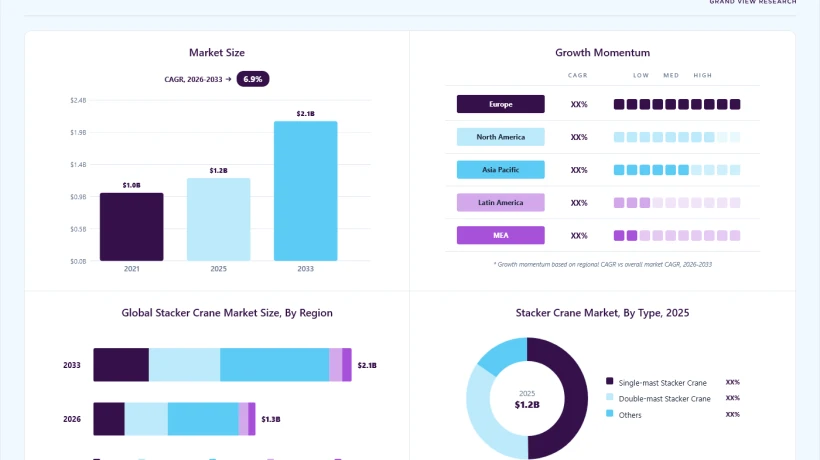
The global stacker crane market size was estimated at USD 1.2 billion in 2025 and is projected to grow from USD 1.3 billion in 2026 to USD 2.1 billion by 2033, at a CAGR of 6.9% from 2026 to 2033.
The stacker crane market is gaining momentum as warehouses, distribution centers, manufacturers, and logistics operators increasingly invest in automated storage and retrieval systems.
Key Market Metrics
- Market size in 2025: USD 1.2 billion
- Estimated market size in 2026: USD 1.3 billion
- Projected market size by 2033: USD 2.1 billion
- CAGR from 2026 to 2033: 6.9%
- Largest type segment: Single-mast stacker cranes, with a 49.7% revenue share in 2025
- Largest operation segment: Semi-automatic, with a 60.4% revenue share in 2025
- Largest end-use segment: Consumer goods, with a 34.9% revenue share in 2025
- Largest regional market: Asia Pacific, with a 44.0% revenue share in 2025
- Fastest-growing country in 2025: India
- Fastest-growing regional market: Europe
Market Drivers and Trends
Warehouse automation is one of the strongest factors supporting stacker crane adoption. Modern facilities are increasingly using automated storage and retrieval systems, warehouse management systems, robotics, machine vision, IoT connectivity, and autonomous control technologies. These systems allow operators to move goods more efficiently while improving inventory accuracy and reducing dependence on manual labor.
The expansion of e-commerce is adding another layer of demand. Online retailers and fulfillment operators face increasing expectations for rapid delivery and accurate order processing. Stacker cranes enable high-density storage and quick retrieval, making them valuable for fulfillment centers where space utilization and throughput directly influence operating performance.
Technological development is also changing stacker crane capabilities. Advanced sensors, artificial intelligence, machine vision, real-time data analytics, and IoT connectivity are enabling more precise handling and better equipment monitoring. Integration with warehouse management systems provides greater visibility into inventory and equipment performance, while predictive maintenance can help identify potential equipment problems before they cause extended downtime.
Another important trend is the development of intelligent warehouse ecosystems. Stacker cranes can increasingly communicate with conveyors, robotics, warehouse control systems, enterprise resource planning platforms, and inventory management software. Cloud-based systems can further improve coordination between equipment and warehouse operations, helping businesses optimize material movement, storage capacity, and order fulfillment.
The type landscape remains led by single-mast systems. The single-mast stacker crane segment held a 49.7% revenue share in 2025. Their lighter construction, cost-effectiveness, compact design, maneuverability, and suitability for narrower aisles make them attractive for small and medium-sized businesses and facilities handling different types of goods.
Double-mast stacker cranes are also gaining attention because of their higher lifting capacity and stability. They can handle heavier loads and reach greater heights, making them useful in high-bay warehouses. Their ability to integrate with warehouse management systems also supports real-time inventory tracking and improved operational visibility.
Operation and End-Use Insights
Semi-automatic stacker cranes led the operation segment with a 60.4% market share in 2025. These systems provide a balance between human oversight and machine-assisted efficiency. They can help businesses improve productivity and reduce labor requirements without requiring the same level of upfront investment associated with fully automated infrastructure.
Automatic stacker cranes are expected to experience significant growth through 2033. Their ability to operate continuously with limited human intervention makes them especially relevant to high-throughput warehouses and e-commerce fulfillment centers. AI, sensors, and real-time analytics further support automated handling, safety, routing, and performance optimization.
The consumer goods segment led end use with a 34.9% revenue share in 2025. High product volumes and the need for rapid distribution are encouraging consumer goods companies to adopt automated storage solutions. Stacker cranes can support high-density storage while improving retrieval and order fulfillment efficiency.
Automotive applications are projected to witness significant growth from 2026 to 2033. Automotive manufacturers require precise storage and movement of heavy components and parts, particularly as production becomes more customized and just-in-time manufacturing becomes increasingly important.
Regional Highlights
Asia Pacific dominated the market with a 44.0% revenue share in 2025. Expanding manufacturing and logistics sectors, e-commerce growth, infrastructure modernization, and increasing automation investments are supporting demand. India is identified as the fastest-growing country in the region in 2025.
Europe is expected to achieve the highest CAGR from 2026 to 2033, supported by investments in smart manufacturing, automation, e-commerce, and logistics optimization. North America is also expected to experience notable growth due to advanced warehousing infrastructure, major e-commerce and retail operations, and automotive activity.
FAQ
What trends are shaping the stacker crane market?
Warehouse automation, artificial intelligence, IoT connectivity, machine vision, predictive maintenance, cloud-based warehouse management systems, robotics, and the expansion of e-commerce and high-density warehousing are among the major trends influencing the market.
Which segment leads the stacker crane market?
Single-mast stacker cranes led by type with a 49.7% revenue share in 2025, while semi-automatic systems led operations with a 60.4% share. The consumer goods segment led end use with a 34.9% revenue share in 2025.
Key Stacker Crane Companies:
· Mecalu, S.A.
· American Crane & Equipment Corporation
· ME-JAN d.o.o.
· Daifuku Co. Ltd.
About us:
Grand View Research, a market research and consulting company, provides syndicated research reports, customized research reports, and consulting services. Grand View Research database is used by the world's renowned academic institutions and Fortune 500 companies to understand the global and regional business environment. Our database features thousands of statistics and in-depth analysis on 46 industries in 25 major countries worldwide.



Comments
Login to Comment