Where Black Box Testing Fits in Modern Test Strategies
27 Feb, 2026
6416 Views 0 Like(s)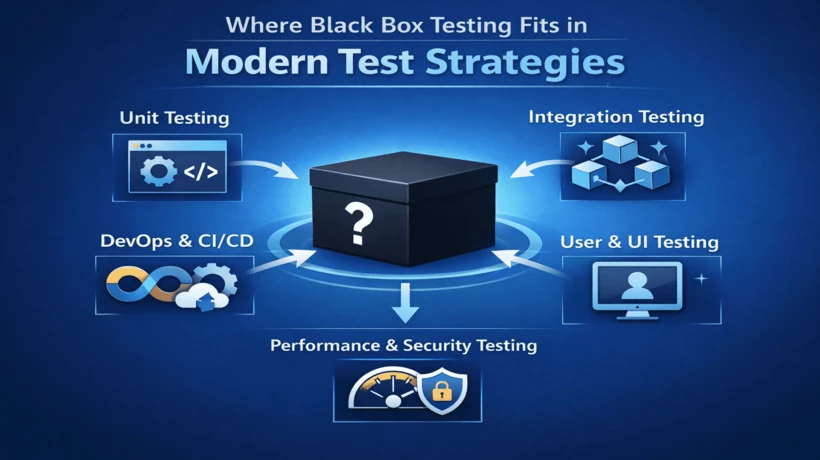
Understand where black box testing fits in modern test strategies. Learn how it strengthens CI/CD pipelines, supports regression testing, and improves API and microservices reliability.
Software systems have changed. Applications are distributed, API-driven, and deployed multiple times a day. Teams rely on CI/CD pipelines, observability tools, and layered validation strategies to maintain release confidence. In this environment, testing is no longer a single phase. It is an ongoing process embedded across development.
Amid unit tests, integration tests, performance checks, and security scans, many teams ask a simple question: where does black box testing actually fit today?
The answer is practical. Black box testing remains one of the most important layers in a modern test strategy because it validates what users and external systems truly experience: observable behavior.
Understanding the Modern Testing Pyramid
Most teams structure their strategy using layered validation:
-
Unit tests validate internal logic at the function or method level
-
Integration tests confirm components work together
-
End-to-end tests simulate complete workflows
-
Performance and security tests assess non-functional requirements
Black box testing is not limited to one layer. It is a perspective rather than a test type. It focuses on validating system behavior without relying on internal code knowledge.
In modern strategies, this perspective strengthens reliability across multiple layers.
Validating External Behavior in API-First Systems
Today, APIs are the backbone of applications. Frontends, mobile apps, and partner systems interact through contracts defined by endpoints and schemas.
Black box testing fits here by validating:
-
Response structure and data types
-
HTTP status codes
-
Authentication and authorization behavior
-
Error handling under invalid input
-
Business logic outcomes from an external perspective
This ensures that even if internal implementations change, the public interface remains stable. In distributed systems, this behavioral validation often matters more than internal correctness.
Supporting CI/CD Pipelines
Modern release cycles demand automation. Every code change should trigger validation before merging and deployment.
Black box testing integrates into CI/CD pipelines by:
-
Running automated API checks on each pull request
-
Validating contract consistency before merging
-
Detecting breaking changes early
-
Confirming production-like behavior in staging environments
This makes it a gatekeeper for release quality. Instead of relying only on unit tests, teams gain confidence that the system behaves correctly in real usage scenarios.
Complementing Unit and White Box Testing
A common misconception is that black box testing duplicates unit testing. It does not.
Unit tests verify internal implementation details. They ensure algorithms and business rules work as expected within isolated components.
Black box testing verifies outcomes. It answers a different question: does the system behave correctly from the outside?
For example:
-
A unit test may confirm a discount calculation formula.
-
A black box test confirms that submitting an order with a discount produces the correct total in the API response.
Both layers are necessary. Together, they reduce blind spots.
Strengthening Regression Safety
As applications evolve, previously working features can break unexpectedly. This is where regression testing becomes critical.
Black box testing fits naturally into regression suites because it validates stable, user-facing behaviors over time. When teams refactor internal logic or optimize performance, external behavior must remain consistent.
By maintaining automated black box tests for critical workflows, teams ensure that changes do not introduce unintended side effects. This is especially important in microservices environments where independent deployments can create integration risks.
Enhancing Microservices Reliability
Microservices communicate through well-defined contracts. Internal changes within one service should not break dependent services.
Black box testing ensures:
-
Backward compatibility of APIs
-
Stability of response schemas
-
Predictable behavior across versions
-
Graceful handling of unexpected inputs
Without this layer, teams may discover contract violations only after deployment. In distributed systems, catching these issues early significantly improves reliability.
Improving User-Centric Validation
Modern applications must prioritize user experience. Internal correctness does not guarantee usable behavior.
Black box testing helps validate:
-
Complete user flows from login to checkout
-
Error messaging clarity
-
Validation rules for forms and inputs
-
Correct state transitions across workflows
By focusing on outcomes rather than implementation, this approach aligns testing with real-world usage.
Reducing Over-Coupling in Test Suites
One advantage of black box testing in modern strategies is reduced coupling to internal structure.
When tests rely heavily on internal implementation details:
-
Refactoring becomes risky
-
Minor structural changes break multiple tests
-
Maintenance costs increase
Black box tests remain stable as long as external behavior does not change. This stability makes them particularly valuable in fast-moving Agile environments.
Where It Should Not Be Used Alone
Although powerful, black box testing is not sufficient on its own.
It cannot:
-
Detect inefficient internal algorithms
-
Guarantee code coverage
-
Validate complex internal branching logic
That is why modern strategies combine it with white box testing, static analysis, performance monitoring, and security scanning.
A balanced approach ensures both internal correctness and external reliability.
A Practical Placement in the Testing Strategy
In a well-designed modern test strategy, black box testing typically fits:
-
At the API validation layer
-
Within end-to-end workflow validation
-
As part of automated regression suites
-
Inside CI/CD quality gates
It acts as the final behavioral validator before code moves forward.
Teams often prioritize high-risk workflows such as payments, authentication, and data updates for black box coverage. This risk-based approach maximizes value without slowing pipelines unnecessarily.
Looking Ahead
Software systems are becoming more distributed and more dynamic. Internal implementations will continue to evolve as teams refactor, scale, and optimize.
What must remain constant is observable behavior.
Black box testing provides that external validation layer. It ensures that regardless of internal changes, users and dependent systems experience consistent, reliable functionality.
In modern test strategies, it is not an optional add-on. It is a stabilizing force that bridges internal engineering efforts with real-world system behavior.
As development accelerates, the teams that maintain strong behavioral validation will release faster without sacrificing trust. The real question is not whether black box testing still matters. It is whether your current strategy gives enough attention to what your system actually delivers to the outside world.



Comments
Login to Comment