What Tally to ERP Migration Actually Looks Like: A Realistic Timeline
24 Aug, 2026
524 Views 1 Like(s)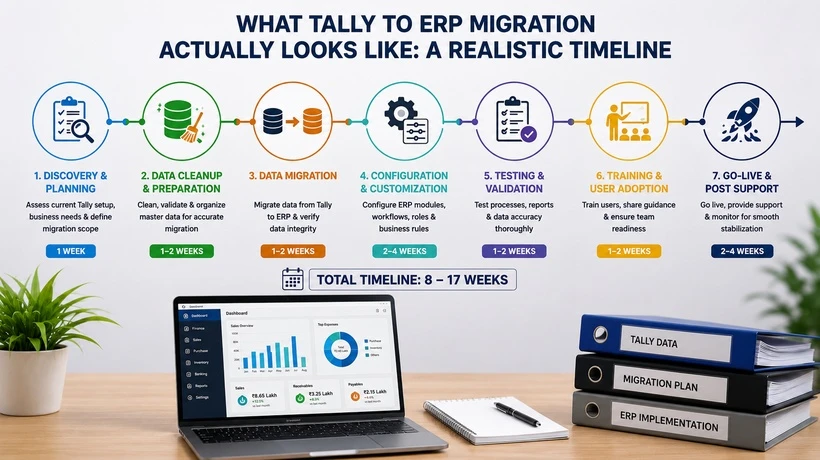
Bsquare Solution
The fear that delays most manufacturers isn't cost — it's disruption. "We cannot afford to have
operations go down for a month while the system changes." That fear is legitimate and based on
real stories of failed implementations. It's also manageable with the right process.
Here is what a well-run Tally to ERP migration looks like for a mid-sized manufacturing
company with 20 to 50 users.
Weeks 1 to 3 — Discovery and master data preparation. This phase determines whether the
implementation succeeds or fails. The implementation team maps current processes and
manufacturing workflows while your team begins cleaning master data — item masters, vendor
masters, customer masters, opening stock, and BOM structures. For a company that has run Tally
for 8 to 10 years, this typically surfaces 20 to 40 percent of items needing correction before
migration. Manufacturers who skip this phase properly are the ones whose teams stop trusting
the system within 90 days of go-live.
Weeks 4 to 8 — Configuration, testing, and training. The ERP is configured to your
workflows: production routing, BOM structures, quality parameters, approval hierarchies, and
GST configuration. Key users from production, purchase, stores, accounts, and sales run real
transactions through the system in structured user acceptance testing — not training, but a way to
surface gaps before go-live. Training runs in parallel, and by go-live every user has practiced
their daily transactions 10 to 15 times.
Weeks 9 to 12 — Parallel running and go-live. The ERP goes live on a defined date. For the
first 2 to 4 weeks, transactions are entered in both Tally and the ERP simultaneously — not
inefficiency, but a safety net that lets the team validate ERP outputs against Tally figures before
cutting over. Most manufacturers complete parallel running in 3 to 4 weeks. Go-live isn't the end
of the implementation: the 30 to 60 days that follow, backed by dedicated post-go-live support,
determine whether the system becomes how the business runs or the system everyone works
around.
Choosing Your ERP: What Matters for Indian Manufacturers
Once the decision to move is made, four dimensions matter specifically for Indian manufacturing
companies.
1. Manufacturing depth versus accounting depth. Some ERP systems are strong on finance
and weak on production, or the reverse. For a manufacturer, production planning, BOM
management, shop floor control, quality management, and job work modules matter more than
the accounting module, since the accountant can continue using Tally for CA-facing work during
transition if needed. Evaluate systems by walking through your most complex production
scenarios in a demo, not by reviewing the accounting feature list.
2. Indian compliance as a native feature, not a plugin. GST, e-invoicing, TDS, PF, ESI, and
professional tax should be native to the ERP, maintained by the vendor, and updated as
compliance changes. Systems where Indian compliance is a third-party add-on carry ongoing
compliance risk. Ask directly: who maintains the GST module when the government changes
something, and how quickly do clients get the update?
3. Implementation ownership. For a manufacturer without a dedicated internal IT team, this is
the most critical selection criterion. The question isn't which ERP has the best features — it's
who is accountable if the implementation doesn't deliver what was promised. Understand clearly,
before signing, whether the vendor owns your implementation outcome or you're dependent on a
third-party partner of variable quality.
4. Post-go-live support model. The ERP a manufacturer buys at go-live isn't the ERP the
business will need in year three. The support model needs to handle workflow modifications,
report customizations, and module additions as the operation evolves — not just bug fixes and
compliance updates. Understand exactly what's covered under the maintenance contract and what
gets billed as additional work before signing
B-Square's Pothera ERP implementations for mid-sized manufacturing companies typically
complete in 8 to 12 weeks from kickoff to go-live. A steel fabrication company in Delhi NCR
went live in 10 weeks with 25 users and reported near-zero training resistance. Alpine Asia
Pacific, an automotive sensor manufacturer, now reports 40 percent faster production reporting
compared to their previous system.


Comments
Login to Comment