What Is Trading Pairs? A Complete Beginner's Guide to Market-Neutral Trading
02 Jul, 2026
1167 Views 0 Like(s)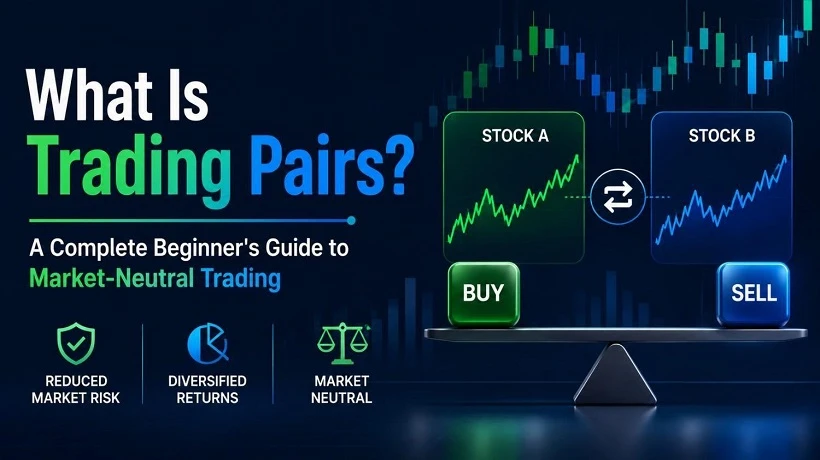
Learn What is Trading Pairs with this beginner's guide to market-neutral trading. Discover strategies, benefits, and insights from Power Pairs.
Financial markets offer countless opportunities for traders, but they also come with significant risks. Market volatility, economic uncertainty, and unexpected news can make traditional investing challenging. This is why many experienced traders look for strategies that reduce overall market exposure while still generating consistent returns. One such approach is pairs trading. If you've ever wondered What is Trading Pairs, you're not alone. This strategy has become increasingly popular among hedge funds, institutional investors, and retail traders because it focuses on relative price movements rather than predicting whether the entire market will rise or fall.
In this guide, we'll explain What is Trading Pairs, how it works, why traders use it, its benefits and risks, and how platforms like Power Pairs help simplify the entire trading process.
What Is Trading Pairs?
The first question every beginner asks is What is Trading Pairs?
Trading pairs, commonly known as pairs trading, is a market-neutral trading strategy where a trader simultaneously buys one security and sells another related security. The goal is to profit from the difference in price movements between the two assets rather than the overall direction of the market.
Instead of betting that the stock market will go up or down, traders identify two assets that usually move together. When these assets temporarily diverge from their historical relationship, they enter positions expecting the prices to eventually return to their normal relationship.
This unique approach helps reduce market risk while creating opportunities in both bullish and bearish environments.
Why Is It Called Market-Neutral Trading?
Traditional investing depends heavily on market direction.
For example:
- Buying stocks generally benefits from rising markets.
- Short selling profits from falling markets.
Pairs trading is different because it combines both positions simultaneously.
A trader:
- Goes long on the undervalued asset.
- Goes short on the overvalued asset.
Since one position benefits from upward movement while the other benefits from downward movement, the portfolio becomes less sensitive to overall market fluctuations.
This is why pairs trading is considered a market-neutral strategy.
How Does Trading Pairs Work?
Understanding What is Trading Pairs becomes much easier through a simple example.
Imagine two companies in the same industry:
- Company A
- Company B
Historically, these stocks move almost identically because they operate under similar market conditions.
Suppose:
- Company A suddenly falls sharply.
- Company B remains stable.
A trader believes the price difference is temporary.
The trade would look like this:
- Buy Company A
- Short Company B
If Company A recovers while Company B slows down, the price gap narrows, allowing the trader to earn a profit regardless of whether the overall market rises or falls.
This relative pricing approach forms the foundation of pairs trading.
Why Do Stocks Move Together?
Successful pairs trading depends on finding assets that share a strong historical relationship.
Common examples include:
- Two banks
- Two airline companies
- Two semiconductor manufacturers
- Two oil companies
- ETFs tracking similar indexes
These securities often react similarly to:
- Interest rates
- Economic data
- Industry news
- Commodity prices
- Investor sentiment
Temporary deviations often create attractive trading opportunities.
Common Assets Used in Pairs Trading
Pairs trading isn't limited to stocks.
Many traders use:
- Stocks
- ETFs
- Commodities
- Forex pairs
- Futures contracts
- Sector indexes
The important factor is that both assets have demonstrated a strong historical correlation.
The Key Components of a Pairs Trade
Every successful pairs trade includes several important elements.
1. Correlation
Correlation measures how closely two assets move together.
Higher positive correlation generally produces stronger trading opportunities.
2. Spread
The spread is the difference between the prices (or relative valuation) of two assets.
Pairs traders monitor this spread carefully.
When it widens beyond historical norms, it may signal a potential trade.
3. Mean Reversion
Most pairs trading strategies rely on the principle of mean reversion.
This assumes that unusual price deviations eventually return toward their historical average.
If the spread becomes unusually large, traders expect it to narrow over time.
4. Entry Signal
A trader enters the trade when statistical indicators suggest that the relationship has become abnormal.
5. Exit Strategy
Positions are closed when:
- The spread returns to normal.
- Profit targets are reached.
- Stop-loss levels are triggered.
Benefits of Trading Pairs
Understanding What is Trading Pairs also means recognizing why traders appreciate this strategy.
Lower Market Risk
Since every trade includes both a long and short position, overall market exposure is reduced.
Consistent Opportunities
Market-neutral strategies can work during:
- Bull markets
- Bear markets
- Sideways markets
This provides more consistent trading opportunities throughout the year.
Diversification
Pairs trading adds another layer of diversification beyond traditional investing.
Instead of relying solely on market direction, traders focus on relative price behavior.
Reduced Volatility
Balanced positions often experience smaller portfolio swings compared to outright long positions.
Data-Driven Decisions
Many successful traders rely on quantitative analysis instead of emotional decision-making.
Statistical models help identify higher-probability setups.
Risks of Trading Pairs
Although pairs trading reduces certain risks, it is not risk-free.
Correlation Breakdown
Historical relationships sometimes disappear.
A pair that moved together for years may stop behaving similarly due to changing business conditions.
Company-Specific Events
Unexpected events can permanently change valuation.
Examples include:
- Earnings surprises
- Mergers
- Bankruptcy
- Regulatory action
These events may invalidate the trade.
Execution Risk
Both trades should ideally be executed simultaneously.
Delays can expose traders to unwanted price movement.
Short Selling Risk
Short positions involve additional considerations such as borrowing costs and the potential for unlimited losses if not managed properly.
How Traders Identify Good Pairs
Professional traders rarely choose pairs randomly.
Instead, they analyze:
- Historical correlation
- Cointegration
- Price spread
- Volatility
- Relative strength
- Statistical deviations
- Sector relationships
Modern software greatly simplifies this process.
How Power Pairs Helps Traders
Finding high-quality trading opportunities manually can take hours of research.
This is where Power Pairs provides a significant advantage.
Power Pairs is designed to help traders discover statistically strong trading pairs using advanced market analysis and intelligent screening tools.
Instead of manually comparing hundreds or thousands of securities, traders can quickly identify pairs with favorable historical relationships and potential mean-reversion opportunities.
Key advantages include:
- Automated pair discovery
- Statistical analysis
- Real-time monitoring
- Portfolio management tools
- Actionable trading insights
- User-friendly interface
Whether you're new to pairs trading or an experienced market participant, Power Pairs can streamline your workflow and improve efficiency.
Tips for Beginners
If you're just learning What is Trading Pairs, keep these best practices in mind.
Start Small
Begin with paper trading or smaller position sizes while learning the strategy.
Focus on Highly Correlated Assets
Choose securities with strong historical relationships.
Use Risk Management
Always define:
- Position size
- Stop-loss
- Profit target
before entering a trade.
Avoid Emotional Decisions
Follow objective trading rules rather than reacting emotionally to short-term market movements.
Keep Learning
Markets evolve constantly.
Continue improving your understanding of statistics, technical analysis, and risk management.
Common Mistakes Beginners Make
Many new traders make avoidable errors.
Some of the most common include:
- Choosing unrelated stocks
- Ignoring statistical analysis
- Overleveraging positions
- Holding losing trades too long
- Trading without exit rules
- Ignoring company-specific news
Learning from these mistakes can significantly improve long-term performance.
Is Trading Pairs Suitable for Everyone?
Pairs trading is suitable for traders who:
- Prefer systematic strategies
- Enjoy data-driven decision making
- Want reduced market exposure
- Understand basic trading concepts
- Practice disciplined risk management
While beginners can certainly learn the strategy, success requires patience, continuous learning, and consistent execution.
The Future of Pairs Trading
Advancements in technology have made pairs trading more accessible than ever.
Artificial intelligence, machine learning, and sophisticated screening platforms are enabling traders to identify opportunities that were once available only to institutional investors.
As quantitative tools continue to evolve, traders can expect even more efficient ways to analyze correlations, monitor spreads, and manage market-neutral portfolios.
Platforms like Power Pairs are helping bridge the gap by offering intuitive tools that simplify the process of identifying and tracking statistically significant trading opportunities.
Final Thoughts
Understanding What is Trading Pairs is an excellent first step toward exploring market-neutral investing. Unlike traditional strategies that rely on predicting the overall direction of the market, pairs trading focuses on the relationship between two correlated assets. By taking both long and short positions simultaneously, traders can potentially reduce market exposure while seeking profits from temporary pricing inefficiencies.
Like any investment strategy, pairs trading requires careful research, disciplined execution, and sound risk management. Beginners should spend time learning the principles of correlation, mean reversion, and trade management before committing significant capital.
For those looking to simplify the process, Power Pairs offers powerful tools to discover, analyze, and monitor high-quality trading pairs, making it easier to implement a structured, data-driven approach. With the right education, technology, and discipline, pairs trading can become a valuable addition to a trader's overall investment strategy.
Frequently Asked Questions (FAQs)
1. What is Trading Pairs?
What is Trading Pairs is a market-neutral trading strategy that involves buying one correlated asset while simultaneously short-selling another. The objective is to profit from changes in their relative prices rather than the overall market direction.
2. Is pairs trading good for beginners?
Yes. Beginners can learn pairs trading effectively by starting with paper trading, understanding correlation and mean reversion, and using reliable analytical platforms like Power Pairs.
3. What markets support pairs trading?
Pairs trading can be applied to stocks, ETFs, futures, commodities, and even forex, provided the assets have a strong historical relationship.
4. What are the biggest risks of pairs trading?
Major risks include correlation breakdowns, company-specific events, execution delays, and improper risk management. Using stop-losses and careful analysis can help mitigate these risks.
5. How can Power Pairs help with pairs trading?
Power Pairs helps traders identify statistically strong trading pairs, monitor spread movements, analyze historical relationships, and manage trades more efficiently through advanced screening and portfolio tools.


Comments
Login to Comment