What Is the Difference Between RCC Pipes, RCC Chambers, and Box Culverts?
31 Jul, 2026
846 Views 0 Like(s)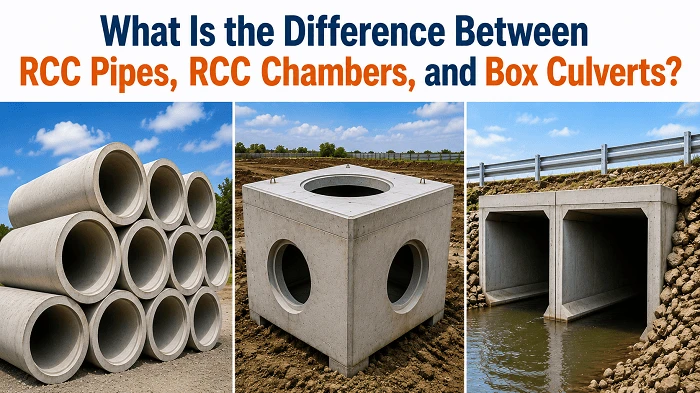
Confused between RCC pipes, chambers, and box culverts? Learn their key differences, uses, and how to choose the right concrete pipe supplier.
If you are planning a construction, drainage, or infrastructure project, you have probably come across three terms again and again: RCC pipes, RCC chambers, and box culverts. They all fall under the broad category of precast concrete products, and they often work together on the same site. But they are not interchangeable. Each one solves a different engineering problem, and using the wrong product in the wrong place can lead to costly mistakes down the line.
This guide breaks down what separates these three products, where each one belongs in a project, and how to choose the right one for your specific needs. Whether you're a contractor, a municipal engineer, or a property developer, understanding these differences will help you plan more accurately and avoid unnecessary delays.
Why This Distinction Matters
Concrete infrastructure projects rarely fail because of bad concrete. They fail because the wrong component was used for the wrong job. A pipe cannot do a chamber's work, and a chamber cannot replace a culvert. When you work with a reliable Concrete Pipe Supplier, you get more than just materials you get guidance on which product actually fits your site conditions, load requirements, and drainage plan. That guidance starts with understanding the basic differences between these three product categories, so let's go through each one in detail.
What Are RCC Pipes?
RCC pipes, or reinforced cement concrete pipes, are cylindrical conduits used to carry water, sewage, or stormwater from one point to another. They are built with a steel reinforcement cage inside a concrete shell, which gives them the strength to handle both internal water pressure and external soil load.
You'll typically find RCC pipes used for:
- Underground drainage and sewage systems
- Stormwater management in urban areas
- Irrigation channels in agricultural land
- Culvert and roadway drainage crossings
RCC pipes come in different joint types, the most common being flush joint and spigot-and-socket designs. Flush joint pipes sit end to end with a smooth, aligned connection, which makes them easier to lay in long straight runs. Spigot-and-socket pipes interlock at the joint, offering a tighter seal that's often preferred for pressure-sensitive applications.
The diameter, wall thickness, and reinforcement of an RCC pipe all depend on the load it needs to bear. A pipe running under a residential road will need a different specification than one running under a highway carrying heavy freight traffic. This is exactly why sourcing from an experienced supplier matters the wrong wall thickness for the wrong load class can crack under pressure within a few years of installation.
What Are RCC Chambers?
RCC chambers are precast concrete structures, often box-shaped or conical, built to provide access to underground pipelines, cables, or drainage systems. Think of them as maintenance access points. Where a pipe carries water or waste continuously through a line, a chamber sits at intervals along that line to allow inspection, cleaning, and repair.
Common types of RCC chambers include:
- Inspection chambers, used to monitor and clean drainage lines
- Manhole chambers, which provide worker access to underground utility networks
- Earthing chambers, used in electrical installations to house grounding systems
- Housing chambers, which protect valves, meters, or junction points
A chamber's design has to account for two very different forces: the load from above (vehicle or foot traffic) and the pressure from surrounding soil. That's why quality chambers are reinforced at both the base and walls, with a precast cover fitted to match the load class of the area light-duty covers for pedestrian zones, and heavy-duty covers for roads and industrial sites.
Chambers are not simply add-ons to a pipeline. They are what keep a drainage or sewage system serviceable over its entire lifespan. Without properly placed chambers, even a well-laid RCC pipeline becomes difficult and expensive to maintain once it's buried.
What Are Box Culverts?
A box culvert is a rectangular or square precast concrete structure designed to allow water to pass underneath a road, railway line, or embankment. Unlike pipes, which are circular and used for controlled drainage flow, box culverts are built for larger volumetric flow and often double as a structural support under the load they sit beneath.
Box culverts are commonly used for:
- Crossing streams or drainage channels under roads and highways
- Managing stormwater runoff in large-scale infrastructure projects
- Providing passage for utility lines in confined spaces
- Supporting embankments while allowing water flow underneath
Because box culverts often bear the direct weight of a road or rail structure above them, they are engineered with thicker walls and heavier reinforcement than standard RCC pipes. Precast box culverts also offer a major advantage over cast-in-place versions: since they're manufactured off-site under controlled conditions, they cure to full strength before installation, which shortens on-site construction time significantly.
Comparing the Three: A Quick Reference
| Feature | RCC Pipes | RCC Chambers | Box Culverts |
|---|---|---|---|
| Primary function | Conveys water/sewage | Provides access/maintenance | Passes water under structures |
| Shape | Cylindrical | Box or conical | Rectangular/square |
| Load handling | Moderate to high | Moderate to high | Very high |
| Typical use | Drainage lines, sewage | Manholes, inspection points | Road/rail crossings |
| Installation | Continuous runs | Placed at intervals | Standalone structures |
Choosing the Right Product for Your Project
Selecting between these products isn't about picking whichever one seems strongest. It's about matching the product to the job. A drainage line needs pipes to carry flow and chambers to keep that line maintainable. A road crossing over a water channel needs a culvert built to bear traffic load while letting water pass freely beneath it.
This is where working with an established RCC Pipe Manufacturer makes a real difference. A manufacturer with in-house production of pipes, chambers, and culverts can guide you through load calculations, joint types, and cover classes based on your actual site conditions rather than leaving you to guess from a catalogue. It also means consistency: pipes, chambers, and culverts sourced from the same production facility are more likely to align in quality, tolerance, and reinforcement standards, which simplifies coordination on-site.
When evaluating a manufacturer, look at a few practical indicators. Ask how they test compressive strength on finished units. Ask whether their reinforcement design changes based on load class, or whether they use a one-size-fits-all approach — the latter is a red flag for larger projects. Ask about their delivery capacity for bulk orders, since infrastructure projects often need hundreds of units delivered on a tight schedule. And ask whether they manufacture all three product types in-house, since that typically indicates deeper technical expertise across drainage and access engineering, not just pipe casting.
Final Thoughts
RCC pipes, RCC chambers, and box culverts each serve a distinct purpose in concrete infrastructure. Pipes move water and waste through a system. Chambers keep that system accessible and maintainable. Culverts allow water to pass safely beneath roads and structures that carry heavy loads. Recognizing these differences early in your project planning saves you from specification errors, unnecessary rework, and long-term maintenance headaches.
Whether you're laying a new drainage network, building road infrastructure, or upgrading an existing system, taking the time to match the right precast product to the right job pays off in durability and cost savings over the life of the structure.
Frequently Asked Questions
1. Can RCC pipes be used without chambers?
Technically yes, but it isn't recommended for any drainage or sewage line longer than a short run. Without chambers at regular intervals, clogs and blockages become nearly impossible to clear without excavation.
2. Are box culverts stronger than RCC pipes?
Generally, yes. Box culverts are engineered to bear direct structural loads from roads or railways above them, so their walls and reinforcement are typically thicker than standard RCC pipes designed for drainage flow alone.
3. How do I know what load class chamber cover I need?
Load class depends on what will pass over the chamber. Pedestrian areas need light-duty covers, while roads, parking areas, and industrial zones need heavy-duty or extra-heavy-duty covers rated for vehicle traffic.
4. Do RCC chambers need maintenance after installation?
Yes. Chambers should be inspected periodically to check for blockages, cracks, or cover damage, especially in high-traffic or high-flow areas where wear accumulates faster.
5. Can one supplier manufacture pipes, chambers, and culverts together?
Many established manufacturers do produce all three, which is often preferable since it ensures consistent quality standards and simplifies logistics for large infrastructure projects.
6. What's the typical lifespan of precast concrete pipes and culverts?
With proper installation and periodic maintenance, precast RCC pipes and box culverts commonly last 50 to 100 years, depending on load conditions, soil environment, and water quality passing through them.



Comments
Login to Comment