Vietnam Exports Growth, Top Products & Trade Insights 2025
06 May, 2026
1751 Views 0 Like(s)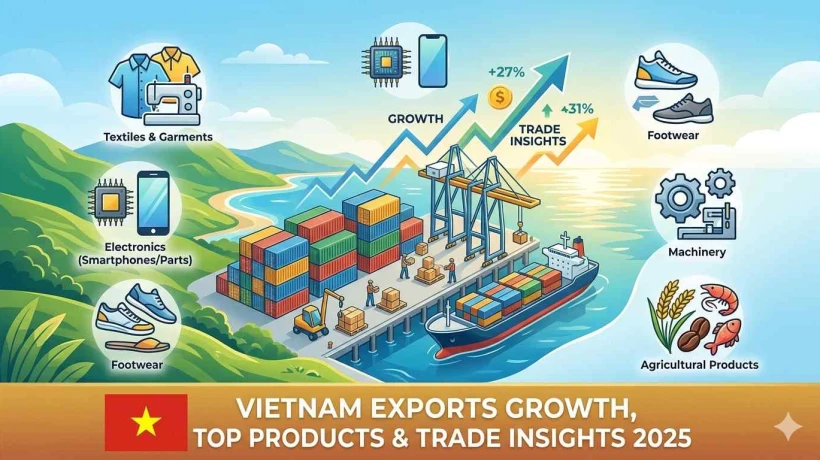
According to recent vietnam export data, the total value of vietnam exports reached approximately $403.2 billion in 2024, marking a steady growth of 6.4% year-over-year.
In recent years, Vietnam has emerged as one of the fastest-growing economies in Asia, transforming itself into a global manufacturing and export powerhouse. With a strategic geographic location, cost-effective labor force, and strong foreign direct investment (FDI), the country has significantly strengthened its position in international trade. According to recent vietnam export data, the total value of vietnam exports reached approximately $403.2 billion in 2024, marking a steady growth of 6.4% year-over-year.
This growth reflects Vietnam’s increasing integration into global supply chains and its ability to diversify across multiple export sectors. Backed by strong Vietnam trade data, the country now ranks among the top exporters globally, securing its position as the 21st largest exporter in the world.
Vietnam Trade Performance & Recent Trends
The upward momentum has continued into 2025. Based on the latest vietnam export data, exports reached $102.8 billion in the first quarter alone, representing a strong 10.6% increase compared to the same period last year. At the same time, total vietnam imports and exports turnover touched $202.5 billion, showcasing a year-on-year growth of 13.7%.
Vietnam’s trade balance also remained positive, with a surplus of $4.67 billion recorded in the first five months of 2025. This consistent surplus highlights the strength of vietnam exports and the country’s growing competitiveness in global markets.
Vietnam Exports Products: Key Sectors Driving Growth
Vietnam’s export structure is diverse, covering electronics, textiles, agriculture, and industrial goods. Over the years, the country has moved beyond traditional exports and strengthened its position in high-value manufacturing.
Top Vietnam Exports Products by HS Code
According to detailed vietnam export data, the following sectors dominate:
1. Electrical Machinery & Equipment (HS Code 85)
Valued at $121.7 billion, this category accounts for nearly 30% of total exports. Electronics remain the backbone of vietnam exports, driven by multinational companies manufacturing smartphones, semiconductors, and components.
2. Footwear (HS Code 64)
Vietnam is a global leader in footwear exports, generating $25.4 billion. The country’s strong manufacturing base and competitive pricing make it a preferred supplier worldwide.
3. Machinery & Mechanical Appliances (HS Code 84)
With exports worth $23.5 billion, this sector includes industrial machinery and mechanical equipment, reflecting Vietnam’s industrial expansion.
4. Apparel (Knit & Non-Knit – HS Codes 61 & 62)
Textiles remain a traditional strength, with combined exports exceeding $40 billion. This segment continues to play a crucial role in vietnam exports products globally.
5. Furniture & Bedding (HS Code 94)
Exports worth $14.2 billion highlight Vietnam’s growing role in global furniture supply chains.
6. Fish & Seafood (HS Code 03)
Seafood exports reached $9.8 billion, making Vietnam a major supplier to international markets.
7. Wood & Wood Products (HS Code 44)
This sector contributed $6.5 billion, supported by strong demand from Europe and the U.S.
8. Coffee, Tea & Spices (HS Code 09)
Vietnam is one of the world’s largest exporters of coffee, contributing $5.6 billion in exports.
9. Rubber & Articles (HS Code 40)
Valued at $4.3 billion, rubber exports play a key role in industrial supply chains.
These categories clearly demonstrate how vietnam exports are transitioning from agriculture-based to technology-driven industries.
Vietnam Exports by Country: Key Trade Partners
An important aspect of Vietnam’s success lies in its strong global trade relationships. According to vietnam exports by country, the nation has built a diverse network of export destinations.
Top Export Markets
- United States – $113.9 billion (27.5%)
- China – $60.7 billion (14.7%)
- South Korea – $28.2 billion (6.8%)
- Japan – $26.8 billion (6.5%)
- Hong Kong – $20.1 billion (4.9%)
- Germany – $14.7 billion (3.6%)
- Netherlands – $10.3 billion (2.5%)
- United Kingdom – $9.2 billion (2.2%)
- Thailand – $8.8 billion (2.1%)
- India – $7.5 billion (1.8%)
The United States remains the largest importer of Vietnamese goods, particularly electronics, textiles, and furniture. Meanwhile, China continues to play a dual role as both a supplier and a major export destination.
This diversified export base ensures stability and reduces reliance on a single market, strengthening long-term growth in vietnam exports.
Leading Exporters Driving Vietnam’s Growth
Vietnam’s export success is heavily supported by multinational corporations and strong domestic companies. According to Vietnam trade data, major exporters include:
- Samsung Group (Vietnam) – Electronics leader
- Intel Products Vietnam – Semiconductor exports
- LG Group – Display and electronic components
- Foxconn Vietnam – Electronics manufacturing
- VINATEX – Textile exports
- Vinamilk – Dairy products
- Intimex Group – Coffee exports
These companies contribute significantly to overall vietnam exports, with foreign-invested enterprises accounting for over 70% of total export value.
Historical Growth of Vietnam Exports
The long-term growth trend highlights Vietnam’s rapid economic transformation:
- 2014: $150.2 billion
- 2018: $243.6 billion
- 2021: $335.7 billion
- 2024: $403.2 billion
This steady rise in vietnam export data reflects the country’s successful shift toward industrialization and global trade integration.
Sector Breakdown & Economic Structure
Recent Vietnam trade data reveals that:
- Manufacturing accounts for 88.7% of exports
- FDI companies contribute over 72%
- Electronics dominate with 35% share
- Textiles & footwear contribute 18%
This structure highlights Vietnam’s reliance on manufacturing and export-oriented growth.
Challenges & Tariff Impacts
Despite strong growth, Vietnam faces challenges related to global trade policies. Tariffs on steel and aluminum, along with proposed duties on exports, could impact pricing competitiveness.
However, free trade agreements such as CPTPP, EVFTA, and RCEP provide significant advantages, enabling tariff-free access to major markets. These agreements play a critical role in sustaining vietnam exports growth.
Future Outlook for Vietnam Exports
Looking ahead, Vietnam is expected to maintain strong export growth of 10–15% annually. Total export value could surpass $450 billion in 2025, driven by:
- Expansion in electronics manufacturing
- Diversification into new markets
- Strengthening supply chains
- Increased investment in technology
The country’s strategic positioning amid global supply chain shifts further boosts its prospects.
Insights for Buyers & Suppliers
For Buyers:
- Monitor price fluctuations due to tariffs
- Secure long-term contracts for stability
- Utilize FTAs for cost advantages
For Suppliers:
- Focus on product diversification
- Improve compliance and documentation
- Expand into emerging markets
These strategies are essential for navigating the evolving landscape of vietnam imports and exports.
Conclusion
Vietnam has firmly established itself as a key player in global trade, with a strong and diversified export portfolio. From electronics and textiles to agriculture and furniture, the country continues to expand its reach across international markets.
Driven by robust vietnam export data, strong manufacturing capabilities, and strategic trade partnerships, Vietnam’s export sector is set for sustained growth. As global supply chains evolve, Vietnam is well-positioned to capitalize on new opportunities and further strengthen its role in international trade.
For businesses seeking opportunities in Asia, understanding vietnam exports, key markets, and industry trends is crucial. With continued investment, policy support, and global demand, Vietnam’s export journey is only just beginning.


Comments
Login to Comment