Twisha Sharma Dowry Death Case | Bhopal Court Denies Parents’ Application for Second Autopsy
21 May, 2026
1647 Views 0 Like(s)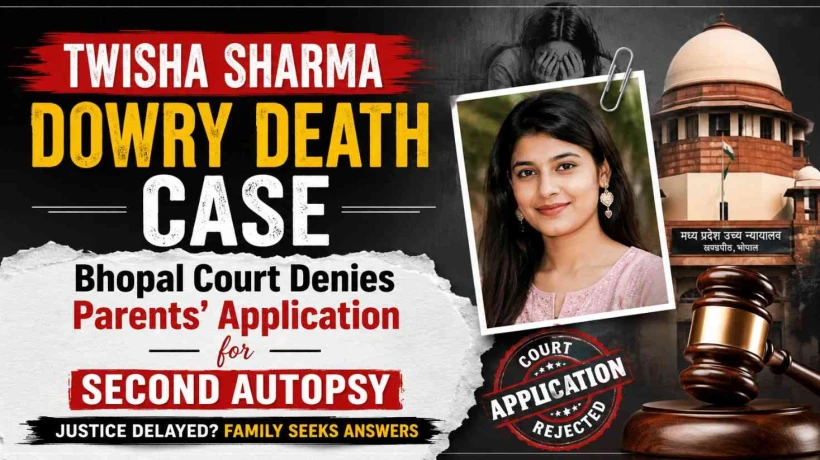
Twisha Sharma Dowry Death Case | Bhopal Court Denies Parents’ Application for Second Autopsy
The Twisha Sharma dowry death case has once again brought national attention to the issue of dowry-related violence and suspicious deaths involving newly married women in India. In a significant development, a court in Bhopal has denied the application filed by Twisha Sharma’s parents seeking permission for a second autopsy. The court’s decision has sparked emotional reactions from the family and renewed public debate over justice, forensic investigations, and women’s safety.
The tragic case revolves around the death of Twisha Sharma, a young woman whose family alleges that she was subjected to harassment and pressure related to dowry demands after her marriage. Her death under suspicious circumstances triggered outrage among relatives and social activists, who demanded a thorough investigation into the incident.
Court Rejects Plea for Second Autopsy
According to reports, Twisha Sharma’s parents approached the Bhopal court requesting a second post-mortem examination, claiming they were not satisfied with the findings of the initial autopsy. The family argued that there were several unanswered questions regarding the circumstances of her death and alleged inconsistencies in the medical report.
However, the court rejected the plea, stating that there was insufficient legal and medical justification to order a second autopsy. The court reportedly observed that the original post-mortem had already been conducted by a competent medical team and there was no clear evidence proving the need for another examination.
The decision has disappointed Twisha’s family, who believe that a second autopsy could have helped reveal additional facts and strengthen their demand for justice.
Family Alleges Dowry Harassment
Twisha Sharma’s family has alleged that she faced continuous mental and emotional harassment after marriage over dowry-related issues. According to relatives, Twisha had reportedly informed family members about pressure and mistreatment from her husband and in-laws.
The family claims that despite attempts to resolve the issues peacefully, the harassment continued. After her sudden death, the parents accused her husband’s family of being involved and demanded strict legal action.
The case quickly gained public attention, especially on social media, where many users expressed anger over recurring incidents of alleged dowry harassment and violence against women.
Police Investigation Continues
Police officials have stated that the investigation into the case is ongoing. Authorities are reportedly examining phone records, witness statements, medical documents, and other evidence related to the incident.
Investigators are also questioning individuals connected to the case, including family members and close relatives. Officials say that all angles are being examined carefully before drawing final conclusions.
Sources indicate that sections related to dowry harassment and suspicious death have been included in the investigation. However, police have urged the public not to spread unverified claims until the inquiry is completed.
Importance of Forensic Evidence
The court’s rejection of the second autopsy request has highlighted the importance of forensic evidence in criminal investigations. In cases involving suspicious deaths, post-mortem examinations play a crucial role in determining the cause and circumstances of death.
Legal experts explain that courts generally approve second autopsies only in rare situations where there is strong evidence of procedural lapses, contradictions, or incomplete findings in the initial report.
In the Twisha Sharma case, the court appears to have relied on the validity of the first autopsy while deciding against another examination.
However, the family continues to insist that a more detailed investigation is necessary to ensure transparency and justice.
Rising Concern Over Dowry Death Cases
The incident has once again raised serious concerns about dowry-related violence in India. Despite strict laws against dowry practices, many families continue to face harassment, emotional abuse, and violence linked to dowry demands.
According to government data, thousands of dowry-related cases are registered across the country every year. Women’s rights organizations have repeatedly called for stricter implementation of laws, faster investigations, and stronger protection mechanisms for women facing domestic abuse.
Social activists say that cases like Twisha Sharma’s reflect the ongoing challenges women continue to face even in educated and urban households.
Public Reaction and Social Media Response
The case has generated strong reactions on social media platforms, where users are demanding justice and accountability. Many people have expressed sympathy for Twisha Sharma’s family and criticized the persistence of dowry-related violence in society.
Several women’s rights groups have also urged authorities to ensure a fair and unbiased investigation. Activists argue that even if the second autopsy request has been denied, the investigation should continue thoroughly and transparently.
The emotional nature of the case has also sparked discussions about mental health, marital pressure, and the social expectations placed on women after marriage.
Legal Perspective
Legal experts point out that the denial of a second autopsy does not necessarily weaken the case against the accused if other evidence supports allegations of harassment or foul play. Courts often rely on witness testimony, digital evidence, forensic reports, and circumstantial details while deciding criminal matters.
If investigators uncover additional evidence during the probe, it could still influence the direction of the case significantly.
The family of Twisha Sharma has reportedly stated that they will continue pursuing legal options to seek justice for their daughter.
Conclusion
The Twisha Sharma dowry death case has become a painful reminder of the continuing problem of dowry-related harassment and violence in India. While the Bhopal court has denied the family’s request for a second autopsy, the investigation into the circumstances surrounding her death remains ongoing.
As authorities continue gathering evidence and examining the case, many people across the country are closely watching developments and hoping for a fair and transparent investigation. The case has once again highlighted the urgent need for stronger awareness, legal enforcement, and societal change to eliminate dowry-related abuse and protect women’s rights.


Comments
Login to Comment