Top Front End Development Company: How to Choose the Right Partner
08 Sep, 2026
527 Views 0 Like(s)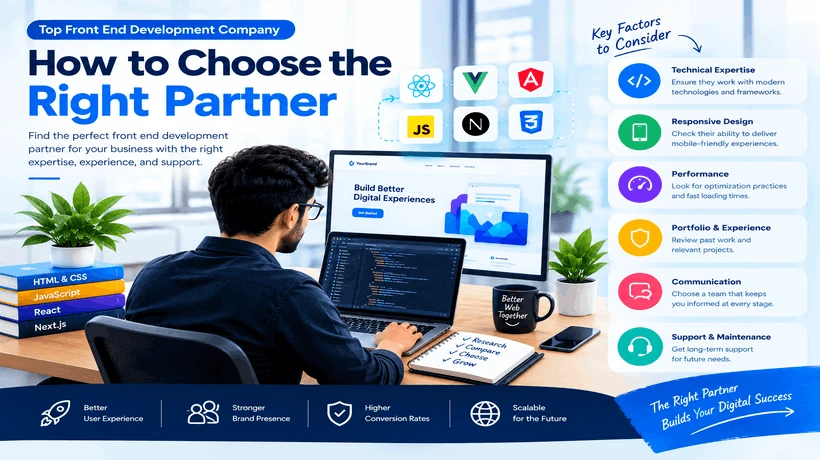
Learn how to choose a top front end development company by evaluating technical expertise, responsive design, performance, portfolio quality, and long-term support.
A business website is often the first interaction a potential customer has with a company. A slow, confusing, or poorly designed website can create a negative impression, while a fast and intuitive interface can make it easier for visitors to explore services and take action.
For businesses planning a new website or improving an existing digital platform, finding a top front end development company can make a significant difference. The right development partner can transform designs and business requirements into a responsive, accessible, and high-performing digital experience.
What Is Front End Development?
Front end development focuses on the parts of a website or web application that users see and interact with.
This includes navigation menus, buttons, forms, layouts, animations, product pages, dashboards, and other interactive components. Developers commonly use technologies such as HTML, CSS, JavaScript, React, Vue.js, Angular, Next.js, and TypeScript.
However, successful frontend development involves more than writing code. Developers also need to understand usability, responsive design, accessibility, performance, and the goals of the business.
Why Choosing the Right Company Matters
The quality of frontend development can affect how users perceive and interact with a website.
A professional development team can help businesses create interfaces that are:
-
Fast and responsive
-
Easy to navigate
-
Mobile-friendly
-
Accessible
-
Visually consistent
-
Compatible with modern browsers
-
Easier to maintain
These qualities can contribute to a better overall digital experience.
Evaluate Technical Expertise
Technical expertise should be one of the first factors to consider.
Different projects require different technologies. A simple corporate website may not need the same architecture as an ecommerce platform or SaaS application.
Before choosing a development company, ask about its experience with the technologies required for your project. A professional team should also be able to explain why a particular technology is appropriate instead of simply listing popular frameworks.
Review the Portfolio
A company's portfolio can reveal how it approaches real projects.
Do not look only at screenshots. Visit completed websites and test them on smartphones, tablets, and desktop computers.
Consider:
-
Page loading speed
-
Navigation
-
Mobile responsiveness
-
Visual consistency
-
Interactive elements
-
Forms
-
Accessibility
-
Overall usability
Projects similar to your own requirements can provide especially useful evidence of experience.
Look for Responsive Development
Modern users browse websites from a wide range of devices.
A responsive website automatically adapts its layout and components to different screen sizes. Menus, images, buttons, text, forms, and other elements should remain easy to use on both large and small displays.
When evaluating a provider, ask how it approaches responsive design and how different devices and browsers are tested.
Consider Website Performance
Website performance is an important part of user experience.
Large images, unnecessary scripts, inefficient code, and excessive third-party resources can make a website slower.
An experienced frontend team should understand techniques such as:
-
Image optimization
-
Lazy loading
-
Code splitting
-
Browser caching
-
Efficient JavaScript
-
Resource optimization
-
Performance monitoring
Building performance into the development process is generally better than trying to solve major speed problems after launch.
Check Accessibility Practices
Accessibility helps ensure that a website can be used by people with different abilities and browsing requirements.
Frontend developers can improve accessibility through semantic HTML, keyboard navigation, descriptive labels, suitable contrast, and logical content structures.
Businesses should ask potential development partners whether accessibility is considered during design implementation and testing.
Understand the Development Process
A clear development process can make a project easier to manage.
A typical workflow may include:
-
Requirement analysis
-
Project planning
-
UI/UX review
-
Frontend development
-
Integration
-
Testing
-
Performance optimization
-
Deployment
-
Maintenance
The exact process can vary, but responsibilities and milestones should be clearly defined before development begins.
Evaluate Communication
Good communication is essential for successful development.
Clients should understand how project updates are delivered, how feedback is collected, and how revisions are managed.
Ask potential providers about communication channels, project management, deadlines, scope changes, and technical discussions.
Clear communication can reduce misunderstandings and help ensure that the final product reflects the original objectives.
Compare Cost With Value
Development costs depend on factors such as project complexity, number of pages, custom functionality, integrations, technology requirements, testing, and maintenance.
The cheapest proposal is not necessarily the best option.
A low-cost project may eventually require additional spending if the website has poor performance, technical problems, limited scalability, or inadequate support.
Instead of comparing prices alone, evaluate the overall value offered by each provider.
Consider Long-Term Support
A website continues to evolve after launch.
Businesses may need new features, design improvements, browser compatibility updates, performance optimization, and technical maintenance.
For this reason, ask whether the development company provides post-launch support.
A long-term development relationship can be particularly useful when the website is an important part of business operations.
Think About Scalability
A website that meets today's requirements may need additional functionality in the future.
Businesses can grow their product catalog, introduce new services, add integrations, or build new digital features.
The frontend architecture should therefore be designed with future requirements in mind.
A capable development partner should be able to explain how its approach supports maintainability and scalability.
Look Beyond Technical Skills
Technical knowledge is important, but understanding business objectives is equally valuable.
An ecommerce website should make product discovery and checkout simple. A SaaS platform should provide an intuitive interface. A corporate website should communicate important information clearly.
The best development partner connects technical decisions with the needs of users and the goals of the business.
For businesses looking for broader technology and digital solutions, Inforisen provides services across multiple areas of digital development.
Final Thoughts
Choosing a top front end development company requires careful consideration of technical expertise, portfolio quality, responsive design, performance, accessibility, communication, pricing, scalability, and support.
Businesses should avoid choosing a provider based only on cost or visual appearance. Instead, they should look for a partner that understands their requirements and can create a reliable, scalable, and user-friendly digital experience.
Backlink placement: Link the first keyword “top front end development company” to the provided Inforisen front-end development page.



Comments
Login to Comment