The Role of Thales Key Management in Strengthening Enterprise Data Security
04 Sep, 2026
520 Views 0 Like(s)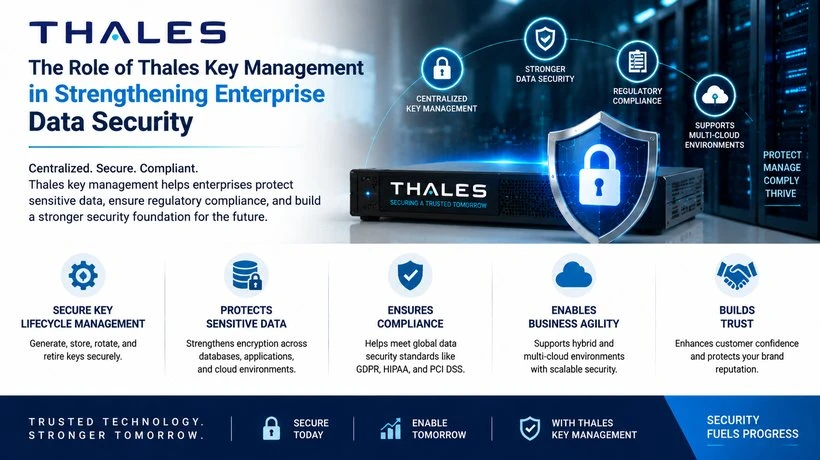
Enterprise data security requires more than encryption; organizations must also protect the cryptographic keys that secure sensitive information. Thales key management helps businesses establish centralized control over encryption keys while improving visibility, compliance, and protection across complex IT environments.
Introduction
Data has become one of the most valuable assets for modern enterprises. Organizations store and process massive amounts of sensitive information, including customer data, financial records, intellectual property, employee information, and business-critical applications. As companies continue adopting cloud computing, digital platforms, and connected technologies, protecting this information has become a major cybersecurity priority.
Cyber threats are becoming more sophisticated, and attackers increasingly target enterprise data repositories to gain unauthorized access. A successful data breach can lead to financial losses, regulatory penalties, operational disruption, and damage to customer trust.
Encryption is one of the most effective methods for protecting sensitive information. It transforms readable data into an encrypted format that unauthorized users cannot access. However, encryption security depends on the protection of encryption keys. If attackers gain access to these keys, they may bypass encryption controls and access confidential data.
This makes secure Key management an essential part of enterprise cybersecurity. Solutions such as Thales key management, HSM Solutions, and HSM modules help organizations protect encryption keys and strengthen their overall data security architecture.
Understanding the Importance of Enterprise Data Security
Enterprise data environments have become increasingly complex. Organizations now operate across multiple platforms, including:
- On-premises data centers
- Public cloud environments
- Hybrid infrastructures
- SaaS applications
- Distributed databases
- Remote access systems
This expansion creates additional security challenges. Businesses must ensure that sensitive information remains protected regardless of where it is stored or processed.
Common enterprise data security risks include:
- Unauthorized data access
- Encryption key theft
- Insider threats
- Database breaches
- Weak access controls
- Compliance failures
A strong data security strategy requires multiple layers of protection, including encryption, identity management, monitoring, and secure key management.
The Role of Encryption in Protecting Enterprise Data
Encryption plays a fundamental role in modern cybersecurity. It protects information by converting data into an unreadable format that can only be accessed using the correct encryption key.
Organizations use encryption to protect:
- Customer information
- Payment details
- Healthcare records
- Financial documents
- Confidential business information
- Application data
However, encryption is only effective when encryption keys are properly managed. Poor key handling practices can create security vulnerabilities even when organizations use advanced encryption algorithms.
This is why key management in cryptography is critical for maintaining secure encryption systems.
What Is Key Management in Cryptography?
Key management in cryptography refers to the processes and technologies used to securely create, store, distribute, use, rotate, and retire encryption keys.
A complete key management lifecycle includes:
Key Generation
Encryption keys must be created using secure cryptographic methods to prevent prediction or unauthorized duplication.
Key Storage
Encryption keys require secure storage mechanisms that prevent unauthorized access.
Key Distribution
Organizations must ensure that encryption keys are provided only to authorized users, systems, and applications.
Key Rotation
Regular key rotation reduces security risks associated with long-term key usage.
Key Retirement
Expired or unused keys must be securely removed to prevent misuse.
Effective Key management ensures that encryption remains reliable throughout the entire data protection lifecycle.
Understanding Thales Key Management
Thales key management provides enterprises with advanced capabilities to manage encryption keys across complex IT environments.
Large organizations often use multiple applications, databases, and cloud platforms that require encryption. Managing encryption keys separately across each environment can create operational challenges and security gaps.
Thales key management helps businesses centralize encryption key operations and maintain stronger control over cryptographic assets.
Key capabilities include:
- Centralized encryption key management
- Secure key lifecycle management
- Access control enforcement
- Encryption policy management
- Security monitoring
- Compliance support
By creating a centralized approach, enterprises can simplify encryption management while improving security visibility.
How Thales Key Management Strengthens Enterprise Security
1. Centralized Control Over Encryption Keys
One of the biggest challenges organizations face is managing encryption keys across multiple systems.
Without centralized management, security teams may struggle to track:
- Where keys are stored
- Who can access them
- Which applications use them
- When keys need rotation
Thales key management provides centralized control, helping organizations manage encryption keys consistently across different environments.
2. Improved Protection Against Data Breaches
Encryption protects data, but encryption keys require additional security.
If attackers gain access to encryption keys, they may decrypt sensitive information. Thales key management helps reduce this risk by applying strong access controls and secure key management practices.
This ensures that encryption keys remain protected throughout their lifecycle.
3. Support for Hybrid and Multi-Cloud Environments
Modern enterprises increasingly use multiple cloud platforms along with traditional infrastructure.
Managing encryption keys across these environments can become complicated. Thales key management helps organizations maintain consistent security policies across:
- Private clouds
- Public clouds
- Data centers
- Enterprise applications
This allows businesses to maintain better control over encryption regardless of where their data resides.
The Importance of HSM Modules in Enterprise Key Protection
HSM modules (Hardware Security Modules) provide dedicated hardware environments for protecting cryptographic keys.
Unlike software-based key storage, HSM modules secure encryption keys within tamper-resistant hardware. This provides an additional layer of protection against unauthorized access.
Organizations use HSM modules for:
- Secure encryption operations
- Cryptographic key generation
- Digital signatures
- Authentication processes
- Certificate protection
By storing critical encryption keys inside secure hardware, HSM modules help prevent key extraction and unauthorized usage.
The Role of HSM Solutions in Data Security
HSM Solutions provide enterprises with secure infrastructure for managing cryptographic operations.
While key management platforms help control encryption policies and lifecycle processes, HSM Solutions provide the secure hardware foundation required to protect sensitive cryptographic assets.
HSM Solutions help organizations achieve:
Stronger Key Protection
Encryption keys remain protected inside secure hardware environments.
Secure Cryptographic Operations
Sensitive operations such as encryption, decryption, and digital signing occur within protected systems.
Better Compliance Support
Organizations can maintain stronger controls required by industry regulations and security frameworks.
Reduced Security Risks
Hardware-based protection reduces vulnerabilities associated with software-only key storage.
Database Encryption Solution and Enterprise Data Protection
Databases often contain some of the most sensitive information within an organization. A database breach can expose customer records, financial information, and confidential business data.
A database encryption solution protects database information by encrypting stored data and restricting unauthorized access.
Database encryption can protect:
- Customer databases
- Financial systems
- Healthcare records
- Business applications
- Internal information systems
However, database encryption requires secure key management. Encryption keys must be protected separately from encrypted data to prevent attackers from gaining complete access.
By combining a database encryption solution with Thales key management and HSM Solutions, organizations can create a stronger data protection framework.
Aligning With Data Security Standards
Organizations must follow strict security requirements to protect sensitive information and maintain customer trust.
Modern Data security standards emphasize the importance of:
- Strong encryption practices
- Secure key management
- Access control policies
- Monitoring and auditing
- Data protection processes
Thales key management and HSM-based security approaches help organizations establish better control over encryption operations and improve their ability to meet security requirements.
However, organizations should continuously evaluate their security practices because compliance requirements and cybersecurity threats continue to evolve.
Best Practices for Implementing Enterprise Key Management
Organizations should follow several best practices to maximize the benefits of secure key management.
Create a Clear Key Management Strategy
Businesses should define policies for encryption key creation, storage, rotation, and retirement.
Protect Keys Separately From Data
Encryption keys should never be stored with the encrypted data they protect.
Use Hardware-Based Protection
Critical encryption keys should be protected using HSM modules whenever appropriate.
Implement Strong Access Controls
Organizations should restrict key access based on user roles and business requirements.
Monitor Key Usage
Security teams should regularly review key activity and investigate suspicious behavior.
Automate Key Lifecycle Processes
Automation improves efficiency and reduces human errors during key management operations.
Future of Enterprise Data Security
As organizations continue adopting artificial intelligence, cloud computing, and digital transformation technologies, data security requirements will continue to grow.
Future enterprise security strategies will focus on:
- Automated key management
- Advanced encryption technologies
- Cloud security integration
- Zero-trust security models
- Stronger compliance frameworks
Technologies such as Thales key management, HSM Solutions, and HSM modules will continue to play an important role in protecting enterprise data.
Organizations that establish strong encryption and key management frameworks will be better prepared to handle future cybersecurity challenges.
Conclusion
Enterprise data security depends on more than encryption alone. Organizations must also protect the encryption keys that secure their sensitive information.
Thales key management helps businesses establish centralized control over encryption keys while improving security, visibility, and compliance across complex IT environments.
By combining Key management, key management in cryptography, HSM Solutions, and HSM modules, enterprises can create a stronger security framework. Integrating these technologies with a database encryption solution further strengthens protection for critical business information.
As cybersecurity threats continue to evolve, adopting advanced key management strategies aligned with Data security standards will remain essential for organizations seeking to protect data, maintain compliance, and build long-term digital resilience.



Comments
Login to Comment