The Hidden Cost of Getting POS Codes Wrong (And How to Fix It Before It Hurts Your Practice)
25 Aug, 2026
6 Views 0 Like(s)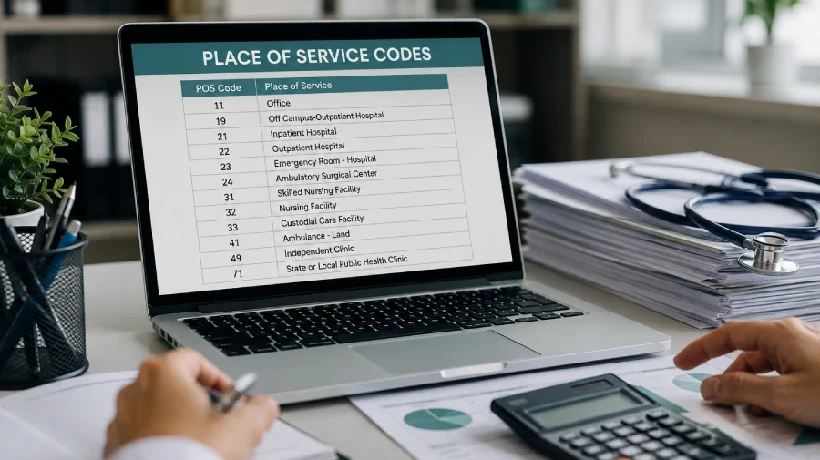
POS codes in medical billing affect claim payments and compliance risk. Learn common errors, legal risks, red flags, and how to prevent costly mistakes.
Imagine running a full week of patient visits, submitting every claim on time, and still watching your revenue come in lower than expected. No missed appointments, no coding for services you didn't provide, nothing dramatic. Just a slow leak in your reimbursements that nobody can quite explain. Nine times out of ten, when practices bring us in to investigate a problem like this, the answer is buried in two tiny digits on the claim form. Learning POS Codes in Medical Billing isn't optional anymore for practices that want predictable cash flow, because payers use this single field to decide how much they owe you and whether they owe you anything at all.
This article takes a practical, boots-on-the-ground look at how POS codes work, what happens when they're wrong, the audits and penalties tied to chronic errors, and a step-by-step system to keep your claims clean going forward.
Starting With the Basics: What a POS Code Actually Does
A place of service code is a two-digit identifier attached to every professional claim. It tells the payer exactly where the patient was seen: a private office, an emergency room, a skilled nursing facility, an ambulance, or dozens of other settings.
Payers don't just use this for record-keeping. They use it to calculate the reimbursement amount. The same CPT code, billed for the exact same procedure, can pay a completely different amount depending on the setting attached to it. This is because Medicare's fee schedule (and most commercial payers that follow it) separates payment into a facility rate and a non-facility rate.
A minor procedure performed in a private office pays the physician more because the physician's practice absorbs all the overhead costs: rent, equipment, staff, supplies. The same procedure performed in a hospital outpatient department pays the physician less, because the hospital bills separately for the facility side of the visit.
Why This Single Field Has So Much Financial Power
Here's the part many practices underestimate: POS code accuracy affects revenue in both directions.
Get it wrong in one way, and you underbill yourself, leaving money on the table every single time that code repeats across your claim volume. Get it wrong in the other direction, and you may be overpaid, which feels fine in the short term but creates a repayment obligation the moment a payer catches it, sometimes years later with interest and penalties attached.
Neither outcome is good. One drains your revenue quietly. The other builds a liability that can surface at the worst possible time, usually during an audit you didn't see coming.
A Scenario That Plays Out More Often Than You'd Think
Consider a multi-specialty group with providers who split their week between the main clinic and a nearby ambulatory surgical center. One physician assistant handles scheduling notes loosely, marking every visit as "clinic" in the system regardless of actual location.
When claims go out, the billing team pulls location data straight from those scheduling notes. Every visit gets coded as POS 11, office, even the ones that happened at the surgical center, which should have been coded POS 24.
For weeks, nothing seems wrong. Claims process, payments come in. But because ambulatory surgical center billing works differently, with a facility fee paid separately to the ASC, the payer eventually notices a mismatch between what the facility billed and what the physician billed. A review gets triggered. The practice has to pull records for dozens of visits, prove where each one actually happened, and in several cases, refund payments they already collected and spent.
This isn't a rare story. It's one of the most common patterns we see in practices that don't have a tight process connecting scheduling, documentation, and billing.
The Compliance Side Nobody Talks About Enough
POS errors aren't treated as harmless clerical mistakes once a pattern develops. If you've never worked with Practice Revenue Partners, you might not realize how seriously payers and regulators treat repeated site-of-service discrepancies, but the consequences are very real and worth understanding before they land on your desk.
Overpayment recoupment. When a payer determines that services were billed under the wrong POS code and the practice was paid more than it should have been, they can demand repayment. This often isn't limited to the flagged claims. Auditors frequently extrapolate an error rate across a larger sample of claims, meaning a handful of mistakes can turn into a repayment demand covering hundreds of claims.
False Claims Act risk. Under federal law, knowingly submitting a claim with false information, including a POS code that misrepresents where a service occurred, can expose a practice to liability under the False Claims Act. This law doesn't require proof of intentional fraud. Reckless disregard or deliberate ignorance of accuracy is enough to create exposure, and penalties can include treble damages plus a per-claim fine.
Increased scrutiny and pre-payment review. Payers sometimes respond to a pattern of errors not with an immediate penalty, but with tighter oversight. Some practices get placed on prepayment review, meaning every claim gets manually checked before payment is released. This slows down cash flow dramatically and adds administrative burden that can last for months.
Contract and network risk. In more serious or repeated cases, payers can flag a provider's contract for review, which in rare situations leads to network termination. Losing an in-network contract because of a preventable coding issue is a painful and completely avoidable outcome.
Red Flags Worth Watching For
Most practices don't catch POS problems until they've already cost money. These warning signs tend to show up before the bigger issues do.
- Claims denied with remark codes referencing place of service inconsistency.
- A gap between what the facility bills for a location and what the physician bills for the same date of service.
- Reimbursement amounts that don't match your expected fee schedule for a given CPT and setting combination.
- Providers who work across multiple locations in the same week but whose claims show identical POS codes regardless of where they actually practiced that day.
- Telehealth claims paid at unexpectedly low rates or denied outright.
- A payer requesting supporting documentation for visits that would normally process automatically.
Any one of these on its own might be nothing. A cluster of them is usually a sign that your POS process needs a closer look.
Building a System That Prevents These Errors
Fixing POS accuracy isn't about hiring more staff or slowing down your billing cycle. It's about building a few reliable checkpoints into your existing workflow.
Start at scheduling, not billing
The place of service is determined the moment an appointment is booked. If your scheduling system doesn't clearly capture and lock in the actual location, your billing team is stuck guessing or relying on assumptions. Fix the front end first.
Create a location-to-code mapping document
List every physical location and service type your practice uses, and map each one directly to its correct POS code. Keep this visible to schedulers, coders, and billers so everyone is working from the same reference.
Separate telehealth logic from your standard workflow
Telehealth POS rules have shifted multiple times over the past several years, and different payers sometimes use different codes for the same type of visit. Build a specific telehealth checklist separate from your regular POS process, and review it against payer bulletins periodically.
Run monthly cross-checks between facility and professional claims
If your providers work in hospitals, surgical centers, or nursing facilities, compare what the facility submitted against what your practice submitted for the same encounters. Mismatches here are one of the clearest early warning signs of a coding problem.
Track denial reasons systematically
Don't treat denials as one-off problems to resolve and forget. Log the reason codes. If POS-related denials show up repeatedly, that's a signal the root cause hasn't been fixed yet, even if individual claims eventually get paid on resubmission.
Schedule periodic internal audits
A quarterly review of a random sample of claims, checked against provider schedules and documentation, catches problems long before a payer audit does. It's far cheaper to fix errors internally than to have a payer find them for you.
Keep documentation tight
If a payer ever challenges your billing pattern, your best protection is clear documentation showing exactly where each visit happened, tied to scheduling records, provider notes, and facility logs. Good documentation turns a potential dispute into a quick resolution.
Why This Deserves More Attention Than It Usually Gets
Most practices spend enormous energy on things like coding accuracy for procedures, prior authorizations, and denial management for medical necessity. Those things matter. But place of service accuracy tends to get far less attention despite having just as much impact on revenue and compliance risk.
Part of the reason is that POS errors don't look dramatic. There's no red flag icon, no obvious sign something is wrong. The claim goes out, gets processed, and the payment looks reasonable enough that nobody questions it until the pattern becomes large enough to trigger a review or the revenue gap becomes too big to ignore.
That's exactly why building a proactive process matters more than reacting to denials after the fact. A practice that treats POS accuracy as a routine part of its billing hygiene, the same way it treats eligibility checks or claim scrubbing, avoids both the quiet revenue loss and the much bigger compliance risk that comes with letting errors compound over time.
Final Thoughts
Two digits shouldn't be able to cause this much trouble, but in medical billing, they do. Place of service codes sit at the intersection of reimbursement accuracy and regulatory compliance, and treating them as a minor detail is a mistake that tends to get expensive over time.
The fix isn't complicated. It requires clear documentation at the point of scheduling, a shared reference for every location your practice uses, regular audits, and a team that understands why this field matters as much as it does. Practices that build these habits early protect both their revenue and their standing with payers, long before either one becomes a problem.
Frequently Asked Questions
Why do the same CPT codes pay differently depending on the place of service?
Medicare and most commercial payers use separate facility and non-facility payment rates. Office-based care typically pays the physician more because the practice covers its own overhead, while facility-based care pays less to the physician since the facility bills separately for its costs.
What happens if a practice is found to have a pattern of incorrect POS coding?
No. An occasional honest mistake is not fraud. Risk increases when errors are frequent, unaddressed, or consistently favor higher payment, which can suggest a pattern rather than isolated human error.
How can a practice tell if POS errors are affecting its revenue?
Watch for denial trends citing place of service issues, unexpected payment amounts compared to your fee schedule, and mismatches between facility and professional claims for the same encounters.
Do telehealth visits use the same POS code as in-person visits?
No. Telehealth generally uses distinct codes, often based on where the patient was physically located during the visit, and these rules have changed multiple times in recent years, so it's important to verify current payer guidance regularly.
How often should a practice audit its place of service coding?
A quarterly internal review is a solid baseline, with additional spot checks anytime denial patterns shift or a new location or service type is added to the practice.



Comments
Login to Comment