The Hidden Cognitive Benefits of Solving Funny Riddles
15 Jun, 2026
1360 Views 0 Like(s)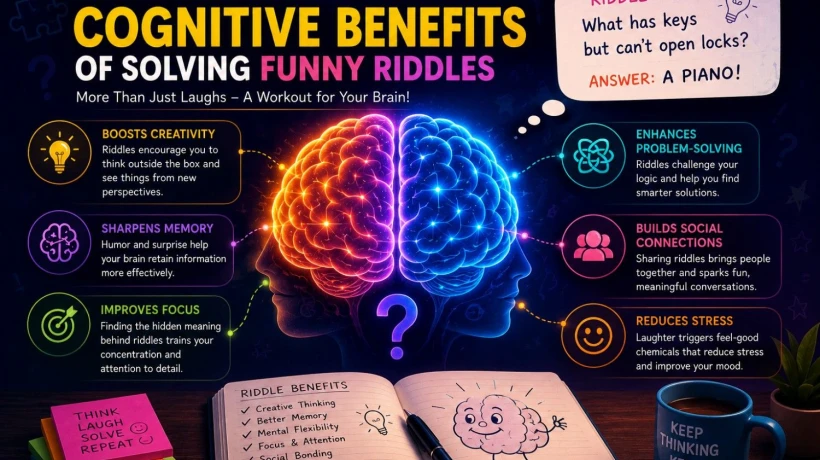
Discover the hidden cognitive benefits of solving funny riddles, from improving creativity and memory to enhancing problem-solving skills.
Most people think of funny riddles as a source of entertainment. They are often shared during family gatherings, classroom activities, road trips, or casual conversations simply to make people laugh. While humor is certainly a major part of their appeal, funny riddles offer something more valuable beneath the surface. They challenge the brain to think differently, question assumptions, and explore unexpected solutions.
Unlike straightforward questions, riddles require a person to look beyond the obvious answer. The combination of humor and mental challenge creates a unique experience that engages multiple cognitive functions at the same time. As a result, solving funny riddles can contribute to mental development in ways many people never realize.
Why Funny Riddles Are Different from Traditional Puzzles
A traditional puzzle often follows a predictable structure. There is usually a clear set of rules, and success depends on applying logic correctly. Funny riddles, however, introduce an additional element: surprise.
The brain naturally searches for familiar patterns when processing information. Funny riddles online take advantage of this tendency by leading people toward an expected answer before revealing an unexpected twist. This moment of surprise is what often creates the humor.
For example, a riddle may appear to be asking about one thing while secretly focusing on something entirely different. To solve it, the brain must temporarily abandon its initial assumption and consider alternative interpretations.
This mental shift is more important than it may seem because it encourages flexible thinking, a skill that plays a significant role in learning, problem solving, and decision-making.
Strengthening Creative Thinking Through Humor
One of the most overlooked benefits of riddles is their ability to encourage creativity.
People often associate creativity with art, writing, or design, but creative thinking is really about finding new ways to approach situations. Funny riddles train the brain to move beyond obvious answers and explore different possibilities.
Imagine hearing a riddle and immediately arriving at an answer that seems correct. Then, after hearing the solution, you realize the question was framed in a completely different way.
Moments like these teach the brain to remain open to alternative perspectives. Over time, this habit can improve adaptability and encourage more innovative thinking in everyday situations.
This is one reason many educators incorporate funny riddles into learning environments. They make critical thinking feel enjoyable rather than demanding.
How Riddles Improve Mental Flexibility
Mental flexibility refers to the ability to adapt thinking when circumstances change. It is an important cognitive skill because real-life problems rarely follow predictable patterns.
Funny riddles constantly challenge expectations. They encourage people to reassess information and adjust their reasoning when new clues emerge.
For example, someone may initially focus on the literal meaning of a question, only to discover that a figurative interpretation provides the correct answer.
Repeated exposure to this process helps the brain become more comfortable with uncertainty and change. Instead of becoming frustrated when an initial assumption proves incorrect, individuals learn to explore alternatives more willingly.
This ability can be useful in academic settings, professional environments, and everyday decision-making.
The Connection Between Humor and Memory
Have you ever noticed how easy it is to remember a joke that made you laugh?
Humor has a powerful effect on memory. When people experience amusement, the brain tends to pay closer attention to the information associated with that emotional response.
Funny riddles benefit from this connection.
Because they combine curiosity, surprise, and humor, they often become more memorable than ordinary questions. The brain treats the experience as meaningful, making it easier to recall later.
This is one reason teachers and trainers sometimes use humor-based learning techniques. Information connected to positive emotions often remains accessible for a longer period of time.
As a result, brain training activities that involve humor can be both enjoyable and effective.
Developing Better Problem-Solving Skills
At first glance, a funny riddle may appear simple. However, solving one usually requires several mental steps.
The brain must:
-
Interpret the question
-
Identify possible meanings
-
Evaluate assumptions
-
Eliminate incorrect answers
-
Recognize hidden clues
-
Select the most logical solution
This process mirrors many aspects of real-world problem solving.
The difference is that riddles present these challenges in a low-pressure environment. There are no serious consequences for making mistakes, which encourages experimentation and curiosity.
Over time, regularly engaging with riddles can help strengthen problem-solving skills by teaching individuals to examine situations from multiple angles rather than settling for the first answer that comes to mind.
Improving Attention and Observation
Many funny riddles rely on details that are easy to overlook.
A single word can completely change the meaning of a question. Missing that detail often leads to an incorrect answer.
This encourages careful reading and attentive listening. Rather than rushing toward conclusions, successful riddle solvers learn to pay closer attention to the information provided.
In a world filled with distractions, this skill has become increasingly valuable.
Developing stronger observation habits can improve learning, communication, and analytical thinking across a wide range of activities.
Why Funny Riddles Encourage Social Learning
Another unique advantage of funny riddles is their social nature.
Unlike many puzzles that are solved individually, riddles are frequently shared among friends, family members, classmates, and coworkers. This creates opportunities for discussion, debate, and collaborative thinking.
When people work together to solve a riddle, they often hear perspectives they would not have considered on their own.
These interactions expose individuals to different ways of thinking and strengthen communication skills. They also make learning feel more engaging and enjoyable.
The laughter that follows a clever answer often becomes just as memorable as the riddle itself.
Cognitive Benefits Across Different Age Groups
Funny riddles are remarkably versatile because they can be enjoyed by people of almost any age.
Children benefit from improved language comprehension and creative thinking. Students develop reasoning abilities and attention to detail. Adults can use riddles as a lighthearted form of mental stimulation, while older individuals may appreciate the opportunity to stay cognitively active.
The difficulty level may vary, but the underlying mental processes remain surprisingly consistent.
This broad appeal is one reason riddles have remained popular for generations.
Final Thoughts
It may seem like simple entertainment, but their impact extends far beyond laughter. By challenging assumptions, encouraging flexible thinking, and rewarding careful observation, they provide valuable opportunities for cognitive growth.
The hidden cognitive benefits of solving riddles include stronger creativity, improved memory, enhanced attention, and better reasoning abilities. They also promote curiosity and help develop skills that can be useful in everyday life.
Most importantly, riddles achieve these benefits in a way that feels enjoyable rather than demanding. They remind us that learning and mental development do not always require serious study sessions. Sometimes, a clever question and an unexpected answer are enough to give the brain exactly the workout it needs.
You have not enough Humanizer words left. Upgrade your Surfer plan.



Comments
Login to Comment