TDD vs BDD: A Practical Comparison for Developers and QA
18 Feb, 2026
7339 Views 0 Like(s)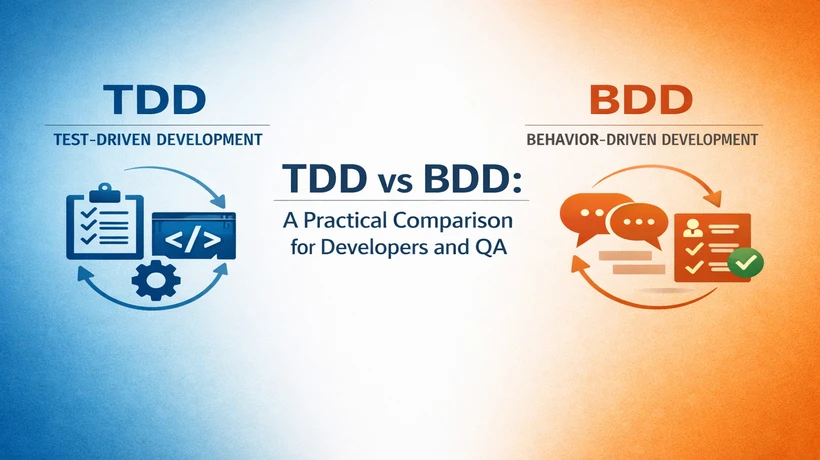
Explore TDD vs BDD with a practical comparison for developers and QA. Learn key differences, best practices, and how to apply both effectively in Agile teams for faster, high-quality software delivery.
In modern software development, testing is not just a final step. It is an integral part of the development process. Agile teams, in particular, rely heavily on structured approaches to ensure both code quality and alignment with business requirements. Two popular methodologies are TDD and BDD. Understanding tdd vs bdd helps developers and QA professionals work efficiently and deliver reliable software.
Let’s explore more about how these approaches differ, where they excel, and how to apply them effectively in real-world projects.
Understanding TDD and BDD
What Is TDD?
Test-Driven Development (TDD) is a coding-centric approach where developers write tests before writing the functional code. The cycle follows three steps:
-
Write a failing test
-
Implement code to pass the test
-
Refactor while ensuring tests still pass
TDD focuses on small units of functionality, ensuring code correctness from the start. It encourages cleaner design, early bug detection, and coverage of edge cases.
What Is BDD?
Behavior-Driven Development (BDD) extends TDD by focusing on the behavior of the application from a user or business perspective. Tests are written in human-readable formats, often using “Given-When-Then” syntax:
-
Given a certain state
-
When an action occurs
-
Then expect a specific outcome
BDD promotes collaboration between developers, QA, and product stakeholders. It ensures that tests reflect real-world user behavior rather than only internal logic.
Key Differences Between TDD and BDD
Understanding tdd vs bdd requires clarity on focus, participants, and output:
| Aspect | TDD | BDD |
|---|---|---|
| Focus | Code correctness | Application behavior |
| Test Type | Unit tests | Acceptance/functional tests |
| Participants | Developers | Developers, QA, Product Owners |
| Language | Programming code | Business-readable, natural language |
| Goal | Prevent defects | Ensure software meets business expectations |
Both approaches complement each other. TDD provides a stable foundation, while BDD ensures that the system behaves correctly for users and stakeholders.
Applying TDD in Development
TDD is most effective when applied at the developer level to validate internal logic. Agile teams benefit from TDD in the following ways:
-
Catching defects early in the cycle
-
Improving code design and modularity
-
Encouraging smaller, testable units
-
Ensuring continuous validation through CI pipelines
Best Practices for TDD:
-
Write tests before code to define expected behavior
-
Keep tests small, focused, and independent
-
Refactor regularly while keeping tests passing
-
Integrate with CI pipelines for instant feedback
TDD is particularly useful in complex systems where early bug detection saves significant time and effort.
Applying BDD in Development
BDD works best at a higher, feature-oriented level. Agile teams can use BDD to:
-
Define clear acceptance criteria for user stories
-
Validate user behavior across the system
-
Promote collaboration between developers, QA, and stakeholders
-
Automate key workflows for CI/CD validation
Best Practices for BDD:
-
Use business-readable syntax so all team members can understand tests
-
Focus on critical workflows rather than trivial features
-
Automate acceptance tests to ensure continuous validation
-
Encourage cross-team discussions to clarify expected behavior
BDD ensures that the application delivers value to the user and meets business requirements.
Combining TDD and BDD
Agile teams often benefit from a layered approach:
-
TDD at the unit level ensures code correctness and stability
-
BDD at the acceptance level ensures alignment with user expectations
This combination creates a robust safety net. Unit tests validate internal logic, while BDD scenarios validate workflows and business rules. Both can be integrated into CI/CD pipelines for fast feedback and high-quality releases.
Common Challenges and Solutions
Even experienced teams encounter challenges when applying tdd vs bdd:
-
Time Pressure: Writing tests upfront may feel slower. Solution: emphasize long-term efficiency and reduced rework.
-
Stakeholder Understanding: Non-technical stakeholders may find BDD syntax unfamiliar. Solution: training and workshops.
-
Maintaining Test Suites: Flaky or outdated tests can disrupt CI pipelines. Solution: regular review and refactoring of tests.
A disciplined approach ensures that TDD and BDD remain effective tools rather than burdens.
When to Prioritize TDD or BDD
-
TDD is ideal when internal code quality, modularity, and regression stability are priorities.
-
BDD is ideal when user experience, business logic, and acceptance criteria need validation.
Agile teams rarely choose exclusively. Instead, they use TDD for unit-level reliability and BDD for end-to-end behavior verification.
Final Thoughts
Understanding tdd vs bdd equips developers and QA professionals to adopt a testing strategy that balances code correctness with business value.
TDD strengthens the foundation by catching defects early and ensuring modular, maintainable code. BDD strengthens collaboration and aligns software with user expectations.
By applying both approaches strategically, agile teams can deliver faster, reduce defects, and maintain high-quality standards without slowing down development cycles.
Quality is not about choosing one methodology over the other. It is about creating a workflow where TDD and BDD work together to build reliable, user-focused software.



Comments
Login to Comment