Sustainable Sourcing Considerations for Organic Peppermint Leaf Powder
13 Aug, 2026
644 Views 0 Like(s)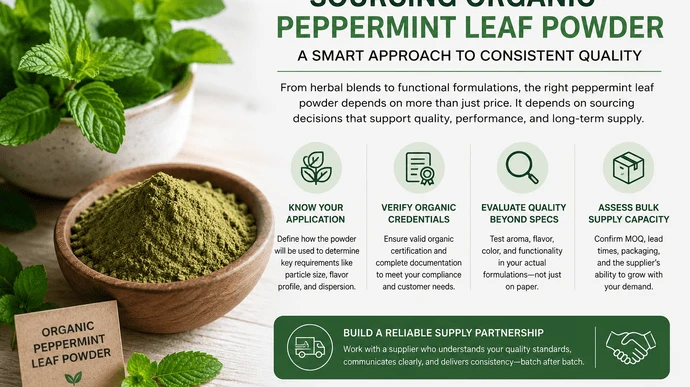
For manufacturers purchasing botanical ingredients, sourcing decisions increasingly involve more than price, specifications, and delivery schedules. Procurement teams are also looking at supply-chain transparency, responsible sourcing practices, resource efficiency, and long-term availability.
When sourcing Organic Peppermint Leaf Powder, these factors can become part of a broader supplier-evaluation process. For businesses purchasing Organic peppermint leaf powder bulk, procurement managers, formulators, R&D professionals, and sourcing teams can use a structured approach to assess whether a supplier can support both current production requirements and long-term sourcing objectives.
Start With Supply-Chain Visibility
A sustainable sourcing strategy begins with understanding where the ingredient comes from.
Peppermint is commonly associated with Mentha × piperita. Buyers should seek information about raw-material origin, cultivation or sourcing practices, processing locations, and batch traceability.
Clear supply-chain information can help procurement teams understand potential sourcing risks and assess whether the supplier has sufficient visibility into its raw-material network.
For bulk purchasing, this information becomes particularly useful when manufacturers need to plan recurring supply.
Verify Organic Certification
Organic certification provides an important starting point for buyers seeking Organic Peppermint Leaf Powder.
Procurement and quality teams should request current certification and verify that it applies to the relevant ingredient and processing activities.
However, certification should be considered alongside other sourcing information.
Buyers can also review:
- Country of origin
- Raw-material traceability
- Processing information
- Product specifications
- Batch documentation
- Supplier quality procedures
This creates a more complete picture of the ingredient supply chain.
Evaluate Raw-Material Availability
Long-term sourcing depends on reliable access to raw materials.
Procurement teams should discuss how suppliers manage seasonal availability, inventory, production planning, and demand changes.
For companies purchasing Organic peppermint leaf powder bulk, an understanding of raw-material availability can help prevent unexpected supply gaps.
Suppliers should ideally have a clear process for managing demand increases while maintaining established product specifications.
Consider Processing Efficiency
Processing methods can influence both product characteristics and resource requirements.
Cleaning, drying, grinding, screening, and packaging should be managed consistently to produce a stable finished powder.
R&D and quality teams should focus on the processing characteristics that affect the final product, while procurement can consider whether the supplier has appropriate capacity and process controls.
The objective is to connect responsible sourcing with practical manufacturing requirements.
Review Packaging Choices
Packaging is another consideration for bulk ingredient procurement.
Manufacturers should evaluate whether packaging protects the powder during transportation and storage while fitting their own warehouse and production systems.
Procurement teams can discuss package sizes, material specifications, labeling, palletization, and handling requirements with suppliers.
The right packaging can help reduce product loss and simplify warehouse operations.
Look at Transportation and Lead Times
Logistics influence both cost and supply planning.
Procurement teams should compare shipping options, lead times, delivery frequency, and supplier location as part of their overall sourcing assessment.
Shorter or more predictable lead times may help manufacturers maintain lower inventory levels.
For bulk buyers, transportation planning can also influence the total landed cost of Organic Peppermint Leaf Powder.
Evaluate Supplier Transparency
A supplier's willingness to provide clear information is an important part of long-term procurement.
Buyers can request relevant documentation covering specifications, certification, testing, traceability, packaging, and quality procedures.
Transparent communication can make it easier for procurement, quality, and R&D teams to evaluate changes and respond to customer requirements.
Assess Long-Term Supply Capacity
Sustainable sourcing also means considering whether a supplier can continue meeting demand as the manufacturer's business grows.
Procurement teams should discuss:
- Current production capacity
- Expected lead times
- Minimum order quantities
- Inventory practices
- Future capacity
- Ability to support volume increases
A supplier that cannot scale with demand may create sourcing challenges even when its current product meets technical requirements.
Consider Supplier Performance, Not Just Claims
Responsible sourcing should be supported by measurable supplier performance.
Manufacturers can track delivery reliability, batch consistency, documentation accuracy, communication, and issue resolution.
Regular supplier reviews provide an opportunity to identify improvements and discuss changes in demand.
This creates a more practical approach than relying on sustainability statements alone.
Develop a Backup Supply Strategy
Long-term supply planning should include contingency options.
Manufacturers that depend heavily on peppermint powder may consider qualifying an alternative supplier.
The secondary source should meet the same technical and quality requirements and should be evaluated before an emergency occurs.
This helps protect production while maintaining established product standards.
Align Sustainability With Commercial Goals
Sustainable sourcing should support business objectives rather than operate separately from procurement.
R&D needs consistent formulation performance. Quality needs reliable documentation. Procurement needs competitive commercial terms. Supply-chain teams need predictable delivery.
A supplier that can support all these requirements provides stronger long-term value.
Conclusion
Sourcing Organic Peppermint Leaf Powder responsibly requires manufacturers to look beyond price and certification. Raw-material visibility, organic documentation, processing controls, packaging, logistics, supplier transparency, capacity, and contingency planning can all influence the strength of a long-term supply program.
For businesses purchasing Organic peppermint leaf powder bulk, a broader sourcing assessment can help procurement teams balance product quality, supply reliability, operational requirements, and responsible purchasing objectives.
By combining sustainability considerations with technical and commercial evaluation, manufacturers can develop a more transparent and resilient approach to botanical ingredient sourcing.



Comments
Login to Comment