Sudoku: A Fun and Challenging Puzzle for Better Logical Thinking
26 Aug, 2026
485 Views 0 Like(s)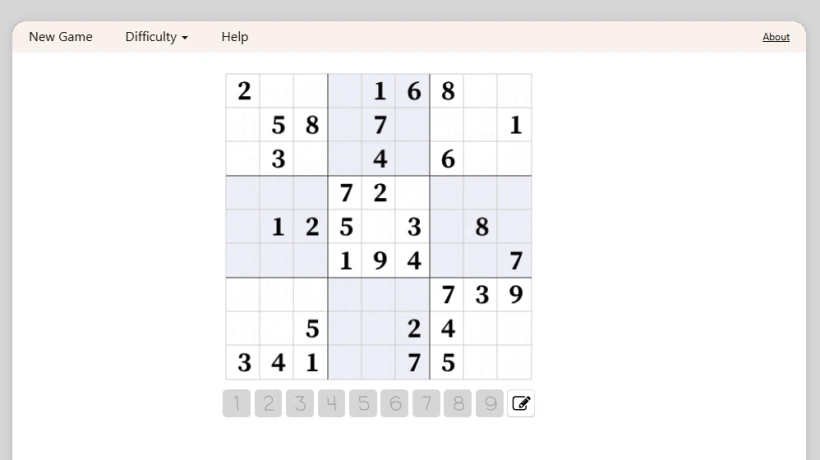
Sudoku offers an accessible introduction to logical puzzles. For experienced players, increasingly difficult grids provide an ongoing mental challenge. With regular practice, Sudoku can become both an enjoyable pastime and a valuable exercise in concentration, deduction, and problem solving.
Sudoku is one of the most popular number puzzles in the world. The game combines simple rules with challenging logic, making it suitable for beginners, experienced puzzle players, and anyone who enjoys mental challenges. A standard Sudoku puzzle contains a 9×9 grid divided into nine smaller 3×3 boxes. The main objective is to fill every empty cell with numbers from 1 to 9 while following a specific set of rules.
Unlike many number games, Sudoku does not require advanced mathematics. Success depends mainly on observation, logical thinking, concentration, and careful decision making. With regular practice, players can develop better problem solving skills while enjoying a relaxing and rewarding activity.
What Is Sudoku and How Does It Work?
Sudoku is a logic-based puzzle that uses numbers from 1 to 9. A completed standard grid must contain each number exactly once in every row, column, and 3×3 box. Some numbers are provided at the beginning, while the remaining cells must be completed through logical deduction.
The rules are easy to understand, but finding the correct solution can become increasingly difficult depending on puzzle level. This combination of simple rules and complex reasoning has helped Sudoku become a favorite puzzle format across newspapers, books, websites, and mobile applications.
Understanding the Sudoku Grid
A standard Sudoku board contains 81 cells arranged in nine rows and nine columns. These cells are separated into nine 3×3 boxes. Every row must contain the numbers 1 through 9 without repetition. The same requirement applies to every column and every 3×3 box.
The starting numbers provide clues for solving the puzzle. Each clue reduces the possible choices for nearby empty cells. By examining these relationships, players can gradually complete the entire grid.
The Main Sudoku Rules
The basic rules of Sudoku are straightforward. Each row must contain numbers 1 through 9 without duplicates. Each column must also contain numbers 1 through 9 without duplicates. Every 3×3 box must contain numbers 1 through 9 without duplicates.
A number can only be placed in a cell when it does not conflict with the existing numbers in the same row, column, or box. Understanding these three restrictions is the foundation for solving Sudoku efficiently.
Why Sudoku Is Popular Around the World
Sudoku has remained popular because the game offers a balance between accessibility and difficulty. A beginner can understand the rules within minutes, while advanced puzzles can require significant concentration and sophisticated logical techniques.
Another reason for the popularity of Sudoku is flexibility. Players can solve a puzzle in a few minutes during a short break or spend much longer working through a difficult challenge. Sudoku also works well in printed form and digital formats, allowing players to choose a convenient way to play.
Sudoku for Mental Exercise
Sudoku provides an engaging form of mental exercise. Solving a puzzle requires players to remember information, compare possibilities, identify patterns, and make logical deductions. These activities encourage active thinking rather than passive entertainment.
Regular puzzle solving can also create a structured mental routine. Players often become more comfortable with analyzing information and eliminating incorrect possibilities as puzzle difficulty increases.
Sudoku for Relaxation and Focus
Although difficult puzzles can be demanding, Sudoku can also provide a calming activity. Focusing on one grid can help players temporarily move attention away from other distractions.
The process of finding a solution can create a strong sense of progress. Each correctly placed number reduces uncertainty and brings the puzzle closer to completion. This gradual progress can make Sudoku satisfying for both casual and dedicated players.
How to Solve Sudoku More Effectively
Learning a few basic techniques can make Sudoku easier and more enjoyable. The best approach is to begin with information that is already clear rather than making random guesses.
Start With Easy Numbers
Look for rows, columns, and boxes that already contain many numbers. These areas usually have fewer missing values, making it easier to identify the correct number for an empty cell.
For example, if a row contains eight different numbers, the missing number can be identified immediately. This simple technique is often called a single candidate approach.
Use Elimination
Elimination is one of the most important Sudoku techniques. Every empty cell has a group of possible numbers. Existing numbers in the same row, column, and box can eliminate several possibilities.
When only one possible number remains, that number can be placed safely. Repeating this process can reveal additional answers throughout the grid.
Look for Hidden Patterns
As puzzle difficulty increases, players may need to search for patterns involving multiple cells. Sometimes a particular number can only appear in one cell within a row, column, or box even when several cells remain empty.
Recognizing these patterns requires practice, but it can greatly improve solving speed. Advanced players often combine several techniques instead of relying on a single method.
Common Mistakes During Sudoku Games
Sudoku rewards accuracy, so one incorrect number can create problems later in the puzzle. A common mistake is placing a number because it appears likely without checking all three restrictions.
Another mistake is relying too heavily on guessing. Guessing may occasionally lead to a solution, but logical deduction provides a more reliable approach. Players should also avoid ignoring earlier possibilities when new numbers change the structure of the puzzle.
Check Every Placement Carefully
Before entering a number, check the entire row, column, and 3×3 box. This quick habit can prevent many errors.
Digital Sudoku games often provide automatic error checking, but learning to verify numbers manually can improve logical skills and make traditional paper puzzles easier to solve.
Different Levels of Sudoku Difficulty
Sudoku puzzles are commonly described as easy, medium, hard, or expert. Difficulty depends on the number and arrangement of starting clues as well as the logical techniques required for solving.
Easy Sudoku
Easy puzzles usually provide many clues and allow players to find answers through straightforward elimination. These puzzles are ideal for beginners who are learning the basic rules.
Medium and Hard Sudoku
Medium puzzles require more attention and may involve several layers of elimination. Hard puzzles can require advanced pattern recognition and careful candidate management.
Expert Sudoku puzzles may provide fewer obvious opportunities and require players to connect information across different parts of the grid. These challenges are especially appealing to experienced players who want a deeper logical test.
Benefits of Playing Sudoku Regularly
Sudoku offers more than entertainment. The game encourages concentration, logical reasoning, patience, and attention to detail. Players must evaluate information carefully before making decisions.
Sudoku can also encourage persistence. Difficult puzzles may not reveal solutions immediately, so players learn to continue analyzing the grid instead of giving up after the first obstacle.
For students and adults, Sudoku can serve as an enjoyable way to incorporate structured thinking into free time. The game does not require expensive equipment, special knowledge, or complicated preparation.
Enjoy the Challenge of Sudoku
Sudoku remains popular because it transforms a simple 9×9 grid into a challenging test of logic. The rules are easy to learn, yet the possibilities can become remarkably complex. Whether a player chooses an easy puzzle for relaxation or an expert puzzle for a serious challenge, every completed grid provides a rewarding feeling.
With consistent practice, players can become faster at identifying patterns, eliminating possibilities, and making accurate decisions. Sudoku is therefore more than a number puzzle. It is an accessible mental challenge that can provide entertainment, focus, and opportunities to strengthen logical thinking. Start with a comfortable difficulty level, apply the basic rules carefully, and gradually explore more advanced solving techniques.



Comments
Login to Comment