Philippines Electronics Imports 2025: Latest Import Data Under HS Code 85
06 Oct, 2026
8 Views 0 Like(s)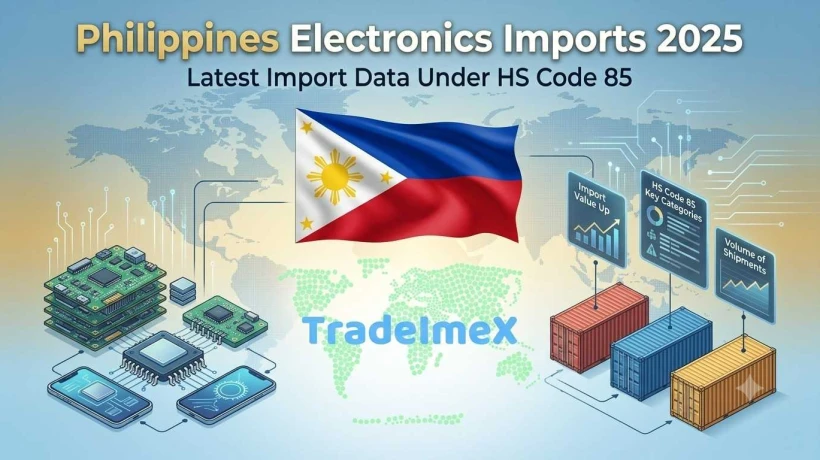
According to the latest Philippines electronics import data, Philippines imports under HS Code 85 reached $33.53 billion in 2025, marking a 20.69% year-on-year increase.
The Philippines continued to strengthen its position as a major electronics manufacturing, assembly, & sourcing hub in Southeast Asia in 2025. Electronics are deeply connected with the country's semiconductor industry, telecommunications infrastructure, industrial manufacturing, consumer markets, and export-oriented production. According to the latest Philippines electronics import data, Philippines imports under HS Code 85 reached $33.53 billion in 2025, marking a 20.69% year-on-year increase.
The scale of this market is significant because the Philippines is not only importing finished electronic products. A substantial share of imports consists of integrated circuits, semiconductor devices, printed circuits, cables, transformers, communication equipment, and other intermediate inputs required by its electronics and semiconductor industries.
Philippines Electronics Import Data 2025: Key Highlights
Total Philippine merchandise imports reached $134.20 billion in 2025, while products classified under HS Code 85 accounted for $33.53 billion. This made electronics one of the country's most important import segments. The country's electronic-product imports measured under the Philippine Statistics Authority's commodity classification reached $32.03 billion, accounting for 23.9% of total Philippine imports.
At the same time, Philippine HS Code 85 exports stood at around $44.43 billion, producing total HS 85 trade turnover of around $77.94 billion. This demonstrates that the country functions as both a major importer and exporter of electronics, with imported components supporting domestic manufacturing, assembly, processing, and re-export activities.
What Does HS Code 85 Cover?
HS Code 85 encompasses a broad range of electrical machinery and electronic equipment. It includes electronic integrated circuits, telephones and communication apparatus, semiconductor devices, insulated wires and cables, printed circuits, electrical switching and protection equipment, transformers, batteries, recording media, and various other electrical products.
In 2025, the Philippines imported $33.53 billion worth of products under this HS chapter. The composition of imports is particularly revealing because electronic components and intermediate goods dominate the market rather than finished consumer electronics alone.
This structure highlights the country's role within international electronics supply chains. Manufacturers operating in the Philippines require large volumes of imported chips, semiconductor devices, circuit boards, cables, power equipment, and communication components.
Top Countries Supplying Electronics to the Philippines
China was the largest supplier of HS 85 products to the Philippines in 2025, accounting for around $11.25 billion, or 33.6% of total HS 85 imports. South Korea ranked second with around $4.28 billion, representing 12.8%, while Japan supplied around $3.22 billion, equivalent to 9.6%. Taiwan followed with $3.03 billion, or 9.1%, reflecting the critical role of East Asian semiconductor and electronics networks.
The United States supplied around $2.48 billion, representing 7.4%, while Singapore contributed around $2.26 billion, or 6.8%. Other significant suppliers included Malaysia at $1.33 billion, Vietnam at $1.18 billion, Thailand at $998.16 million, and Hong Kong at $827.06 million. The concentration of supply among Asian economies demonstrates how closely the Philippines is connected to the broader regional electronics ecosystem.
China Dominates Philippines Electronics Import Supply
China's leading position is particularly important for businesses studying the Philippines electronics import market. Philippine imports of electrical and electronic equipment from China reached around $11.26 billion in 2025. The product mix included integrated circuits, telephony equipment, insulated wires and cables, semiconductor devices, printed circuits, transformers, and electric accumulators.
China's ability to supply both components and finished or semi-finished electronic products makes it an important sourcing market for Philippine businesses. The wider regional picture reinforces this trend. East Asia accounted for $41.87 billion, or 53.6%, of Philippine imports during the first half of 2026, making it the country's largest geographic source of imports.
Electronic Integrated Circuits Lead Imports
Electronic integrated circuits under HS Code 8542 were by far the largest electronics import category in 2025. Philippine imports of integrated circuits reached around $16.88 billion, representing 50.37% of total HS Code 85 imports. This extraordinary concentration reflects the country's importance in semiconductor assembly and electronics manufacturing. Integrated circuits are essential inputs for computers, smartphones, telecommunications equipment, automotive electronics, industrial machinery, consumer electronics, and numerous other technologies.
Other major imported categories included telephones and communication apparatus under HS 8517 at $2.94 billion, diodes, transistors and semiconductor devices under HS 8541 at $2.06 billion, and insulated wire, cable and optical fibre under HS 8544 at $1.66 billion. Printed circuits under HS 8534 generated $1.27 billion, while electrical switching and protecting apparatus under HS 8536 reached $1.10 billion. Electrical transformers and inductors under HS 8504 accounted for $989.34 million, followed by electric accumulators at $738.62 million.
These figures demonstrate that semiconductor components, connectivity equipment, electrical infrastructure, and manufacturing inputs represent the core of Philippine electronics demand.
Ten-Year Growth in Philippines Electronics Imports
The long-term trend shows that demand for HS 85 products has expanded considerably. Philippine HS 85 imports increased from $20.70 billion in 2016 to $21.54 billion in 2017 and $28.34 billion in 2018. Imports remained substantial at $26.98 billion in 2019 and $25.91 billion in 2020.
The market recovered strongly afterward, reaching $31.09 billion in 2021 and $32.54 billion in 2022. Although imports declined to $27.14 billion in 2023, they increased to $27.75 billion in 2024 before jumping to $33.53 billion in 2025. This makes 2025 the strongest year in the period shown, underlining the renewed momentum in Philippine electronics demand.
Semiconductor Demand Drives the Market
Semiconductors are at the heart of Philippine electronics imports. In addition to the $16.88 billion of integrated circuits, the country imported around $2.06 billion of diodes, transistors, and semiconductor devices. Other components supporting electronics production included $1.27 billion of printed circuits, $1.10 billion of electrical switching and protecting equipment, and $989.34 million of transformers and inductors. The strength of these categories points to sustained demand from semiconductor assembly, electronics manufacturing, industrial equipment, telecommunications, automotive electronics, and other technology-intensive sectors.
Electronics Imports Continue Rising in 2026
The strong momentum did not end in 2025. During January-June 2026, Philippine imports under HS Code 85 reached around $23.76 billion, representing a 29.11% year-on-year increase from the corresponding period of 2025. Electronic products represented 30.4% of total Philippine imports during the first half of 2026, remaining the country's largest import commodity group. This provides an indication that electronics demand was accelerating rather than simply recovering from the previous year's performance.
Why Philippines Electronics Import Data Matters
For exporters, manufacturers, sourcing companies, distributors, & market researchers, Philippines electronics import data provides valuable insight into the structure of the country's technology supply chain. Businesses can analyze import activity at the HS code and product level to identify high-demand categories such as integrated circuits, semiconductor devices, communication equipment, printed circuits, cables, transformers, and batteries. Country-level analysis can then reveal where Philippine buyers are sourcing these products.
Shipment-level global trade data can provide an even deeper view by connecting products with importers, suppliers, countries, ports, shipment activity, and historical purchasing patterns. This can help companies identify potential buyers, assess competitors, discover sourcing opportunities, and evaluate market-entry strategies.
Conclusion
The latest Philippines electronics import figures show a market expanding at a strong pace. HS Code 85 imports reached $33.53 billion in 2025, up 20.69% year on year, with electronic integrated circuits accounting for an impressive $16.88 billion, or more than half of the chapter's import value. China remained the leading supplier with $11.25 billion, followed by South Korea, Japan, Taiwan, and the United States. Meanwhile, strong first-half 2026 imports of $23.76 billion indicate that the market has maintained its growth trajectory.
For companies looking to understand Philippine sourcing patterns, identify electronics buyers, or assess opportunities across semiconductor and electrical product categories, detailed import statistics provide an important foundation for informed market decisions. Contact info@tradeimex.in for the latest Philippines electronics import data by country or HS code, AI-driven trade search on the top electronics importers in Philippines, customized trade reports, and market insights.
Also read about:
How to Use the TradeImeX AI Search Tool

Comments
Login to Comment