Key Management in Cryptography: How Access Policies Improve Cryptographic Security
23 Oct, 2026
17 Views 0 Like(s)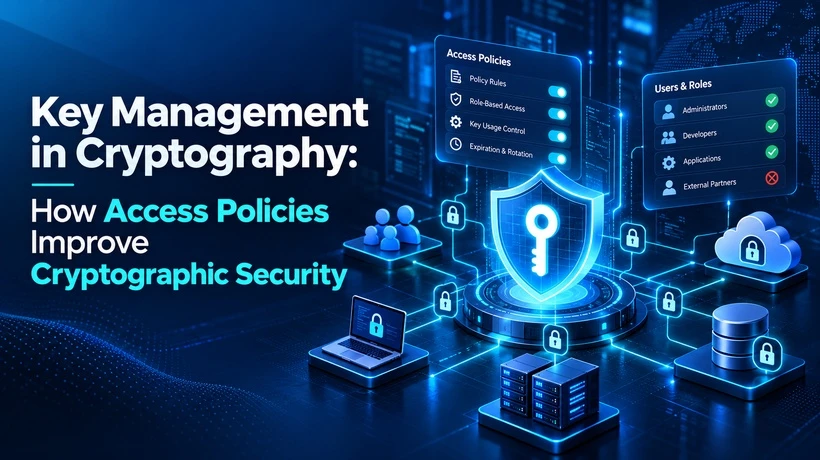
Access policies determine who and what can interact with cryptographic keys, making them an important part of enterprise security. Key management in cryptography helps organizations establish controlled access to the keys protecting sensitive data and applications.
Introduction
Cryptographic keys are essential to modern data security.
Organizations use them to encrypt information, authenticate applications, secure communications, protect databases, and support digital certificates.
However, cryptographic keys can create significant security risks when organizations provide excessive or poorly controlled access.
A strong encryption system cannot provide adequate protection if unauthorized users or applications can obtain the keys behind it.
This makes access policies an important part of key management in cryptography.
Effective Key management should define who can access a key, which applications can use it, what operations they can perform, and when that access should end.
Why Cryptographic Access Policies Matter
Not every employee, application, or service requires access to every cryptographic key.
For example, an application that processes customer information may need access to a specific encryption key.
It should not automatically receive access to keys used by:
-
HR applications
-
Financial systems
-
Internal databases
-
Backup infrastructure
-
Development environments
Access policies create boundaries around cryptographic assets.
Understanding Key Management in Cryptography
Key management in cryptography covers the complete lifecycle of cryptographic keys.
This includes:
-
Generation
-
Storage
-
Access
-
Usage
-
Rotation
-
Backup
-
Recovery
-
Retirement
-
Destruction
Access policies should operate throughout this lifecycle.
Applying Least Privilege
Least privilege means providing only the permissions necessary for an approved task.
Organizations should apply this principle to cryptographic keys.
A user may need permission to request a cryptographic operation without needing direct access to the underlying key material.
Similarly, an application may need to use a specific key without receiving access to unrelated keys.
This approach reduces unnecessary exposure.
User Access Policies
Organizations should define which administrators and security personnel can manage cryptographic keys.
Administrative permissions should be limited according to job responsibilities.
Businesses should regularly review access when employees:
-
Change roles
-
Leave the organization
-
Move between departments
-
Take on new responsibilities
Removing unnecessary access helps maintain stronger control.
Application Access Policies
Applications may require cryptographic operations to perform business functions.
Organizations should define which applications can access specific keys.
For example, a payment service may access payment-related cryptographic operations, while a customer support application receives access only to the keys required for its approved functions.
This creates logical separation between workloads.
Service Accounts
Automated workloads often use service accounts.
These accounts may have access to cryptographic services.
Organizations should define:
-
Ownership
-
Purpose
-
Permissions
-
Rotation
-
Expiration
-
Revocation
Service accounts should not receive broad access simply because they operate automatically.
Authentication and Authorization
Strong Key management should distinguish authentication from authorization.
Authentication determines who or what is requesting access.
Authorization determines whether that identity has permission to perform the requested operation.
Both controls are important for protecting cryptographic assets.
Monitoring Access to Keys
Organizations should monitor access to important cryptographic keys.
Security teams should review:
-
Successful key access
-
Failed access attempts
-
Permission changes
-
Administrative actions
-
Key creation
-
Key rotation
-
Key retirement
Monitoring can help identify suspicious behavior.
Key Rotation and Access Policies
Key rotation can affect access policies.
When organizations replace a key, they must ensure that authorized applications can use the new key while preventing unnecessary access to the old one.
Security teams should identify application dependencies before rotation.
Temporary Access
Some situations may require temporary access to cryptographic keys.
For example, an administrator may need elevated permissions during an incident or migration.
Organizations should define procedures for temporary access.
Temporary permissions should expire when the approved task ends.
Cloud Access Policies
Cloud environments may involve many identities and services.
Organizations should define access policies for:
-
Cloud applications
-
Service accounts
-
Administrators
-
APIs
-
Automated workloads
Centralized Key management can help organizations apply consistent policies across supported cloud environments.
Database Encryption Keys
Database encryption keys should receive strict access controls.
Applications should receive only the access required to perform their approved functions.
Database administrators may need different permissions from security administrators.
Separating these responsibilities can improve governance.
Digital Certificates
Digital certificates use cryptographic keys to establish trusted identities.
The associated private keys require strong access controls.
Organizations should define who can:
-
Create certificates
-
Access private keys
-
Renew certificates
-
Replace keys
-
Revoke credentials
Protecting Keys During Development
Development environments can create additional risks.
Organizations should avoid exposing production keys to development teams unless there is a specific business requirement.
Separate environments and access policies can reduce unnecessary exposure.
Access Reviews
Organizations should review cryptographic permissions regularly.
A review should identify:
-
Unused permissions
-
Excessive access
-
Former employees
-
Retired applications
-
Outdated service accounts
Regular reviews help keep access aligned with current business requirements.
Common Access Policy Challenges
Excessive Permissions
Users or applications may receive broader access than necessary.
Shared Credentials
Multiple users may use the same administrative credentials.
Poor Documentation
Teams may not know who owns specific permissions.
Inactive Accounts
Former users or obsolete services may retain access.
Fragmented Policies
Different teams may use different access standards.
Best Practices
Organizations should:
-
Apply least privilege
-
Define key ownership
-
Separate administrative responsibilities
-
Use strong authentication
-
Review permissions regularly
-
Restrict application access
-
Control service account permissions
-
Monitor key usage
-
Establish temporary access procedures
-
Remove obsolete permissions
-
Protect private keys
-
Document cryptographic access policies
Building a Policy-Driven Key Management Framework
A strong framework can follow this process:
Identify → Classify → Authorize → Monitor → Review → Revoke
Organizations first identify cryptographic assets, then classify their importance and establish appropriate access policies.
Security teams monitor activity and regularly review permissions.
When access is no longer required, organizations revoke it.
Conclusion
Access control forms a critical part of cryptographic security.
Organizations must ensure that only authorized users, applications, and services can interact with sensitive cryptographic keys.
Key management in cryptography provides the framework for managing keys throughout their lifecycle, while effective Key management applies access controls, least privilege, authentication, authorization, monitoring, rotation, and revocation.
By creating clear access policies and reviewing them regularly, enterprises can reduce unnecessary key exposure and establish stronger control over the cryptographic infrastructure protecting their sensitive information.



Comments
Login to Comment