India Aerospace Composites Market Size, Share Analysis, Growth, Outlook and Trends Report 2026-2034
26 Oct, 2026
8 Views 0 Like(s)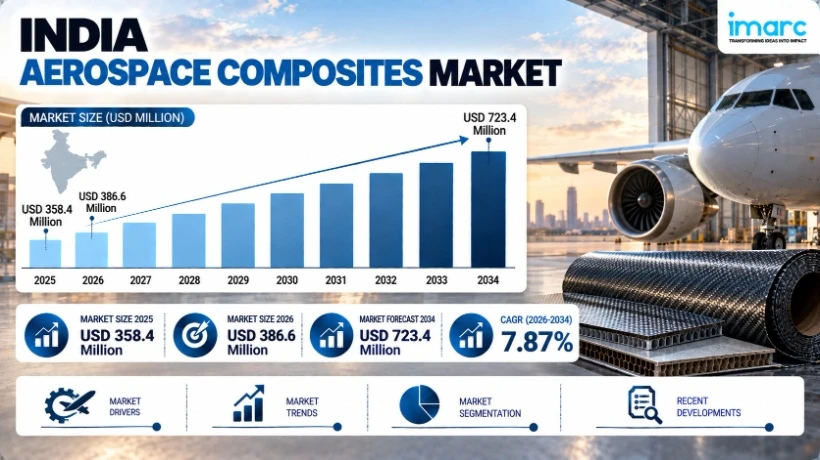
India aerospace composites market grew from USD 358.4 Million in 2025 to USD 394.5 Million in 2026. Looking forward, IMARC Group expects the market to reach USD 723.4 Million by 2034, exhibiting a growth rate (CAGR) of 7.87% during 2026-2034
India Aerospace Composites Market Outlook
This IMARC Group study provides a forecast of market size, share, and emerging trends for the India Aerospace Composites Market for 2026–2034. The report covers segmentation by fiber type, resin type, aircraft type, application, manufacturing process, and region, with regional coverage across North India, West and Central India, South India, and East and Northeast India.
Market Snapshot
-
Base Year Market Size (2025): USD 358.4 Million
-
Forecast Market Size (2034): USD 723.4 Million
-
CAGR (2026–2034): 7.87%
What Is the Current Size of the India Aerospace Composites Market?
The India Aerospace Composites Market grew from USD 358.4 Million in 2025 to USD 394.5 Million in 2026 and is projected to reach USD 723.4 Million by 2034, expanding at a CAGR of 7.87% during 2026–2034. Growth rests on global OEM sourcing expansion into India, indigenous carbon fibre capacity development, military and commercial aircraft assembly programs, and state-backed composites manufacturing clusters.
What Are the Emerging Trends in the India Aerospace Composites Market?
Global OEM Sourcing Scales Beyond Pilot Programs
FACC expanded its cooperation with Kineco Aerospace in Goa to a second work package of composite components for Airbus, covering several thousand parts per year with serial production scheduled by end-2027 . Boeing aims to make India its largest foreign supplier base, with more than 325 Indian suppliers of parts and services worth $1.25 billion, while Airbus targets increasing Indian sourcing from $1.4 billion to $2 billion annually . This matters because it signals that global aerospace supply chains are treating India as a production base rather than a low-cost sourcing option. Long-term work packages with qualification milestones create predictable demand for composite manufacturing capacity.
Indigenous Carbon Fibre Capacity Moves from Lab to Plant
The Bombay Textile Research Association and Maharashtra Industrial Development Corporation signed an MoU in July 2026 to establish India’s first 120 TPA Carbon Fibre Technology Demonstration Plant at PM MITRA Park in Amravati . The facility includes a technology demonstration plant, R&D centre, testing laboratory, and scale-up facility. This matters because aerospace-grade carbon fibre is currently imported, adding cost and supply chain vulnerability. Domestic demonstration capacity, even at pilot scale, creates the foundation for commercial production that aerospace manufacturers need to reduce lead times and currency exposure.
Large-Format Additive Manufacturing Cuts Tooling Lead Times
Lohia Aerospace signed an MoU with Massivit in August 2026 to install large-format 3D-printing for composite tooling at its Kanpur facility, the first commercial deployment of the technology for composite manufacturing in India . The company plans to invest USD 8 million to USD 10 million over two years and expects production cycles to shrink by up to 90% . This matters because tooling is a bottleneck in composites manufacturing. Faster tool production allows suppliers to respond to design changes and ramp production without waiting weeks for imported moulds.
Military Aircraft Programs Anchor Domestic Composite Demand
Tata Advanced Systems operates composite manufacturing facilities in Bangalore, Nagpur, and Hyderabad, producing advanced composite floor beams, tail cones, wing spars, and control surfaces for global aerospace programs . The company has delivered 300 AH-64 Apache attack helicopter fuselages and shipped its first vertical fin structures for the 737 family . This matters because military and commercial programs provide volume commitments that justify investment in autoclaves, clean rooms, and NDT equipment. Once these capabilities exist, they can serve additional programs as India’s aerospace ecosystem expands.
Download Sample Report with Datasheet: https://www.imarcgroup.com/india-aerospace-composites-market/requestsample
What Factors Are Driving the Growth of the India Aerospace Composites Market?
Airbus and Boeing Localization Commitments Create Volume
Airbus is establishing a C-295 military aircraft factory in Gujarat with Tata Advanced Systems, the first time Airbus has deployed an aircraft’s entire production system outside its home nation . Boeing signed an agreement with TASL for advanced composite assemblies for the 737 MAX, 777X, and 787, produced in Bengaluru and Nagpur . These commitments matter because they convert India from a parts supplier into a structural assembly location. Aircraft assembly requires composite components at scale, creating sustained demand beyond individual work packages.
Indigenous Trainer Aircraft Program Uses All-Composite Airframe
CSIR-NAL launched the production version of the Hansa-3(NG) trainer aircraft, India’s first all-composite airframe two-seater, with an industry partner setting up a ₹150 crore facility in Kuppam, Andhra Pradesh, to produce up to 100 aircraft annually . The program addresses a requirement for nearly 30,000 pilots over the next 15–20 years . This matters because trainer aircraft production creates recurring demand for composite airframes at a scale that military programs alone do not provide. It also demonstrates that indigenous design can fully utilize composite materials.
Global Supply Chain Diversification Favors India
CompositesWorld’s market forecast identifies India as the world’s fastest-growing composites market, with carbon fiber value chain growth running at roughly twice the rate of other composite categories . This growth coincides with global aerospace companies seeking to reduce concentration in single-region supply chains. India’s combination of engineering talent, lower manufacturing costs, and government support for aerospace manufacturing makes it a beneficiary of this diversification. The trend matters because supply chain decisions made now will determine production locations for the next decade.
State Government Incentives Support Manufacturing Clusters
Maharashtra’s PM MITRA Park in Amravati is hosting the carbon fibre demonstration plant, supported by MIDC and aligned with the PM MITRA scheme . The project aims to reduce import dependence, strengthen domestic manufacturing, and develop skilled manpower for the advanced composites sector . This matters because composite manufacturing requires specialized infrastructure and trained workers. State-backed industrial parks provide shared facilities and reduce the capital burden on individual companies entering the sector.
What Are the Opportunities in the India Aerospace Composites Market?
Tier-2 Supplier Development for Global OEM Programs
Tata Advanced Systems operates three composite plants and employs over 1,800 trained workers, but the scale of Airbus and Boeing commitments requires a broader supplier base . The opportunity lies in developing Tier-2 suppliers that can produce sub-components, tooling, and specialized services for Tier-1 manufacturers. As global OEMs increase Indian sourcing, they need suppliers beyond the few established players. Companies with AS9100 and NADCAP certifications can position themselves for work packages that larger manufacturers subcontract.
Carbon Fibre Commercial Production Beyond Demonstration Scale
The 120 TPA demonstration plant at Amravati is a pilot facility, but aerospace demand requires commercial volumes . The opportunity lies in scaling indigenous carbon fibre production once the technology is validated. Aerospace-grade carbon fibre commands premium pricing and long-term contracts. Domestic production would reduce lead times for Indian composite manufacturers and allow them to source locally rather than relying on imported fibre with long shipping cycles.
Additive Manufacturing for Tooling and Complex Parts
Lohia Aerospace’s Massivit installation targets composite tooling, but large-format additive manufacturing can also produce complex composite parts with internal structures that traditional layup cannot achieve . The opportunity lies in applying the technology beyond tooling to end-use components. As the technology matures and material properties are qualified for aerospace use, additive manufacturing could reduce part count and assembly time for complex geometries.
What Are the Challenges in the India Aerospace Composites Market?
Qualification Cycles Limit Speed of Supplier Onboarding
FACC’s second work package with Kineco Aerospace requires completion of a qualification milestone with Airbus before serial production begins by end-2027 . Aerospace qualification is rigorous and time-consuming, covering process certification, material testing, and part validation. This matters because new suppliers cannot simply enter the market with competitive pricing. They must invest in certification and wait through qualification cycles that can take years. The barrier protects established suppliers but slows the expansion of capacity.
Carbon Fibre Import Dependence Persists
India’s carbon fibre production remains at demonstration scale, with the 120 TPA plant not yet operational . Aerospace-grade carbon fibre requires consistent properties and traceability that few domestic sources can currently provide. This matters because imported fibre adds freight costs, currency risk, and lead time variability. Until domestic commercial production achieves aerospace qualification, Indian composite manufacturers remain exposed to global supply chain disruptions.
Skilled Workforce Shortage Constrains Expansion
Composite manufacturing requires trained technicians for layup, autoclave operation, NDT inspection, and quality assurance. Tata Advanced Systems employs over 1,800 workers across three plants, but the industry’s growth plans require many more . The BTRA-MIDC project includes a skill development and training centre, recognizing the gap . This matters because composite manufacturing is less automated than metal machining. The quality of hand layup and inspection directly affects part performance, making workforce capability a critical constraint on expansion speed.
What Are the Key Market Segments in the India Aerospace Composites Market?
The India Aerospace Composites Market is segmented by fiber type, resin type, aircraft type, application, manufacturing process, and region.
Which Fiber Types Lead the India Aerospace Composites Market?
-
Carbon Fiber Composites
-
Ceramic Fiber Composites
-
Glass Fiber Composites
-
Others
Carbon fiber composites lead because they offer the highest strength-to-weight ratio among aerospace materials, making them the default choice for primary structures and control surfaces where weight reduction directly improves fuel efficiency. Glass fiber composites follow as a lower-cost alternative for secondary structures and interior components where extreme performance is not required.
Which Resin Types Lead the India Aerospace Composites Market?
-
Epoxy
-
Phenolic
-
Polyester
-
Polyimides
-
Thermoplastics
-
Ceramic and Metal Matrix
-
Others
Epoxy leads because it offers the best balance of mechanical properties, processability, and cost for aerospace composites, and it has the widest qualification base with OEMs. Phenolic follows for interior applications where fire resistance and low smoke toxicity are critical requirements.
Which Aircraft Types Lead the India Aerospace Composites Market?
-
Commercial Aircraft
-
Business Aviation
-
Civil Helicopters
-
Military Aircraft and Helicopters
-
Others
Commercial aircraft leads because global OEM sourcing commitments from Airbus and Boeing are driving the largest volume of composite work packages in India . Military aircraft and helicopters follow as indigenous defense programs and offset obligations create demand for domestic composite structures.
Which Applications Lead the India Aerospace Composites Market?
-
Interior Parts
-
Exterior Parts
Exterior parts lead because primary and secondary structures like floor beams, wing spars, and fuselages use the highest volumes of composite material per aircraft. Interior parts follow as airlines and OEMs seek lightweight panels and closeout components that reduce weight while meeting fire safety standards.
Which Manufacturing Processes Lead the India Aerospace Composites Market?
-
AFP/ATL
-
Layup
-
RTM/VARTM
-
Filament Winding
-
Others
Layup leads because it is the most established process for aerospace composite structures and is used by domestic manufacturers like Tata Advanced Systems for floor beams and control surfaces . AFP/ATL is the faster-growing process for large structures as automation reduces labor intensity and improves consistency.
Which Regions Lead the India Aerospace Composites Market?
-
North India
-
West and Central India
-
South India
-
East and Northeast India
South India leads because Bengaluru and Hyderabad host Tata Advanced Systems’ composite facilities and major aerospace clusters, supported by engineering talent and existing OEM relationships . West and Central India is the significant secondary region, with Nagpur’s composite floor beam production and Gujarat’s C-295 assembly facility driving demand.
Who Are the Key Players in the India Aerospace Composites Market?
Competitive Landscape & Key Player Positioning:
Covering an in-depth analysis of the competitive landscape, market structure, key player positioning, competitive dashboards, top winning strategies, and detailed profiles of all major industry participants you will gain access to all these exclusive insights within the full research report.
What Are the Latest Recent Developments in the India Aerospace Composites Market?
In August 2026, FACC expanded its cooperation with Kineco Aerospace in Goa to a second work package of composite components for Airbus, comprising several thousand parts per year with serial production scheduled to start by the end of 2027 following completion of a qualification milestone with Airbus . The deal builds on a long-term supply chain agreement signed at the 2025 Paris Air Show.
Customization Note: If you require any specific information not covered within this report's scope, we will provide it as part of the customization.
Request Report Customization: https://www.imarcgroup.com/request?type=report&id=21587&flag=E
Media Contact:
Company Name: IMARC Group
Email: sales@imarcgroup.com
Contact: +1-201971-6302
Address: 134 N 4th St., Brooklyn, NY 11249, USA


Comments
Login to Comment