How Does a Robotic Palletizer Support Multiple Product and Pallet Patterns?
26 Oct, 2026
13 Views 0 Like(s)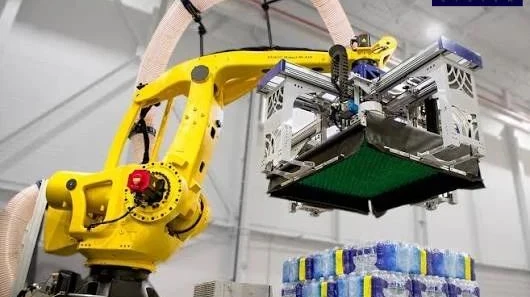
A robotic palletizer supports multiple product and pallet patterns by using programmable robotic arms equipped with adaptive grippers and vision systems.
Changing between these patterns on a conventional machine requires mechanical adjustment and considerable downtime. In a robotic system, it’s a recipe change—selected on a touch screen and confirmed in seconds.
Enabling Multi-SKU Palletizing in High-Mix Environments
One of the most complex challenges in end-to-end automation is multi-SKU palletizing. "If you have ten product variants coming off different lines at different rates, synchronization is key.
There are a few ways robots deal with this:
-
Managing recipes: Each SKU has a recipe that is stored with the gripper settings, layer patterns, pallet type, and slip sheet requirements. Switching takes less than 2 minutes.
-
Barcode and RFID reading: Products are automatically identified as they arrive to trigger the correct palletizing routine without operator input.
-
Mixed-pallet building: Sophisticated systems are able to accept product from multiple SKUs at the same time and create retailer-specified mixed pallets in one cycle.
This functionality is particularly important to FMCG manufacturers who supply modern trade retailers in Malaysia, where retailers are increasingly requesting store-ready pallets with specific product mixes and label orientations.
Dealing with Various Product Formats—Bags, Boxes, Cartons, etc.
Not all products will end up the same at the end of the line. The filled bags deform under pressure. Glass bottles topple over. Multipacks, shrink-wrapped, slide. A robotic palletizer must be designed around these physical realities.
Specific Handling Considerations for the Product
-
Bags (rice, flour, pet food): Require wide, padded vacuum or clamp grippers. Pallet patterns are usually column stacked with interlayer sheets to avoid slippage.
-
Corrugated cartons (beverages, canned goods): - Vacuum cup grippers. Layer patterns are close-packed and can be programmed for high stack heights.
-
Shrink-wrapped trays or multipacks: Require gentle handling with adjustable clamp pressure. The flexibility of the packaging material must be considered in pattern programming.
-
Bottles and jars: Often need to be row by row with precision alignment. Vision systems are very important to maintain orientation for label visibility.
The ability of automatic robots to work with all these formats—on the same production floor and in the same system—is what makes them a long-term investment rather than a single-purpose tool.
How Can It Help Manufacturers Perform Better?
The transition to robotic palletizing brings measurable operational gains beyond flexibility that are meaningful to plant directors and production managers.
-
Less dependency on labor: Palletizing is a physically demanding and repetitive task. Automation eliminates the ergonomic risk and reduces headcount pressure in a tight labor market.
-
Consistent stack quality: All pallets are built to specification—no layer misalignments, no overhang, and no operator or shift variation.
-
Quick Changeovers: Recipe-based switching means format changes that used to take 30-45 minutes now take less than five.
-
Data integration: Modern systems are linked to MES and ERP platforms and log pallet counts, cycle times, and error rates for process optimization.
-
Scalability: With growth in product lines, new recipes are implemented in software—no capital expenditure on additional mechanical equipment.
Is a Robotic Palletizer the Right Choice for Your Line?
The answer depends on your product mix, throughput, and growth plans. If you have more than three to four SKUs, frequent changeovers or products with different physical characteristics, a robot system will almost always beat a fixed conventional palletizer over a three-to-five year horizon.
In Malaysia’s food, beverage, and packaging industries, where the number of products is growing and the rules around retail compliance are getting stricter, manufacturers are starting to see robotic palletizing not as an advanced option but as a basic expectation.
Buildtech provides robotic palletizing solutions tailored for high-mix manufacturing environments. If you are considering end-of-line automation for your facility, their team can help you match the right system configuration to your product mix and production targets. See Buildtech for their complete range of industrial automation solutions.
Common Questions
Can one robotic palletizer handle multiple product types at once?
Yes, one robotic palletizer can handle multiple product types at once.
Yes. More advanced robotic palletizers can take product from multiple conveyor lines and build mixed-SKU pallets in one cycle using barcode identification and pre-programmed recipes. Ideal for food and FMCG manufacturers with multiple product lines running simultaneously.
How fast can a robotic palletizer switch from one pallet pattern to another?
Modern robotic palletizing systems can switch from one stored pallet pattern recipe to another in less than two minutes using a touchscreen HMI. This is a major increase in speed over the mechanical retooling that traditional fixed palletizers require, reducing production downtime during changeovers.
What products can a robotic palletizer handle?
Robotic palletizers are capable of handling corrugated cartons, filled bags, shrink-wrapped multipacks, bottles, jars, and rigid cases. The system’s end-of-arm tooling and grip pressure settings are set for specific product types to safely and consistently handle varying packaging formats.
What is multi-SKU palletizing, and why is it important for FMCG producers?
Multi-SKU palletizing is the production of pallets with more than one variant of a product, something that is often required by modern trade retailers. It enables FMCG manufacturers to deliver pallets that are ready for the store and eliminates downstream sorting. Robotic systems do this automatically using recipe-based product identification and layer programming.
How does a robotic palletizer increase pallet stability compared to stacking by hand?
Robotic palletizers can provide consistent placement force, precise layer alignment, and interlocking patterns that manual stacking cannot reliably replicate. This reduces product damage in transit, reduces the number of rejected pallets at distribution centers, and ensures each stack meets the compliance standards of the retailer or logistics company.
Can robotic palletizing systems connect with existing factory software?
Yes. Most of the industrial robotic palletizing systems are built with integration to MES, ERP, and SCADA systems in mind. This allows for real-time data transfer of pallet counts, production rates, and error logs to enable continuous process improvement and traceability throughout the manufacturing operation.


Comments
Login to Comment