How to Ease Sciatica: Common Causes and Effective Relief Strategies
08 Aug, 2026
711 Views 0 Like(s)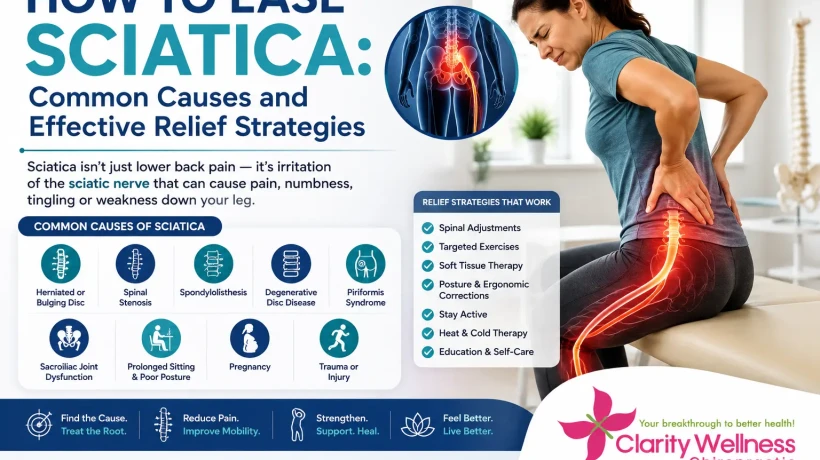
Last spring, a patient came to see me after two weeks of what he described as "a hot poker running down my leg every time I stood up from my desk."
Last spring, a patient came to see me after two weeks of what he described as "a hot poker running down my leg every time I stood up from my desk." He was a graphic designer who spent most of his day sitting, and he assumed the pain in his lower back was just tightness from a long project deadline. It was not until the pain started shooting past his knee and into his calf that he realized something else was going on. That something else was sciatica, and by the time he sat down with me, he had already tried three different pillows, a lot of ibuprofen, and near-total inactivity, none of which had helped much.
His story is a common one in my Etobicoke practice. Sciatica is one of the most talked about, and most misunderstood, types of pain I treat. So let us break down what it actually is, what causes it, and which relief strategies are genuinely backed by evidence rather than internet folklore.
What Sciatica Really Is
Sciatica is not a diagnosis in itself. It is a pattern of symptoms, specifically pain, numbness, tingling, or weakness that travels along the path of the sciatic nerve. This nerve is the longest and widest in the human body, formed from nerve roots in the lower spine, mainly at the L4, L5, and S1 levels, and it runs from the lower back through the buttock and down the back of the leg.
When something irritates or compresses one of those nerve roots, the nerve reacts along its entire length, not just at the site of irritation. That is why a problem in the lower back can produce a burning, shooting, or electric sensation that shows up as far away as the calf or the sole. Clinically, this is often called lumbosacral radiculopathy, and research suggests it affects roughly 13 to 40% of people at some point in their lives, with new episodes developing in about 1 to 5% of the population each year. In other words, if you are dealing with it right now, you are in very large company.
Causes of Sciatica
Understanding what is actually pinching or irritating the nerve is the first step toward easing it, because the right relief strategy depends heavily on the cause. Here are the most common ones I see.
Herniated or bulging disc. This is by far the leading cause, responsible for most sciatica cases. The soft cushioning discs between the vertebrae can bulge or rupture, pressing directly on a nearby nerve root.
Spinal stenosis. This is a narrowing of the spinal canal, often from age-related changes, that reduces the space available for nerves and increases the odds of compression.
Spondylolisthesis. This happens when one vertebra slips forward over the one below it, which can pinch the nerve roots exiting that level of the spine.
Degenerative disc disease. As discs naturally lose height and hydration with age, the space around nerve roots can shrink, making irritation more likely.
Piriformis syndrome. The piriformis is a muscle deep in the buttock that sits close to the sciatic nerve. When it becomes tight, inflamed, or spasms, it can compress the nerve and mimic classic sciatica, even though the spine itself may be completely fine. This condition is estimated to account for a meaningful share of sciatica-like presentations and is reported far more often in women than in men.
Sacroiliac joint dysfunction. The joint connecting the base of the spine to the pelvis can become irritated or move abnormally, referring pain down the leg in a pattern that closely resembles true sciatic nerve pain.
Prolonged sitting and poor posture. Sitting for long stretches increases pressure on the lower discs and can tighten the muscles around the pelvis, both of which raise the risk of nerve irritation. This is exactly what was happening with the designer I mentioned earlier.
Pregnancy. As the growing uterus shifts weight distribution and loosens pelvic ligaments, it can place added pressure on the lower spine and nearby nerves.
Trauma or direct injury. A fall, car accident, or sudden forceful movement can injure a disc or vertebra and trigger nerve compression.
Most of these causes overlap in real life. A person with early disc degeneration who then sits at a desk all day and has tight hip muscles is essentially stacking risk factors on top of each other, which is often exactly what I see walk through my door. This is part of why two people can describe nearly identical pain and end up needing quite different treatment plans. One person's sciatica might respond beautifully to hip and glute stretching because a tight piriformis is doing most of the damage. In contrast, another person's pain barely budges until we address the disc itself with a more targeted spinal approach. Figuring out which pattern you fall into, rather than treating every case of sciatica the same way, is where a proper assessment earns its value.
A Few Common Questions
Is sciatica the same as a pinched nerve?
Not exactly. A pinched nerve is a broader term for any nerve being compressed anywhere in the body. Sciatica is specifically what happens when that compression involves the sciatic nerve or the lumbar nerve roots that feed into it.
Can sciatica affect both legs at once?
It can, though it is far less common than one-sided pain. Bilateral symptoms, especially alongside numbness in the groin or new bladder changes, are red flags that warrant urgent evaluation rather than home care.
Does sciatica mean I need surgery?
For the vast majority of people, no. Surgery is generally reserved for cases involving significant, persistent neurological deficits or the rare emergency symptoms described below, and most people improve substantially with conservative, non-surgical care.
How to Ease Sciatica: What Actually Works
Here is the part most people want to skip straight to, and rightly so. The good news is that major clinical guidelines, including those from NICE in the United Kingdom and the American College of Physicians, converge on a similar first-line approach, and it is refreshingly low-tech.
Stay as active as you comfortably can. This might be the single most counterintuitive piece of advice, but prolonged bed rest is no longer recommended for sciatica. Guidelines consistently favor staying mobile and gradually building strength over extended rest, because movement helps nutrients circulate the disc and discourages the muscles around it from stiffening further.
Try gentle extension-based movement. Lying face down and slowly propping up on your forearms, similar to a modified cobra pose, can relieve pressure on the nerve root for some people, particularly when the pain pattern is moving from the leg back toward the spine, a sign clinicians call centralization. Stop immediately if any movement causes sharp new pain.
Stretch the piriformis and hip muscles. A simple seated or lying piriformis stretch, gently pulling the knee across the body toward the opposite shoulder, can ease pressure on the sciatic nerve where it passes near that muscle.
Use heat, and sometimes cold. Heat is well supported by evidence for easing muscular tension and improving comfort, especially in the first few days. Some patients also find brief periods of cold helpful for calming acute inflammation.
Correct your sitting setup. Since prolonged sitting is such a common contributor, small ergonomic changes, like a supportive chair, regular standing breaks, and keeping your knees roughly level with your hips, can meaningfully reduce ongoing irritation.
Consider chiropractic adjustment and manual therapy. Spinal manipulation is recommended in several major guidelines as part of a broader sciatica treatment plan that includes exercise, particularly for people whose pain has not resolved with self-care alone. In my practice, this often involves gentle, specific adjustments to reduce nerve irritation, combined with soft tissue work on tight surrounding muscles.
Build core and hip strength once the acute pain eases. Once the sharpest pain has settled, strengthening the muscles that support the lower spine and pelvis helps prevent the same pattern from returning.
Guidelines consistently advise against prolonged rest and urge caution with certain medications, since evidence for their benefit in sciatica specifically is weaker than most people assume.
When Sciatica Needs Urgent Attention
The overwhelming majority of sciatica is not dangerous, but there is a rare and serious complication called cauda equina syndrome that requires emergency care. Seek immediate medical attention if you experience any of the following:
-
Numbness in the saddle area, meaning the inner thighs, groin, or buttocks
-
New difficulty controlling your bladder or bowels
-
Rapidly worsening weakness in one or both legs
-
A foot that suddenly starts dragging or catching as you walk
-
Severe pain that begins right after a significant fall or accident
These symptoms are uncommon, but when they occur, timing matters enormously for recovery, so do not wait to see if they improve on their own.
A Realistic Recovery Timeline
Most people want to know how long this will last, and the honest answer is that it depends on the underlying cause, but the trend is genuinely encouraging. Many acute cases meaningfully improve within 4 to 6 weeks. If you are not seeing any improvement after 2 to 3 weeks of consistent self-care, that is generally a reasonable point to seek professional evaluation rather than continuing to wait it out. Cases tied to ongoing structural issues, like significant disc degeneration, may take longer and benefit from a more individualized plan. Still, the vast majority of people improve substantially with conservative care alone.
Putting It Into Practice
Sciatica can feel alarming, especially the first time that shooting pain travels down your leg. Still, it is rarely a sign of something dangerous, and it responds well to the right combination of movement, targeted stretching, posture correction, and hands-on care. Understanding your specific cause, rather than guessing, is what separates lasting relief from relief that keeps slipping away.
Dr. Clarise Chan is a chiropractor in Etobicoke, Ontario, with a focus on family and musculoskeletal care.



Comments
Login to Comment