How to Choose the Right AI Certification in 2026: A Complete Guide
20 Jul, 2026
940 Views 0 Like(s)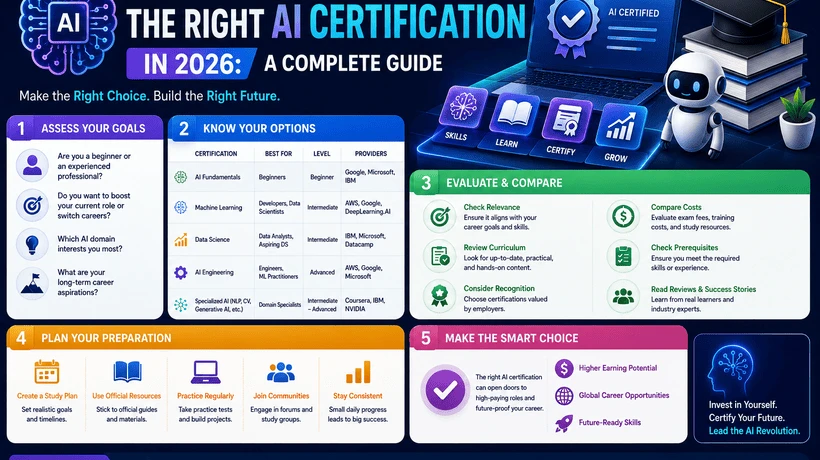
Learn how to choose the right AI certification in 2026 by comparing providers, career goals, skills, costs, and preparation strategies for long-term success.
Artificial Intelligence (AI) is reshaping industries faster than almost any other technology. Organizations are integrating AI into software development, cybersecurity, customer service, healthcare, finance, manufacturing, and cloud computing. As demand for AI professionals continues to rise, certifications have become an effective way to validate technical skills and demonstrate commitment to continuous learning.
However, choosing the right AI certification can be challenging. Today, dozens of certifications cover machine learning, generative AI, data engineering, cloud AI services, prompt engineering, and AI governance. Selecting the wrong certification may lead to unnecessary costs or preparation for skills that don't align with your career goals.
This guide explains how to evaluate AI certifications, identify the best option for your experience level, and build a certification path that supports long-term career growth in 2026.
Start with Your Career Goal
The best AI certification depends on the role you want to pursue rather than simply choosing the most popular credential.
Consider the type of work that interests you:
-
AI Engineer
-
Machine Learning Engineer
-
Data Scientist
-
Cloud AI Engineer
-
AI Solutions Architect
-
Generative AI Developer
-
AI Product Manager
Each role emphasizes different technical skills. For example, a cloud engineer may benefit more from learning managed AI services, while a machine learning engineer typically requires stronger knowledge of model development and deployment.
Defining your destination first makes it easier to select a certification that supports your long-term objectives.
Watch the latest Cert Mage YouTube AI certification guide.
Assess Your Current Skill Level
Before enrolling in any certification program, honestly evaluate your experience.
A beginner should focus on foundational concepts such as:
-
Artificial intelligence basics
-
Machine learning fundamentals
-
Responsible AI
-
Data fundamentals
-
Cloud computing basics
Intermediate professionals can move toward certifications covering model training, deployment, automation, and cloud AI services.
Experienced professionals often benefit from advanced certifications involving AI architecture, enterprise implementation, MLOps, and large-scale AI solution design.
Starting with an appropriate certification reduces frustration and builds confidence for more advanced learning.
Compare Certification Providers
Several technology companies offer respected AI certifications, each with a different focus.
|
Provider |
Best For |
Primary Focus |
|
Microsoft |
Business AI and Azure AI |
Azure AI services, responsible AI, generative AI |
|
Google Cloud |
Cloud AI professionals |
Vertex AI, machine learning, cloud AI solutions |
|
AWS |
Cloud developers and engineers |
Amazon AI services, machine learning, generative AI |
|
IBM |
Enterprise AI |
Watsonx, enterprise AI workflows |
|
NVIDIA |
AI infrastructure specialists |
GPU computing, deep learning, accelerated AI |
Rather than choosing a certification based solely on brand recognition, review the published exam objectives to ensure they match the technologies you expect to use professionally.
Review the Exam Objectives
Every reputable certification provider publishes an official exam guide describing the knowledge and skills measured.
Before selecting a certification, review:
-
Technical domains
-
Recommended experience
-
Exam format
-
Required prerequisites
-
Practical skills assessed
-
Supported technologies
This information helps you determine whether the certification aligns with your background and career plans.
If an exam focuses heavily on cloud services but your goal is data science, another certification may provide a better return on your study time.
Consider Hands-On Learning
AI is highly practical.
Employers increasingly expect candidates to demonstrate experience building, testing, deploying, or integrating AI solutions rather than simply understanding theoretical concepts.
Look for certifications that encourage practical learning through:
-
Cloud laboratories
-
Machine learning projects
-
AI model deployment
-
Prompt engineering exercises
-
Data preparation tasks
-
Real-world business scenarios
Hands-on experience strengthens both certification preparation and workplace readiness.
Evaluate Industry Recognition
Not every certification carries the same level of recognition.
Well-established vendors typically maintain:
-
Clearly defined certification paths
-
Regular exam updates
-
Industry partnerships
-
Official training resources
-
Active certification communities
Research job postings in your preferred industry to identify certifications employers frequently request. This simple step can help you prioritize credentials that have practical value in the job market.
Balance Cost and Value
Certification expenses include more than the exam fee.
When comparing options, consider:
-
Exam registration
-
Training courses
-
Practice labs
-
Study materials
-
Practice exams
-
Renewal requirements
A slightly more expensive certification may provide greater long-term value if it aligns closely with your career goals and employer demand.
Focus on the overall return on investment rather than the initial exam price alone.
Build a Long-Term Learning Path
AI technologies evolve rapidly.
Instead of viewing certification as a one-time achievement, consider building a structured learning path.
For example:
-
Begin with an AI fundamentals certification.
-
Learn cloud AI services.
-
Study machine learning deployment.
-
Explore generative AI technologies.
-
Develop MLOps and AI architecture skills.
This progressive approach builds practical expertise while allowing you to adapt as AI technologies continue to evolve.
Preparing for Success
Regardless of the certification you choose, a balanced study plan produces the best results.
An effective preparation strategy should combine:
-
Official documentation
-
Instructor-led training
-
Hands-on cloud labs
-
AI projects
-
Practice questions
-
Mock examinations
-
Regular revision
Many candidates also strengthen their preparation with updated practice questions, realistic exam simulators, and structured learning resources available on this website certmage.com, while continuing to use official vendor documentation and practical AI projects as their primary learning resources.
Conclusion
Choosing the right AI certification in 2026 begins with understanding your career goals, evaluating your current experience, and selecting a certification that aligns with the skills employers expect. Whether you are entering AI for the first time or expanding an existing cloud or data background, selecting the appropriate certification creates a stronger foundation for future growth.
Remember that certifications are most valuable when supported by practical experience, continuous learning, and real-world projects. By combining official training, hands-on practice, and consistent study, you can build skills that remain relevant as artificial intelligence continues to transform the technology industry.
FAQs
Which AI certification is best for beginners?
Beginner-friendly AI certifications usually focus on AI fundamentals, responsible AI, and basic machine learning concepts before introducing advanced cloud services or model development techniques.
Do I need programming experience before studying AI?
Not always. Many foundational AI certifications require little or no programming knowledge, although advanced machine learning and AI engineering certifications typically expect coding experience.
Which cloud provider offers the best AI certification?
Microsoft, Google Cloud, AWS, IBM, and NVIDIA all offer respected AI certifications. The best choice depends on your career goals, preferred technologies, and employer requirements.
How important are hands-on AI projects?
Hands-on projects help reinforce theoretical knowledge, improve problem-solving skills, and demonstrate practical experience that employers often value alongside certification achievements.
Should I earn multiple AI certifications?
Yes, if they support your career progression. Building certifications gradually across fundamentals, cloud AI, machine learning, and architecture creates a broader and more valuable skill set.
Read More: AI Certification Cost Guide 2026: Exam Fees, Training, and Preparation Resources


Comments
Login to Comment