How to Choose a Safe and Age-Appropriate Ballet Class for Toddlers
22 Sep, 2026
12 Views 0 Like(s)
Find the right ballet class for toddlers in Singapore with tips on age, instructors, class size, safety, teaching style, and trials.
Choosing the right ballet class for toddlers means checking for age-appropriate structure, qualified instructors, small class sizes, and a nurturing teaching approach. A good toddler ballet programme uses creative play, age-suitable movement, and a safe studio environment. Children aged 2.5 to 4 typically benefit most from classes that prioritise exploration over technique.
If your little one has started twirling around the living room, it might be time to find a proper class. But not every ballet programme is built with toddlers in mind. Here is what every parent should know before enrolling.
What Age Can Toddlers Start Ballet?
Most reputable dance schools in Singapore recommend starting structured ballet classes from age 2.5 to 3. At this stage, children have developed enough coordination and attention span to follow simple movement sequences. Classes for this age group focus on rhythm, spatial awareness, and imaginative play — not formal technique.
Enrolling too early, before a child is emotionally and physically ready, can create anxiety around dance rather than joy. A good programme meets children where they are developmentally.
8 Things to Check Before Enrolling Your Toddler in Ballet
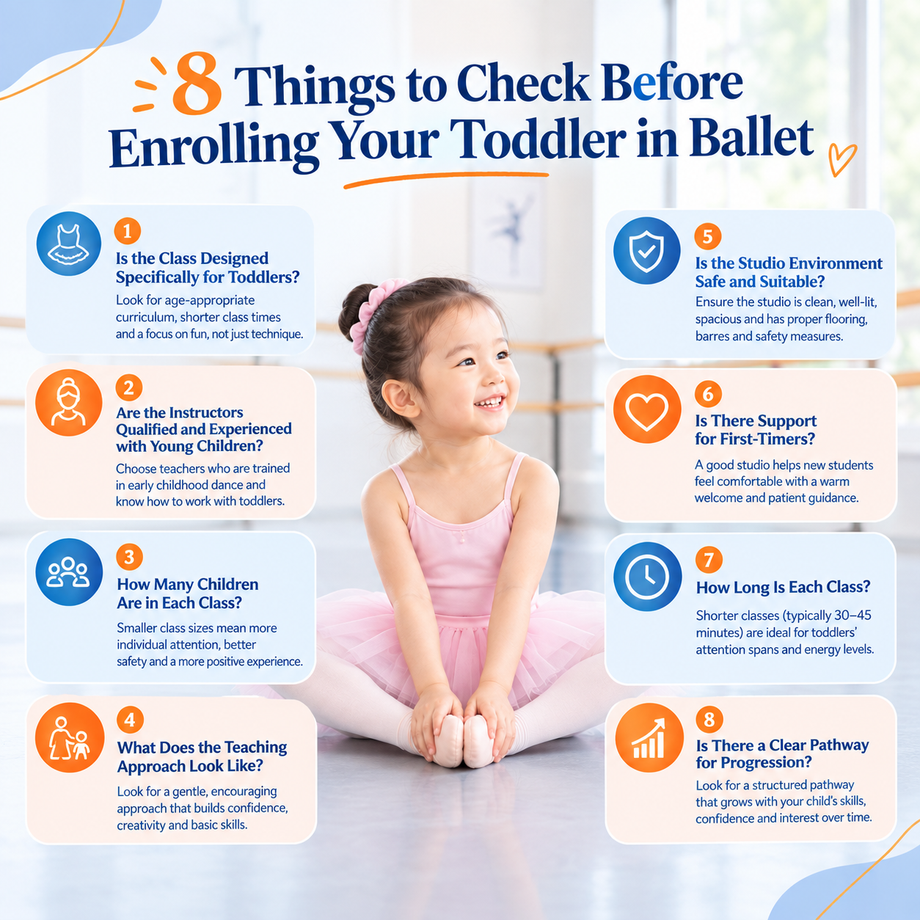
1. Is the Class Designed Specifically for Toddlers?
A toddler ballet class should look very different from a class for 7-year-olds. Look for programmes that describe their curriculum using words like "creative movement," "pre-ballet," or "dance exploration." If the programme expects toddlers to hold formal positions for extended periods, it is likely not age-appropriate.
Age-banded classes — for example, 2.5 to 3.5 years, then 3.5 to 5 years — signal that the school understands developmental differences.
2. Are the Instructors Qualified and Experienced with Young Children?
Instructor credentials matter significantly. Look for teachers trained under recognised syllabi such as the Royal Academy of Dance (RAD) or Cecchetti method. These bodies set internationally benchmarked standards for both technique and pedagogy.
Beyond qualifications, ask whether the instructor has specific experience teaching toddlers. Working with very young children requires patience, child development awareness, and the ability to pivot an entire lesson plan on the spot.
3. How Many Children Are in Each Class?
Class size directly affects the quality of attention each child receives. For toddlers, a class of 6 to 10 children per instructor is considered ideal. Larger classes increase the risk of children being overlooked, becoming disengaged, or developing habits that go uncorrected.
If a school cannot tell you the maximum class capacity upfront, that is worth noting.
4. What Does the Teaching Approach Look Like?
The best toddler ballet classes use storytelling, props, music, and imaginative games to teach movement. Children at this age learn through play. A lesson built around "flying like butterflies" or "stomping like elephants" is doing exactly what it should.
Avoid programmes that use pressure, comparison, or performance anxiety as motivators. At this age, the goal is confidence and enjoyment — not competition.
5. Is the Studio Environment Safe and Suitable?
Before your child steps into a studio, inspect the physical environment. Key things to check:
-
Sprung or cushioned flooring to protect developing joints
-
Appropriate barre height for toddler-sized bodies
-
Clean, well-ventilated, and well-lit space
-
A secure entry and exit with no unsupervised access
-
Adequate space per child during movement exercises
In Singapore's climate, air conditioning is also a practical necessity during active classes for young children.
6. Is There Support for First-Timers?
Starting a new class can feel overwhelming for a toddler. Schools that offer trial classes, parent-and-child starter sessions, or settling-in periods demonstrate an understanding of how young children adjust to new environments.
Ask whether parents can observe the first few lessons. Some studios also allow caregivers to sit nearby during the initial weeks, which can reduce separation anxiety and help the child feel secure.
7. How Long Is Each Class?
Toddlers have short attention spans. A well-designed class for children aged 2.5 to 4 should run between 30 to 45 minutes. Anything longer is likely to result in disengagement and can associate ballet with fatigue rather than fun.
As children grow and progress to older age groups, class durations can gradually increase. A good school structures this progression thoughtfully.
8. Is There a Clear Pathway for Progression?
Even at the toddler stage, it is worth asking what comes next. Does the school offer a structured progression into primary-level ballet? Are there optional examinations through recognised bodies like RAD? Is there a recital or showcase opportunity for older students?
A school with a clear progression pathway shows long-term investment in each student's development — not just enrolment numbers.
Related Post: What Happens During Your Child’s First Ballet Class?
What to Ask at a Trial Class or School Visit
A trial class is your best research tool. While you observe, keep these questions in mind:
-
Does the teacher engage every child, including the quiet or hesitant ones?
-
Is the pace adjusting naturally to how the children respond?
-
Are corrections given kindly and constructively?
-
Do the children look like they are enjoying themselves?
-
Is the transition between activities smooth, keeping energy focused?
Trust your instincts. If your toddler leaves the trial smiling and asking to come back, that tells you a great deal.
Kids Ballet Classes in Singapore: What the Local Market Looks Like
Kids ballet class Singapore options range from community centre programmes to private studios with international syllabi. The Singapore curriculum landscape for early childhood arts education is shaped partly by MOE enrichment standards and the growing recognition of dance as a developmental tool for young children.
When comparing schools, look beyond pricing. A cheaper class that lacks qualified instruction or safe facilities is a false economy — especially when it comes to your child's physical development and early relationship with movement.
A Comparison Table: What Strong vs. Weak Toddler Ballet Programmes Look Like
|
Factor |
Strong Programme |
Red Flags |
|---|---|---|
|
Age grouping |
Banded by developmental stage |
All ages in one class |
|
Teaching method |
Play-based, imaginative, exploratory |
Rigid technique for 3-year-olds |
|
Class size |
6–10 students per teacher |
15+ children with one instructor |
|
Instructor credentials |
RAD, Cecchetti, or equivalent |
No stated qualification |
|
Trial option |
Trial class or observation available |
Full term payment required upfront |
|
Progression pathway |
Clear levels and optional exams |
No structured next steps |
Finding the Right Fit for Your Child
There is no single perfect programme — the right choice depends on your child's personality, readiness, and how they respond to a new environment. Some toddlers thrive in structured settings immediately; others need a gentler on-ramp.
For families exploring ballet Singapore options, Elevate Dance Academie offers structured toddler ballet programmes taught by qualified instructors in a purpose-built studio environment. Their age-appropriate curriculum and class sizes are designed with early childhood development in mind — giving young dancers the foundation to grow with confidence.
Frequently Asked Questions
What is the right age for a toddler to start a ballet class?
Most children are ready to start a structured ballet class from age 2.5 to 3. At this stage, they have enough coordination and focus to engage with age-appropriate movement activities. Classes at this age should focus on creative play and rhythm rather than formal ballet technique.
How do I know if a ballet class is safe for my toddler?
Check for sprung or cushioned flooring, small class sizes, qualified instructors, and a secure studio environment. A safe toddler ballet class also uses a developmentally appropriate teaching approach that avoids physical strain or pressure on young joints and growing bodies.
What qualifications should a toddler ballet instructor have?
Look for instructors trained under internationally recognised syllabi such as the Royal Academy of Dance (RAD) or Cecchetti method. These certifications indicate training in both dance technique and teaching methodology, which matters especially when working with very young and beginner students.
How long should a ballet class be for toddlers?
A toddler ballet class should run between 30 to 45 minutes. This duration aligns with the attention span of children aged 2.5 to 4 and keeps the experience enjoyable and engaging without causing fatigue or disinterest in future sessions.
Are there trial classes available for toddler ballet in Singapore?
Many reputable dance schools in Singapore offer trial classes or observation sessions for new students. A trial class lets your child experience the environment before committing to a full term, and it gives parents a chance to assess teaching quality and studio safety firsthand.



Comments
Login to Comment