How to Calculate Concrete for Curbs and Curbing Projects
23 Sep, 2026
9 Views 0 Like(s)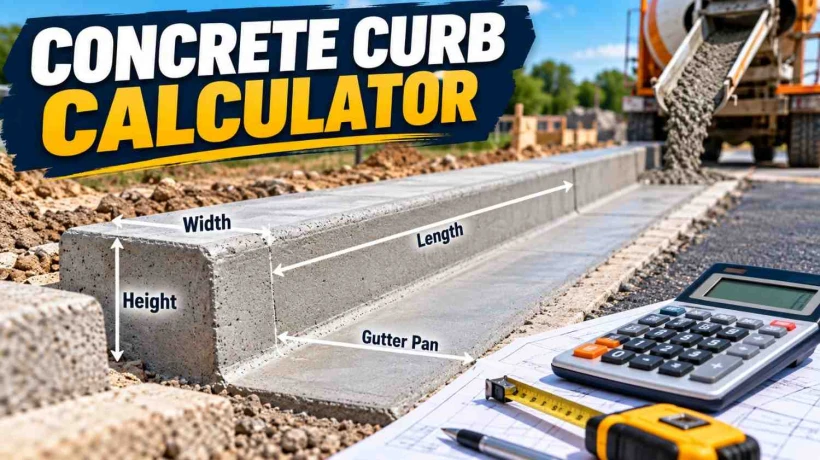
Learn how to estimate concrete for curbs and gutters using curb dimensions, run length, cross-section shape, gutter pan measurements, and waste allowance.
I underestimated a curb project once and ended up mixing a rushed second batch halfway through a pour. It wasn't pretty, and the seam is still visible if you look closely. Curbs look simple compared to slabs or driveways, but the math still needs to be right.
Whether you're pouring a driveway edge, a garden border, or a full parking lot curb, getting your concrete estimate correct upfront saves you from patchy pours and wasted material. Here's how to work through it.
Why Curbs Are Easy to Underestimate
Curbs are long and narrow, which makes people assume the volume is small. That assumption is often wrong.
A curb that runs 100 feet, even at a modest height and width, adds up to more concrete than most people expect. The length is what catches people off guard, since it's easy to focus on the small cross section and forget how far that shape extends.
Underestimating a curb pour usually means mixing a second batch mid project, which risks a visible seam where the old and new concrete meet. That seam is both a cosmetic issue and a weaker point structurally.
The Basic Shape You're Working With
Most curbs have a fairly simple cross section, even if the curb itself curves along its length. You're usually looking at a rectangle or a rectangle with a small lip or taper on top.
For a basic rectangular curb, multiply height by width to get the cross sectional area in square feet. Then multiply that by the total length of the curb to get cubic feet.
For example, a curb that's 6 inches tall and 6 inches wide has a cross section of 0.25 square feet. Run that along 50 feet of curb, and you get 12.5 cubic feet, which comes out to a little under half a cubic yard once you divide by 27.
Accounting for Curves and Corners
Straight curbs are simple, but most real projects include curves, corners, or driveway cutouts. These sections need a bit more care.
For gentle curves, measuring along the centerline of the curb rather than the inside or outside edge gives you a more accurate length. For sharp corners or curb returns, it often helps to measure those sections separately and add them to your straight run totals.
Skipping this step is one of the most common reasons curb estimates come up short, since curved sections often use slightly more material than a straight line covering the same footprint.
Curb and Gutter Combinations
Some projects combine a curb with an attached gutter section, which changes the cross sectional shape significantly. Instead of a simple rectangle, you're now calculating an L-shaped or more complex profile.
The easiest way to handle this is breaking the shape into two sections, the curb portion and the gutter portion, calculating each separately, then adding the totals together. Treating the combined shape as one uniform rectangle usually leads to a noticeable underestimate.
A Faster Way to Handle the Math
Manual math works fine for a short, straight curb, but it gets complicated fast once curves, corners, and gutter sections are all part of the same project.
This is where running your numbers through a Concrete Curb Calculator instead of calculating everything by hand makes a real difference. You enter your dimensions and length, and it handles the volume conversion for you, which cuts down on the kind of small errors that lead to a short pour.
It's especially useful on longer projects where a small measurement mistake at the start can throw off the entire order by the time you reach the end of the run.
Common Mistakes on Curb Projects
A few mistakes show up again and again with curb pours.
The first is measuring only the straight sections and forgetting curves or corners entirely. The second is assuming a curb and gutter combination uses the same formula as a plain rectangular curb. The third is not accounting for slight variations in height or width along a long run, which can happen even with careful formwork.
Adding a small buffer, usually 5 to 10 percent, is a smart habit for any curb project, especially longer ones where a shortage is expensive to fix mid pour.
Final Thoughts
Curbs might look simple, but the math adds up quickly once length becomes part of the equation. Taking the time to measure curves, corners, and combination sections separately makes a real difference in how accurate your final estimate turns out to be.
A little extra care during planning means a cleaner pour, fewer seams, and a curb that holds up the way it's supposed to.

Comments
Login to Comment