How to Build a Custom Machine Learning Solution from Scratch
28 Oct, 2026
4 Views 0 Like(s)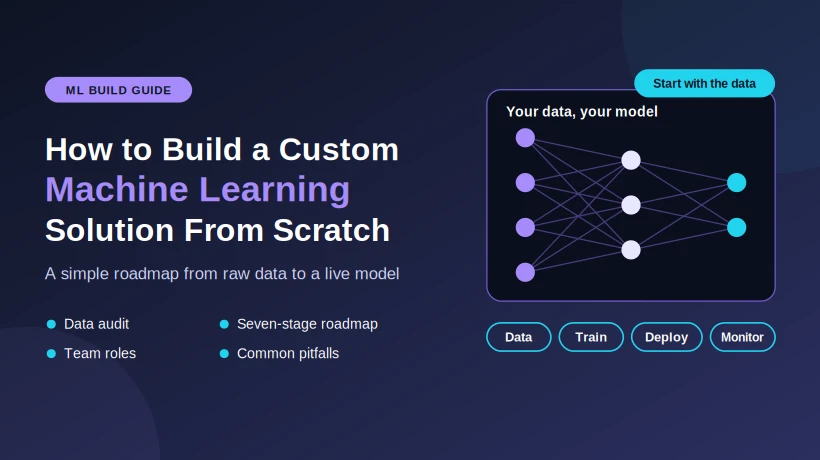
Learn the seven stages of building a machine learning solution, from data audit to monitoring, plus the team roles and pitfalls to plan for.
Building a machine learning solution is a lot like constructing a house. The clever parts, such as the model itself, get all the attention, but the foundation decides whether the whole structure stands. In machine learning, that foundation is data. Gartner predicts that through 2026, organizations will abandon 60 percent of AI projects that are not supported by AI-ready data, and a Gartner survey found that 63 percent of organizations either lack the right data management practices or are unsure whether they have them. This guide walks you through every stage of machine learning solution development in simple language, so you can plan a project that survives well past the pilot phase.
Start With the Problem, Not the Algorithm
Many teams begin by asking which model to use, but a better first question is what business problem you want to solve. Write it down in one clear sentence, such as predicting which customers are likely to leave or detecting faulty products on a production line. Then decide how you will measure success, whether that is fewer errors, saved hours, or higher revenue. A clear goal keeps the project focused and makes it easier to judge the results later.
The Seven-Stage Roadmap From Idea to Live Model
Once the goal is clear, most projects follow these stages:
- Collect and audit your data: Gather information from your internal systems, check how much you have, and look for gaps, errors, bias, and legal restrictions.
- Clean and label it: Remove duplicates, fix mistakes, handle missing values, and label examples when the model needs to learn from them.
- Build a simple baseline first: Test a basic model to set a benchmark, so you can tell whether a more complex approach truly adds value.
- Train and validate: Split your data into training, validation, and test sets, then measure results with metrics tied to your business goal.
- Test in real-world conditions: Run a pilot with real scenarios to uncover edge cases and unfair outcomes before launch.
- Deploy and integrate: Connect the model to your app or workflow, usually through an API, on infrastructure that can handle real traffic.
- Monitor and retrain: Track accuracy over time, because changes in user behavior or data can make a model less reliable.
Who Does What: The Skills Your Team Needs
A successful project rarely depends on one person. This table shows the main roles and how they contribute:
| Role | What they do |
|---|---|
| Domain expert | Defines the problem, sets success measures, and checks whether results make business sense |
| Data engineer | Builds the pipelines that collect, store, and prepare data |
| Data scientist or ML engineer | Designs, trains, and validates the model |
| MLOps or DevOps engineer | Deploys, monitors, and maintains the model in production |
Pitfalls That Quietly Sink Machine Learning Projects
Even well-funded teams run into these common problems:
- Poor data quality: Incomplete or inconsistent data leads to unreliable predictions, no matter how advanced the model is.
- Skipping the baseline: Without a simple benchmark, it is hard to prove that a complex model is worth its cost.
- Overfitting: A model that memorizes training data often performs badly on new data.
- Ignoring monitoring: A model that is never checked after launch can slowly lose accuracy without anyone noticing.
Final Thoughts: Build the Foundation First
The most reliable machine learning projects start with a clear problem, ready data, and a team that covers every stage from design to monitoring. If you do not have all these skills in-house, custom machine learning development services can fill the gaps while you stay in control of the business goals. Begin small, prove the value with a baseline, and scale only after the results are consistent.
Frequently Asked Questions
1. How long does it take to build a machine learning solution?
It can take a few weeks for a simple prototype and several months for a production system, depending on data readiness and complexity.
2. How much data do I need?
There is no fixed rule, since it depends on the problem and the model. In general, data quality matters more than sheer quantity.
3. Can I build a machine learning solution without a data science team?
For simple use cases, pre-built tools can help. Custom solutions, however, usually need skilled people to design, test, and maintain them.
4. What is the difference between a prototype and a production model?
A prototype proves that an idea can work, while a production model runs reliably at scale with monitoring and support.
5. Why do many machine learning projects fail?
The most common reasons are poor data, unclear goals, and a lack of monitoring after launch.


Comments
Login to Comment