How Thales Key Management Can Simplify Cryptographic Security Across Enterprise Systems
31 Aug, 2026
500 Views 0 Like(s)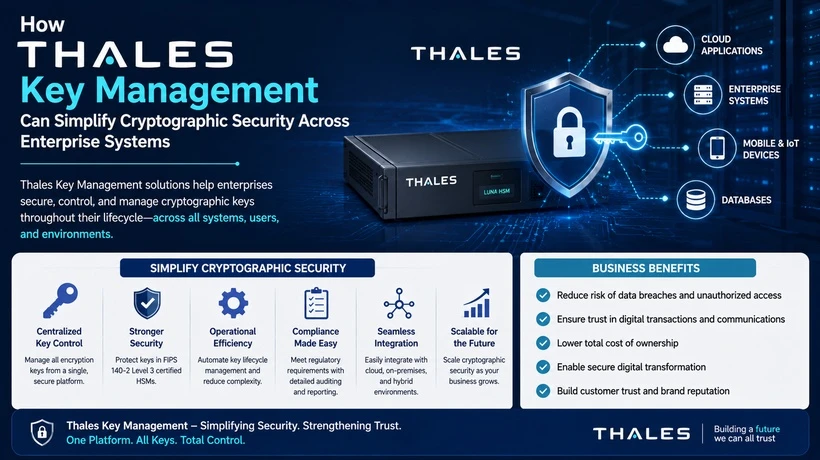
Enterprise systems rely on encryption to protect sensitive data across applications, databases, cloud platforms, and digital services. Effective key management ensures that encryption keys remain secure and accessible only to authorized systems. Thales key management helps enterprises centralize cryptographic controls, simplify key lifecycle operations, and improve visibility across complex IT environments.
Introduction
Modern enterprises operate across increasingly complex technology environments. Organizations use cloud applications, databases, SaaS platforms, virtual infrastructure, APIs, mobile applications, and distributed data centers to support daily operations. While these technologies improve efficiency and scalability, they also create new challenges for protecting sensitive information.
Encryption has become an essential part of enterprise cybersecurity. It protects data from unauthorized access by converting readable information into an encrypted format. However, encryption alone cannot provide complete protection. Organizations must also protect the cryptographic keys that control access to encrypted data.
This is where effective Key management becomes critical.
When enterprises manage encryption keys across multiple applications and environments without centralized control, security teams may struggle to track keys, enforce policies, rotate credentials, and maintain compliance. A centralized approach can simplify these processes and provide better control over cryptographic assets.
Thales key management can help organizations establish a structured approach to managing encryption keys across enterprise systems. When integrated with HSM Solutions and other security technologies, it can provide a strong foundation for protecting data and managing cryptographic operations at scale.
What Is Enterprise Key Management?
Enterprise key management refers to the processes, technologies, and policies used to control encryption keys throughout their lifecycle.
Encryption keys go through several stages during their lifecycle, including:
- Key generation
- Key storage
- Key distribution
- Key activation
- Key rotation
- Key backup
- Key archival
- Key revocation
- Key destruction
Each stage requires appropriate security controls. If an organization stores keys insecurely or fails to rotate them when required, attackers may gain opportunities to compromise protected data.
Effective key management in cryptography provides organizations with a systematic way to control these processes. Instead of allowing individual applications to manage keys independently, enterprises can establish centralized policies and security controls.
Why Cryptographic Security Becomes Difficult at Enterprise Scale
Small environments may manage a limited number of encryption keys. Large enterprises, however, can have thousands of keys distributed across different applications and infrastructure.
Several factors increase this complexity.
Multiple IT Environments
Organizations may operate on-premises infrastructure alongside public cloud, private cloud, and hybrid environments. Each environment can have different encryption requirements and security controls.
Growing Data Volumes
As businesses generate more customer, financial, operational, and business data, they need more encryption mechanisms to protect it.
Diverse Applications
Enterprise applications may use different encryption technologies and key types. Managing them independently can create fragmented security processes.
Regulatory Requirements
Industries such as banking, healthcare, telecommunications, and government must comply with strict data protection requirements. Organizations need visibility into how cryptographic keys are generated, stored, and used.
Human Error
Manual key management can result in expired keys, incorrect permissions, insecure storage, or inconsistent rotation schedules.
A centralized key management strategy helps address these challenges by bringing cryptographic controls under a more consistent framework.
How Thales Key Management Simplifies Enterprise Security
Thales key management is designed to help organizations manage encryption keys and cryptographic policies across diverse IT environments.
Instead of managing encryption keys separately within every application, organizations can use centralized management capabilities to improve visibility and control.
1. Centralized Key Administration
Centralization allows security teams to manage cryptographic keys from a unified management framework.
Teams can establish policies for key creation, access, rotation, and retirement. This reduces the need to configure individual security controls manually across every application.
Centralized administration also makes it easier to understand where keys are being used and which systems depend on them.
2. Improved Key Lifecycle Management
Encryption keys should not remain active indefinitely. Organizations need defined processes for rotating, revoking, archiving, and destroying keys.
Thales key management can help organizations establish structured lifecycle policies. Automated processes can reduce manual intervention and make key rotation more consistent.
This approach reduces the possibility of forgotten or outdated keys remaining active within enterprise systems.
3. Consistent Security Policies
Large organizations often have multiple security teams managing different applications and infrastructure. Without centralized controls, each team may follow different key management practices.
A centralized approach allows organizations to establish consistent policies across environments.
For example, an enterprise can define requirements for:
- Key strength
- Access permissions
- Rotation frequency
- Key usage
- Retention
- Auditing
Consistent policies help reduce security gaps created by fragmented processes.
The Role of HSM Solutions in Enterprise Key Protection
While centralized key management provides administrative control, organizations also need secure infrastructure for protecting sensitive cryptographic material.
This is where HSM Solutions play an important role.
Hardware Security Modules provide dedicated environments for generating, storing, and using cryptographic keys. They protect sensitive cryptographic operations from unauthorized access and provide additional hardware-based security controls.
Organizations can use HSM Solutions for:
- Encryption and decryption
- Digital signatures
- Authentication
- Certificate management
- Secure key generation
- Payment processing
By combining centralized key management with hardware-based protection, enterprises can create multiple layers of cryptographic security.
How HSM Modules Strengthen the Security Architecture
HSM modules provide a secure environment for cryptographic operations. Instead of exposing sensitive keys directly to application servers, organizations can keep critical cryptographic material within protected hardware.
This architecture can reduce the risk of key exposure if an application server or database becomes compromised.
For example, an enterprise application may need to encrypt sensitive customer information. Rather than storing the encryption key directly within the application environment, the application can communicate with an HSM to perform the required cryptographic operation.
The key remains protected while the application receives the required cryptographic result.
This separation between applications and cryptographic keys adds an important security layer to enterprise architecture.
Supporting Cloud and Hybrid Environments
Cloud adoption has made enterprise infrastructure more distributed than ever. Organizations may store data across multiple cloud platforms while continuing to operate legacy systems within their own data centers.
This creates a major challenge for cryptographic security.
A modern key management strategy needs to provide consistent controls across different environments. Centralized management can help organizations maintain visibility and apply security policies without treating every infrastructure environment as a separate security island.
Thales key management can support enterprises as they manage cryptographic requirements across cloud, on-premises, and hybrid environments.
This is particularly important for organizations pursuing digital transformation while maintaining strict control over sensitive information.
Improving Compliance and Audit Readiness
Compliance is another important reason to adopt structured key management.
Regulations and industry standards often require organizations to demonstrate that sensitive data receives appropriate protection. Security teams may need to provide evidence of access controls, encryption practices, key rotation, and other security activities.
Centralized Key management can simplify these processes by providing greater visibility into cryptographic operations.
Organizations can establish policies that support:
- Access control
- Key lifecycle management
- Security monitoring
- Audit trails
- Policy enforcement
- Cryptographic governance
When these processes operate consistently, security teams can spend less time collecting information manually and more time addressing actual security risks.
Reducing Operational Complexity
One of the biggest benefits of centralized cryptographic management is operational efficiency.
Without centralized controls, security teams may need to manage keys separately across databases, applications, cloud services, and infrastructure. This increases administrative workloads and makes it harder to maintain consistent policies.
A centralized framework can reduce this complexity.
Security teams can establish standardized procedures and automate repetitive activities wherever appropriate. This can reduce human error while helping organizations manage growing numbers of cryptographic assets.
Automation becomes particularly valuable as businesses expand their digital infrastructure.
Key Management Best Practices for Enterprises
Organizations should follow several practices when developing an enterprise cryptographic security strategy.
Establish a Centralized Management Framework
Create a unified approach for managing encryption keys across applications and infrastructure.
Protect Critical Keys With HSM Modules
Use hardware-based protection for highly sensitive cryptographic keys and operations.
Define Clear Key Lifecycle Policies
Establish procedures for generating, rotating, revoking, archiving, and destroying keys.
Apply Role-Based Access Controls
Limit access to cryptographic operations according to job responsibilities and security requirements.
Monitor Key Usage
Track key activity and investigate unusual or unauthorized operations.
Automate Where Practical
Automate repetitive lifecycle processes to reduce human error and improve operational consistency.
Regularly Review Security Policies
Cryptographic requirements change as technologies, threats, and regulations evolve. Enterprises should periodically review their key management policies and update them when necessary.
Thales Key Management and the Future of Enterprise Cryptographic Security
Enterprise infrastructure will continue to become more distributed. Cloud-native applications, artificial intelligence, connected devices, APIs, and digital services will increase the amount of data organizations need to protect.
This expansion will also increase the number of cryptographic keys enterprises must manage.
Future-ready security architectures will therefore require centralized visibility, automation, strong access controls, and hardware-backed protection.
Solutions that combine Thales key management, HSM Solutions, and HSM modules can help organizations establish a scalable foundation for these requirements.
The goal is not simply to create more encryption. It is to create a structured cryptographic security framework in which organizations know where their keys are, who can use them, how they are protected, and when they should be replaced.
Conclusion
Cryptographic security becomes increasingly complex as enterprises adopt cloud platforms, distributed applications, and digital services. Encryption remains essential for protecting sensitive information, but organizations must also secure and manage the keys behind that encryption.
Effective Key management provides the governance needed to control cryptographic assets throughout their lifecycle. Through centralized policies, automation, access controls, and monitoring, enterprises can reduce operational complexity and improve security consistency.
Thales key management can help organizations centralize cryptographic management across diverse enterprise environments. When combined with HSM Solutions and HSM modules, it provides a layered approach that protects critical keys while supporting encryption, authentication, digital signatures, and other security operations.
Ultimately, strong key management in cryptography is not simply a technical requirement. It is a core component of enterprise cybersecurity. By adopting a centralized and well-governed approach, organizations can simplify cryptographic security, strengthen compliance, and create a more resilient foundation for continued digital transformation.


Comments
Login to Comment