How EML to Gmail Importer Preserves Folder Hierarchy
16 Mar, 2026
4799 Views 0 Like(s)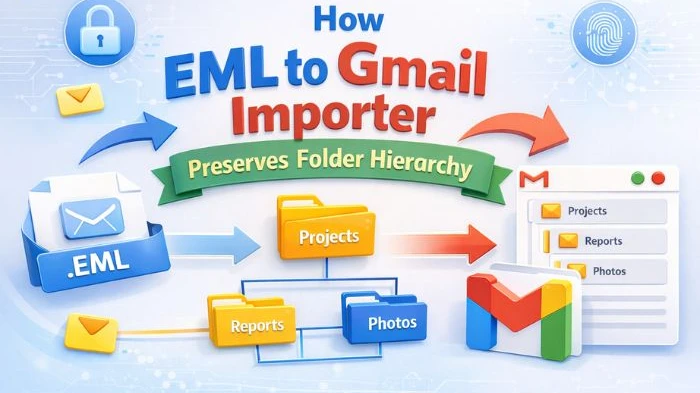
Find out how an EML to Gmail Importer can help you move EML files to Gmail without changing the original folder structure. This post goes over frequent problems that come up when moving emails, the manual IMAP technique, and a simple way to keep your emails organized while you're importing them.
When emails are saved in several file formats, it might be hard to keep track of them. Windows Live Mail, Thunderbird, and other email applications save emails in the EML format. People typically have trouble moving those files over to Gmail while keeping everything structured. This is when an EML to Gmail Importer comes in handy.
With an EML to Gmail Importer, you can easily move EML files straight into your Gmail account. One of the biggest worries during this process, though, is whether the original folder structure will stay the same following the import. If you lose the structure of your folders, it can be hard to discover and manage emails later.
In this blog post, we'll talk about common challenges that come up while moving EML files and how a dependable way to keep the folder structure when importing emails into Gmail.
Why Folder Hierarchy Matters During Email Migration
People commonly put their emails into folders with names like "Inbox," "Work," "Personal," "Projects," and so on. These folders help keep things organised and make it easy to find what you need. Keeping the same structure during email migration keeps things orderly.
- If the folder structure is not kept, some problems might happen:
- After the transfer, emails can all be in one folder.
- It becomes hard to find important signals
- It takes a lot of time to reorganise thousands of emails.
- Attachments and chats can not make sense anymore.
To minimise misunderstandings, businesses and professionals need to keep their folders in the same order.
Common Problems
A lot of people try to move EML files to Gmail by hand. Sadly, these methods often cause a lot of problems.
1. The structure of the folder is lost
- Most of the time, manual drag-and-drop methods only move emails and don't keep the original folder arrangement. Gmail mixes up emails as a result.
2. A process that takes a long time
- Moving EML files by hand gets quite sluggish and hard if there are hundreds or thousands of them.
3. The chance of missing emails
- Some emails can not be uploaded or completed when you do it by hand.
4. Technical Problems
- A lot of manual methods need several email clients or complicated settings, which might not work for everyone.
Many professionals choose a specialised EML to Gmail Importer instead because it makes the whole process easier.
Manual Method to Convert EML Files into Gmail
A common way to do this by hand is to use an email client to sync IMAP. This method works for a limited number of emails, but it takes a few steps.
Step 1: Turn on IMAP in Gmail
- Go to the settings after logging into Gmail. In the Forwarding and POP/IMAP section, turn on IMAP and save your settings.
Step 2: Set up Gmail in an email client
- Use IMAP settings to set up your Gmail account in an email client like Thunderbird or Outlook.
Step 3: Make a New Folder
- After you connect Gmail, make a new folder in your email client that will sync with Gmail.
Step 4: Move EML files by dragging and dropping them
- Find the saved EML files and drag them into the folder you made in the email client.
Step 5: Await the completion of the sync.
- Through IMAP, the email client will start syncing emails with Gmail. When the process is done, the emails will show up in Gmail.
This strategy works in some circumstances, but it doesn't function well with big email collections.
Smart Approach to Import EML into Gmail
A dedicated email migration solution can frequently make the migration process go more smoothly. The EML to Gmail Importer Tool helps you move EML files to Gmail without changing the structure of the original folders.
In most cases, the tool needs to be securely linked to a Gmail account. The application checks the emails in the folder you chose and gets them ready for migration.
When you import something, the software usually makes the same folder structure as Gmail. This makes sure that emails go to the right folders, which makes them easier to find and manage after the move is done.
Another useful thing about these applications is that they can work with more than one EML file at a time. This feature can be useful when you have a lot of emails to transfer because it speeds up the process and makes it easier.
Steps to Import
- Step 1: Get the EML to Gmail Converter

- Step 2: Choose the folder that has the EML files in it.

- Select "Export to IMAP account."

- Step 4: Type in the information for your Gmail account
- Step 5: Begin the import process

Advice for a Smooth Transition from EML to Gmail
It helps to follow a few easy steps before you start the import procedure.
- Find out how much room you have in Gmail.
- Put EML files in the right order
- Turn on IMAP in Gmail
- Make sure your internet connection is stable.
Following these procedures can speed up and make the migration process more reliable.
Professional Method vs Manual IMAP Method
To use the manual IMAP technique, you need to set up Gmail in an email client and drag EML files into folders that are synced. It can be slow and can not always keep the original folder hierarchy, but it works for simple migrations. This strategy can also make it hard to handle a lot of emails.
On the other hand, the professional solution uses a special EML to Gmail Importer that uploads EML files straight to Gmail. It keeps the folder hierarchy, saves attachments, and speeds up the migration process. This method is usually more dependable and efficient, especially when moving a lot of emails at once.
Why Professionals Prefer Automated Solutions
Every day, businesses and professionals send and receive thousands of emails. When you move, losing your organisation might make things confusing and lower your productivity.
Automated migration solutions assist in keeping things in order by keeping:
- Hierarchy of folders
- How to format an email
- Attachments
- Information about the sender and the date
Many businesses employ professional tools to move email data to Gmail because of these benefits.
Conclusion
Moving EML to Gmail can be hard, especially if you want to keep the original folder structure. When you do things by hand, your emails are often messy, some messages are lost, and the process takes a long time.
The migration procedure is easier and more organised when you use a good EML to Gmail Importer. The Software and other similar tools can let you move emails safely while keeping the original folder structure.
Emails stay structured and easy to find in Gmail when you keep folders intact. This makes it easy to switch from EML-based email clients to a modern cloud-based email platform.

Comments
Login to Comment