How Credit Card Merchant Services and ATM Placement Work
14 Sep, 2026
3 Views 0 Like(s)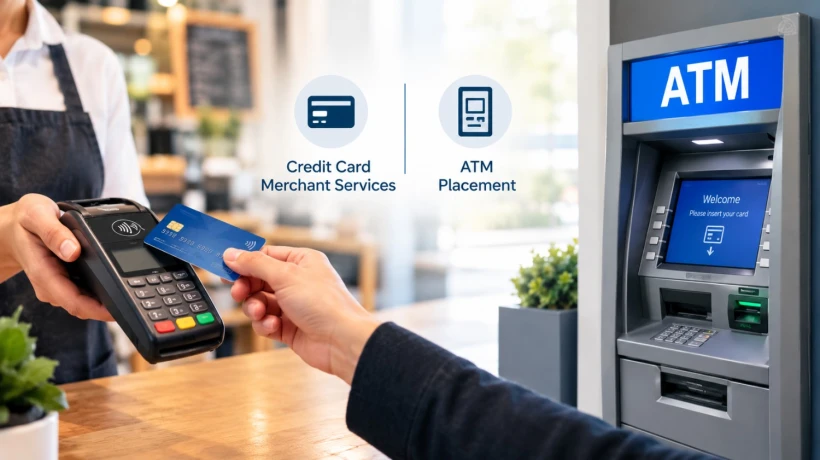
Learn how credit card merchant services and ATM placement can improve payment convenience, customer experience, and business operations.
Running a business today means giving customers convenient ways to pay and access cash. For many businesses, accepting card payments is essential, while offering an ATM can provide another useful service that encourages customers to stay longer and spend more.
This is where credit card merchant services and ATM placement can become valuable parts of a business strategy. Although they serve different purposes, both can improve the customer experience and help businesses manage everyday transactions more efficiently.
What Are Credit Card Merchant Services?
Credit card merchant services are the systems and services that allow a business to accept credit and debit card payments. When a customer taps, inserts, or swipes a card, several steps happen behind the scenes before the payment reaches the business.
A typical card transaction involves:
- The customer's card or digital wallet
- A payment terminal or point-of-sale system
- A payment processor
- The customer's card-issuing bank
- The merchant's account
The transaction is authorized, processed, and eventually settled into the business's designated account.
Merchant services may include payment processing, card terminals, point-of-sale integration, online payment capabilities, transaction reporting, and other payment-related tools.
For businesses that handle frequent card transactions, choosing an appropriate payment processing setup can make daily operations much easier.
Why Businesses Need Reliable Card Payment Processing
Customers increasingly expect fast and convenient payment options. If a business only accepts cash, it may lose sales from customers who prefer using cards or mobile wallets.
Reliable card processing can help businesses:
- Accept major credit and debit cards
- Reduce dependence on cash transactions
- Speed up checkout
- Track payment activity
- Provide customers with more payment choices
- Integrate payments with business management systems
However, businesses should not choose a payment solution based only on whether it accepts cards. Transaction fees, equipment costs, contract terms, security features, customer support, and integration options can all affect the overall value.
Understanding the Costs of Merchant Services
One of the most common problems businesses face is not understanding how payment processing fees work.
Depending on the provider and service agreement, costs may include transaction-based fees, monthly charges, equipment expenses, statement fees, or other service costs.
Before signing an agreement, business owners should ask:
- What is the total cost per transaction?
- Are there monthly or annual fees?
- Is payment equipment included?
- Are there cancellation or early termination fees?
- Does the system support the payment methods customers commonly use?
- What type of technical support is available?
Looking at the complete pricing structure rather than one advertised rate can make it easier to compare merchant service options.
What Is ATM Placement?
ATM placement is the process of installing an automated teller machine at a business or other suitable location where customers can conveniently withdraw cash.
ATMs can be placed in locations such as:
- Convenience stores
- Restaurants and bars
- Retail shops
- Hotels
- Entertainment venues
- Gas stations
- Shopping centers
- Event locations
- High-traffic commercial spaces
The success of an ATM depends heavily on location. A machine positioned where customers frequently need cash can receive considerably more usage than one placed in an area with little foot traffic.
How ATM Placement Can Benefit a Business
An ATM can provide more than cash withdrawal access. It may also contribute to customer convenience and potentially create an additional revenue opportunity for the business or ATM operator, depending on the arrangement.
For example, a customer visiting a cash-only business may need to leave to find an ATM. Having one available nearby can make the transaction easier and keep the customer at the location.
An ATM can also be useful for businesses where customers commonly make smaller cash purchases, pay tips, or need cash for nearby services.
The key is to consider whether the location has enough regular traffic and genuine demand for cash access.
Choosing the Right Location for an ATM
Location is one of the most important factors in ATM performance.
A good ATM location should be visible, accessible, secure, and convenient for customers. Businesses should consider both foot traffic and customer behavior instead of simply choosing the busiest-looking area.
Questions to consider include:
- Do customers frequently visit the location?
- Is cash commonly used by the target customers?
- Can customers easily see the ATM?
- Is there enough space for safe installation?
- Is the area accessible during business hours?
- Are there competing ATMs nearby?
- Does the location have adequate security?
An ATM hidden behind equipment or positioned in an inconvenient area may receive fewer transactions even when the business has substantial customer traffic.
ATM Placement and Customer Convenience
Convenience can have a direct effect on the customer experience.
Imagine a customer at a restaurant who wants to pay in cash but does not have enough with them. If an ATM is conveniently available at the location, the customer may be able to complete the purchase without leaving.
The same principle can apply to convenience stores, entertainment venues, hospitality businesses, and other high-traffic locations.
For this reason, ATM placement should be viewed as part of the overall customer experience rather than simply placing a machine somewhere inside the building.
Credit Card Processing and ATM Services Serve Different Needs
It is important not to treat card processing and ATM services as the same type of solution.
Credit card merchant services help businesses accept payments. An ATM provides customers with cash access.
A business may benefit from both when its customers use a combination of card and cash payments. For example, a retail location could use a payment terminal for card purchases while providing an ATM for customers who need cash.
Offering multiple transaction options can make the payment experience more flexible.
Security Should Be a Priority
Payment processing and ATM services involve financial transactions, so security should never be overlooked.
Businesses should work with reputable service providers and use equipment that follows applicable security requirements. Employees should also know how to identify suspicious activity and report equipment problems.
For card payments, secure payment technology helps protect transaction information. For ATMs, physical security, proper installation, monitoring, and regular maintenance are important considerations.
Businesses should also understand their responsibilities under applicable payment and financial regulations before adding new services.
How to Decide If These Services Are Right for Your Business
Not every business needs an ATM, and not every payment processing setup will be suitable for every company.
Start by looking at your customers and transaction patterns. If most customers already pay electronically, reliable card acceptance should be a priority. If customers frequently ask where they can get cash, an ATM may be worth considering.
Also compare the expected benefits with the costs involved.
A practical evaluation should include:
- Customer payment preferences
- Average transaction volume
- Existing payment processing costs
- Local competition
- Available space
- Security requirements
- Equipment and maintenance needs
- Provider support and contract terms
This approach can help prevent businesses from paying for services they do not actually need.
Final Thoughts
Both credit card merchant services and ATM placement can improve how businesses serve their customers, but they solve different problems. Card processing makes electronic payments easier, while an ATM provides convenient access to cash.
The best solution depends on the business model, customer preferences, location, transaction volume, and overall operating costs. Rather than choosing services based solely on advertised features, business owners should compare pricing, security, reliability, equipment, support, and long-term value.
When properly selected and managed, payment processing and ATM services can create a smoother customer experience while supporting more efficient day-to-day business operations.


Comments
Login to Comment